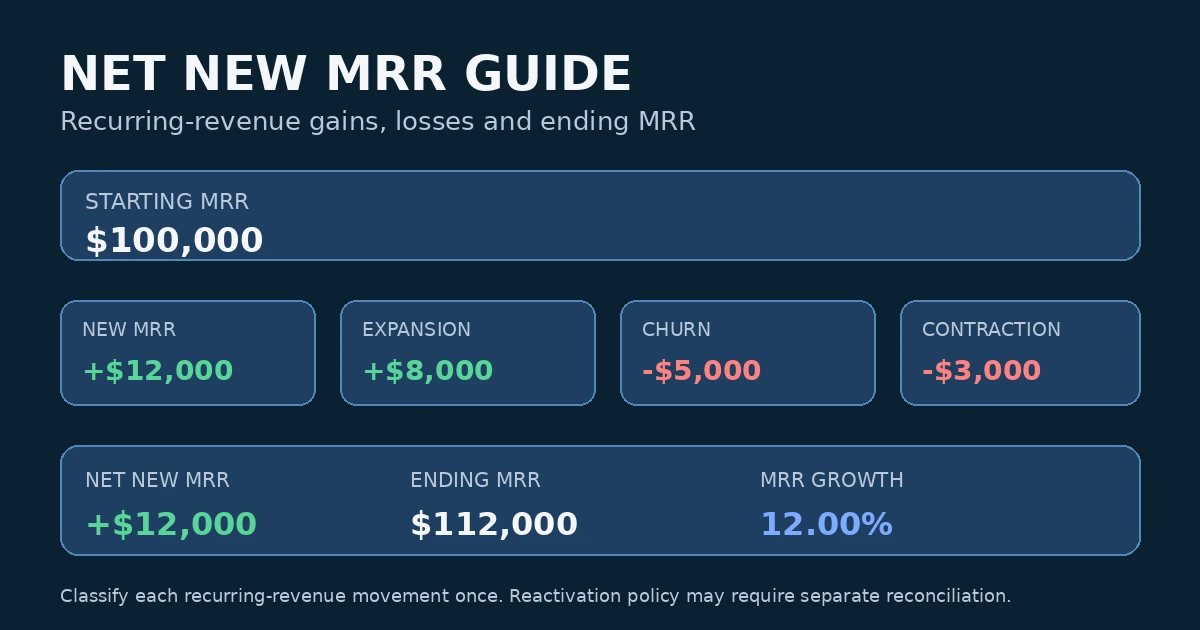
Net New MRR is the recurring-revenue bridge between one period and the next. It combines New MRR and Expansion MRR with Churned MRR and Contraction MRR so operators can see how much monthly recurring revenue was actually added or lost-and why the ending balance moved.
What Net New MRR Measures
Net new MRR measures the net recurring-revenue dollars added or lost during a reporting period after the major positive and negative MRR movements are combined. It is a flow metric, not a snapshot: starting MRR describes the opening recurring-revenue base, while net new MRR explains how that base changed during the month, quarter or other chosen interval.
A positive result means recurring-revenue gains exceeded losses; a negative result means churn and contraction were larger than new business and expansion. The number is most useful when the movement components remain visible, because the same +$10,000 net result can come from very different combinations of acquisition, upsell, downgrade and churn.
Net New MRR Formula
The SolveIndex convention follows the common four-part formula: add New MRR and Expansion MRR, then subtract Churned MRR and Contraction MRR. Keep every value on the same normalized monthly recurring-revenue basis and within the same reporting interval.
The formula deliberately separates the opening balance from movements. Starting MRR is not added inside the net-new formula itself; it is used afterward to reconcile to ending MRR and to convert the dollar change into a growth percentage.
Starting MRR
Starting MRR is the normalized recurring revenue at the beginning of the selected period. Use the same subscription normalization rules that your MRR reporting system uses: annual contracts should be translated to a monthly recurring equivalent, while one-time implementation fees, hardware sales and nonrecurring services should stay outside MRR.
Starting MRR matters for reconciliation and the growth-rate output. If the opening balance comes from a different timestamp, currency basis or revenue policy than the movement data, ending MRR will not reconcile cleanly even when each individual movement appears reasonable.
New Business MRR
New MRR is recurring revenue from customers who become paying customers during the period. It represents acquisition-driven growth and should be separated from expansion generated by customers who were already active. The measured keyword pack also surfaced what is new MRR, reinforcing the need to keep this component explicit rather than treating every positive movement as the same thing.
Do not substitute bookings or signed contract value for New MRR. A multi-year contract can have a large booked value while contributing a much smaller normalized monthly amount. The calculator expects the recurring monthly contribution that became active under your chosen MRR policy.
Expansion MRR
Expansion MRR is additional recurring revenue from existing active customers, such as upgrades, more seats, increased usage, recurring add-ons or cross-sells. In the UK keyword export, what is expansion MRR carries measurable supporting demand, but direct Expansion MRR search intent still belongs to the dedicated Expansion MRR guide.
For the Net New MRR calculation, expansion is simply one positive movement. Record only the incremental MRR increase, not the customer's entire post-upgrade MRR, and avoid double-counting the same revenue change under multiple labels.
Churned MRR
Churned MRR is recurring revenue lost when a paying customer fully cancels or otherwise stops contributing recurring revenue under your reporting policy. It is a negative movement. Use the MRR amount immediately before churn rather than lifetime contract value or total cash previously collected from the customer.
Churn can coexist with strong acquisition. That is why a positive net new MRR number should not be interpreted as proof that churn is healthy. Always compare the churn component with the new and expansion gains that are replacing it.
Contraction MRR
Contraction MRR is recurring revenue lost from customers who remain active but pay less after a downgrade, seat reduction, usage decline, removed add-on or similar change. The keyword pack shows measurable interest in what is contraction MRR, making this distinction important for explaining how net growth is built.
Contraction differs from full churn because the customer relationship continues. Treating a downgrade as churn can distort both customer-retention and revenue-retention analysis, even if the arithmetic change in total MRR happens to be similar.
Reactivation MRR and the SolveIndex Convention
Some analytics systems track Reactivation MRR separately when a previously churned customer returns to a paid plan. ChartMogul, for example, lists Reactivation as its own MRR movement alongside New Business, Expansion, Contraction and Churn. Stripe also describes Reactivation MRR as a distinct MRR type while presenting the common Net New MRR formula as New + Expansion - Churn - Contraction.
This calculator does not expose a separate Reactivation field. If your finance or analytics policy reports reactivation separately, document that policy and reconcile it consistently rather than silently changing the meaning of New or Expansion from period to period.
MRR Gains vs MRR Losses
The calculator groups New MRR plus Expansion MRR as gains and Churned MRR plus Contraction MRR as losses. That simple bridge makes the operating story easier to read: gains show how recurring revenue was created, while losses show how much of that progress was offset by customer attrition or lower spend.
In the default example, gains equal $20,000 and losses equal $8,000, leaving +$12,000 net new MRR. A positive result with very large gains and losses may still indicate a less efficient growth engine than the same net result produced with much lower churn and contraction.
Classify Each MRR Movement Once
Every recurring-revenue change should appear once in the movement bridge. If an existing customer upgrades a plan and adds seats in the same billing event, use the net recurring increase produced by your reporting system rather than counting the same dollars separately under multiple positive categories.
The same principle applies to losses. A customer who fully cancels should not also have the identical MRR amount counted as contraction. Consistent movement classification is more important than forcing every operational event into a long list of labels.
MRR Bridge and Waterfall
An MRR bridge is a practical way to connect the opening recurring-revenue base with the closing balance. Start with Beginning MRR, add positive movements, subtract negative movements, and arrive at Ending MRR. Net new MRR is the net movement in the middle of that bridge.
The keyword exports did not show measurable direct demand for MRR bridge in this pack, so SolveIndex treats it as supporting terminology rather than a primary target keyword. It is still useful operationally because it provides a clear reconciliation path for finance and SaaS reporting teams.
Worked Net New MRR Example
Using the calculator defaults, start with $100,000 MRR. During the period, add $12,000 of New MRR and $8,000 of Expansion MRR, then subtract $5,000 of Churned MRR and $3,000 of Contraction MRR. Gains are $20,000, losses are $8,000, and net new MRR is therefore +$12,000.
| Movement | Example value |
|---|---|
| Starting MRR | $100,000 |
| New MRR | +$12,000 |
| Expansion MRR | +$8,000 |
| Churned MRR | -$5,000 |
| Contraction MRR | -$3,000 |
| Net New MRR | +$12,000 |
| Ending MRR | $112,000 |
Reconcile Net New MRR to Ending MRR
Under the four-part SolveIndex convention, Ending MRR equals Starting MRR plus Net New MRR. The default example therefore reconciles as $100,000 + $12,000 = $112,000. This identity is useful as a data-quality check because it connects movement reporting with the period-end recurring-revenue balance.
If the equation does not hold, investigate missing movement types, timing differences, currency conversion, backdated subscription changes, migration adjustments or a reactivation policy that is being handled outside the calculator.
Why MRR Reconciliation Can Break
Real billing data can include corrections that do not fit a simplified four-input model. Reactivations, backdated invoices, subscription merges, plan migrations, foreign-exchange effects and imported historical adjustments can all create differences between a movement report and a period-end MRR snapshot.
Do not force unexplained differences into New MRR just to make the bridge balance. Create an explicit adjustment policy or use the movement categories provided by your subscription analytics system, then document how those categories map into management reporting.
Net New MRR vs New MRR
New MRR measures recurring revenue from newly acquired customers. Net new MRR is broader: it combines New MRR with Expansion and then subtracts Churn and Contraction. A company can therefore have strong New MRR but weak or negative Net New MRR if recurring-revenue losses are even larger.
This difference matters when evaluating acquisition quality. New sales tell you how much recurring revenue entered the business through customer acquisition; net new MRR tells you how much the entire recurring-revenue base actually moved after both gains and losses.
Net New MRR vs MRR Growth Rate
Net new MRR is a dollar movement. MRR growth rate expresses that movement relative to the starting MRR base. With $100,000 starting MRR and +$12,000 net new MRR, the growth rate is 12%. If the same +$12,000 movement occurred on a $400,000 base, the growth rate would be only 3%.
Direct MRR-growth intent belongs to the separate MRR Growth Rate pair. On this page the percentage is a secondary interpretation of the net recurring-dollar movement.
Net New MRR vs NRR
Net new MRR and Net Revenue Retention answer different questions. Net new MRR can include New MRR from newly acquired customers. NRR intentionally focuses on the customer cohort that existed at the start of the period, so new-business revenue is excluded from the NRR numerator.
Use net new MRR to understand total recurring-revenue movement across acquisition, expansion and losses. Use NRR when you want to isolate whether the existing customer base is expanding or shrinking after churn, contraction and expansion effects.
Net New MRR vs Net MRR Movement
The phrase net MRR movement can mean different things across analytics tools. ChartMogul's Net MRR Movements report, for example, nets all subscription changes for each customer within a reporting interval and then categorizes the customer's net change as New Business, Expansion, Contraction, Churn, Reactivation or another defined state.
SolveIndex's Net New MRR calculator instead uses an aggregate company-level bridge. When comparing reports, confirm whether “net” refers to a company total, a customer-level movement or a specific retention metric.
Positive Net New MRR
Positive net new MRR means the included recurring-revenue gains exceeded the included recurring-revenue losses for the period. It is a necessary condition for increasing total MRR under the same scope, but it does not tell you whether the growth came from efficient acquisition, healthy expansion or unusually low churn.
Review the movement mix. Growth driven almost entirely by expensive new-logo acquisition can have different economics from growth supported by strong expansion and low recurring-revenue loss.
Negative Net New MRR
Negative net new MRR occurs when Churned MRR plus Contraction MRR exceed New MRR plus Expansion MRR. The result can happen even when sales are still closing new customers, because recurring-revenue losses from the existing base are larger than the gains.
Investigate both sides of the bridge before choosing a response. The problem may be insufficient acquisition, weak expansion, elevated customer churn, downgrade pressure, or a combination of several drivers.
Zero Net New MRR
Zero net new MRR means recurring-revenue gains exactly offset recurring-revenue losses under the chosen reporting convention. Ending MRR therefore equals Starting MRR even though substantial customer activity may have occurred underneath the headline number.
A flat result with $50,000 of gains and $50,000 of losses is operationally different from a quiet period with almost no movement. That is why the gains and losses outputs should be reviewed alongside the net value.
Monthly, Quarterly and Other Reporting Periods
MRR is monthly-normalized revenue, but movement analysis can be summarized over different reporting intervals. A monthly bridge is usually the most intuitive operational view; quarterly reporting can smooth individual contract timing, while annual reporting is useful for strategic trends.
Keep the interval consistent when comparing periods. Do not compare one month of movement with one quarter of movement without clearly normalizing or labeling the difference.
Evaluate New Business Quality
New MRR should be evaluated with acquisition efficiency and downstream retention, not only as a volume target. Large New MRR can produce weak durable growth if the newly acquired customers churn quickly or require excessive sales and marketing spend.
Pair the movement with CAC, payback, customer quality and early cohort retention. The goal is not merely to maximize the positive bar in the MRR bridge but to build recurring revenue that persists and can expand over time.
Evaluate Expansion Quality
Expansion MRR can improve net new MRR without requiring a new logo, which often makes it a valuable source of efficient growth. Still, expansion should be tied to real recurring value such as more seats, higher usage, upgrades or add-ons rather than one-time implementation work.
Track whether expansion is broad across the customer base or concentrated in a few large accounts. Concentrated expansion can make period-to-period net new MRR more volatile.
Churn and Contraction Pressure
Churn and contraction both reduce net new MRR, but they often point to different problems. Full churn may reflect customer failure, product fit, service issues or competitive loss. Contraction may indicate pricing pressure, lower usage, seat reductions or customers moving to smaller plans.
Separating the two helps operators choose the right intervention. A retention program aimed at preventing cancellations may not solve widespread downgrade pressure caused by packaging or usage economics.
Net New MRR in Usage-Based SaaS
Usage-based pricing can make MRR movements more volatile because recurring revenue changes with consumption. Use a consistent normalization method and make sure temporary usage spikes are not misclassified as durable expansion if your reporting policy smooths or normalizes variable revenue.
The same bridge still works conceptually, but the movement definitions should match the billing analytics system. Document when usage changes are recognized and how minimum commitments or credits affect MRR.
Currency and FX Effects
For multi-currency businesses, exchange-rate changes can make reported MRR move even when customer subscriptions did not change. Decide whether your management reporting uses transaction-date rates, fixed planning rates or another consistent conversion policy.
If FX movements are material, separate them from commercial New, Expansion, Churn and Contraction movements when possible. Otherwise a currency swing can be mistaken for real recurring-revenue growth or loss.
Segment and Cohort Net New MRR
Company-wide net new MRR can hide meaningful differences between customer segments, geographies, products or acquisition cohorts. Enterprise accounts may have slower new-logo velocity but stronger expansion, while SMB segments may show more new business and higher churn.
Calculate the bridge consistently at the segment level when decisions require it. Make sure movements and starting balances use the same segment definitions so transfers between segments are not mistaken for genuine growth or churn.
Large Customer and Deal Effects
A single large contract can dominate net new MRR for a period. That is not mathematically wrong, but it can make trend interpretation unstable. Compare absolute movement with customer concentration and review several periods before concluding that the underlying growth engine has permanently accelerated or weakened.
Boards and operators may benefit from showing both reported net new MRR and a commentary section that identifies unusually large wins, expansions, contractions or churn events.
Exclude Bookings, Cash and One-Time Revenue
Net new MRR is a recurring-revenue metric. Do not enter total contract value, annual cash collections, setup fees, professional services, hardware sales or other nonrecurring amounts merely because they occurred in the same period.
Bookings and cash flow are important, but they answer different questions. Mixing them into MRR makes the bridge difficult to reconcile and weakens comparisons across months or customer segments.
Use Net New MRR in a SaaS Dashboard
A useful dashboard shows the headline net new MRR together with its movement components, Ending MRR and the growth rate. This layout helps readers distinguish scale from drivers: the net value summarizes the period, while New, Expansion, Churn and Contraction explain why it changed.
Keep definitions visible in reporting documentation and use the same movement policy in finance, billing and executive dashboards. Consistent labels reduce disputes about whether an apparent change is operational or methodological.
How to Improve Net New MRR
Improving net new MRR can come from four direct levers: increase New MRR, increase Expansion MRR, reduce Churned MRR, or reduce Contraction MRR. The best mix depends on the business. Early-stage companies may rely more on acquisition, while mature SaaS companies often need stronger retention and expansion to sustain efficient growth.
Prioritize the movement with the largest economic opportunity rather than optimizing the headline in isolation. For example, reducing churn may improve both net new MRR and future expansion potential.
Common Net New MRR Mistakes
Common mistakes include mixing recurring and one-time revenue, using inconsistent time windows, double-counting customer movements, treating new business as expansion, recording a downgrade as churn, ignoring reactivation policy, and comparing movement data with an opening MRR balance based on different currency or subscription rules.
Another mistake is interpreting a positive result as sufficient evidence of healthy SaaS economics. Net new MRR should be reviewed with retention, acquisition efficiency, gross margin and cash efficiency.
Practical Net New MRR Workflow
Choose the reporting interval, lock the starting MRR balance, export movement data from the billing or subscription analytics system, classify each movement once, and reconcile the result to ending MRR. Investigate any difference before publishing the metric.
Then compare the movement mix with prior periods and important segments. Save both the headline net result and the underlying gains and losses so later analysis can explain whether growth improved because of acquisition, expansion, retention or reporting changes.
Net New MRR Quick Reference
| Item | Rule |
|---|---|
| New MRR | New paying customers |
| Expansion MRR | Existing active customers paying more |
| Churned MRR | Recurring revenue lost from full cancellations |
| Contraction MRR | Recurring revenue lost from downgrades or lower usage |
| Reactivation | Separate movement in some systems; not a separate SolveIndex input |
| Net New MRR | New + Expansion - Churn - Contraction |
Use this table as a mapping aid, not as a substitute for your company's billing policy. Management metrics are only comparable when the same definitions are applied consistently.
Frequently Asked Questions
Sources and Methodology
The formulas and movement definitions in this guide were cross-checked against current subscription-metrics documentation. SaaS management metrics are not universal accounting standards, so companies should document their own movement policy and apply it consistently.
Use the Net New MRR Calculator
Enter Starting MRR, New MRR, Expansion MRR, Churned MRR and Contraction MRR to reproduce the bridge and test alternative movement scenarios.
Open the Net New MRR Calculator