Monthly recurring revenue is one of the most widely used operating metrics in subscription businesses because it turns contracts with different billing schedules into one comparable monthly run rate. It is useful for tracking growth, diagnosing churn and expansion, and building a recurring-revenue forecast.
MRR is not the same as cash collected, bookings or accounting revenue recognized. A rigorous MRR process depends on a documented subscription definition, monthly normalization, mutually exclusive movement categories and reconciliation back to the billing system.
What Is MRR and Why SaaS Companies Track It
MRR stands for monthly recurring revenue. It is the monthly-normalized amount of recurring subscription revenue expected from active eligible subscriptions under a company's reporting definition. SaaS teams use it as a forward-looking operating metric because recurring revenue is easier to compare month to month after billing cadence has been normalized.
MRR answers a different question from recognized revenue. A customer can prepay for a year, creating cash today, while the subscription still contributes one-twelfth of its recurring annual contract value to MRR each month. Stripe explicitly distinguishes MRR from GAAP revenue, and subscription analytics platforms similarly treat MRR as an operating metric.
MRR becomes more useful when it is decomposed into movements. New business shows acquisition, expansion shows recurring growth from existing customers, contraction shows downgrades, churn shows recurring revenue that disappears, and some systems separately identify reactivation when a previously churned customer returns.
MRR Formula and Monthly Recurring Revenue Calculation
For a single point in time, approximate MRR by adding the monthly-normalized recurring value of all eligible active subscriptions. For month-to-month movement analysis, start with opening MRR and apply recurring revenue gains and losses.
The movement equation only works cleanly when categories are mutually exclusive. A downgrade should not also be counted as churn. A new customer's first recurring subscription should not also be counted as expansion. Define each movement once, then apply that definition consistently.
Worked MRR Calculation Example
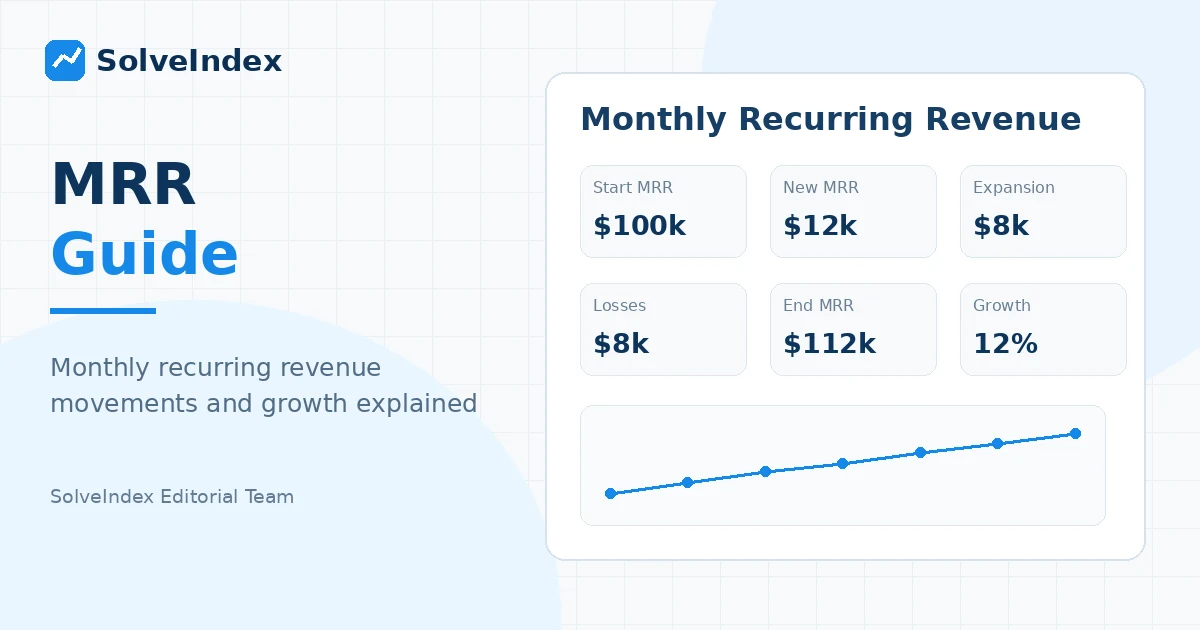
Assume a SaaS company starts the month with $100,000 MRR. New customers add $12,000 MRR. Existing customers add $8,000 through expansion. Downgrades remove $3,000 and full churn removes $5,000.
| Metric | Calculation | Result |
|---|---|---|
| Recurring gains | $12,000 new + $8,000 expansion | $20,000 |
| Recurring losses | $3,000 contraction + $5,000 churn | $8,000 |
| Net new MRR | $20,000 - $8,000 | $12,000 |
| Ending MRR | $100,000 + $12,000 | $112,000 |
| MRR growth rate | $12,000 / $100,000 | 12.0% |
| ARR run rate | $112,000 x 12 | $1,344,000 |
The worked example is a movement model, not a revenue-recognition schedule. It assumes the input values have already been normalized to a monthly recurring amount.
Normalize Annual and Quarterly Subscriptions
Billing cadence should not distort recurring run rate. Divide a recurring annual contract by 12 and a recurring quarterly contract by 3. A $1,200 annual subscription and a $300 quarterly subscription each contribute $100 MRR, assuming the entire contract value is recurring subscription revenue.
Do not enter the full annual invoice as new MRR in the month cash is received. That would imply the customer pays the annual amount every month and materially overstate the recurring base.
New MRR
New MRR is recurring revenue from customers who become paying customers for the first time during the reporting period. It should represent the monthly-normalized recurring value of their new subscriptions, not setup fees, implementation services or other one-time charges.
Keep new business separate from expansion. A new logo joining at $500 MRR is new MRR. An existing customer increasing from $500 to $700 creates $200 of expansion MRR instead.
Expansion MRR
Expansion MRR is recurring revenue added by existing customers. Common sources include upgrades, additional seats, recurring add-ons and higher recurring usage. Expansion is important because it shows growth from the installed customer base rather than acquisition alone.
Expansion can partly or completely offset recurring revenue losses. That relationship is examined more directly in NRR, but it also contributes to total MRR growth.
Contraction MRR
Contraction MRR is recurring revenue lost when an existing customer remains active but pays less. Downgrades, removed seats, lower recurring usage and expiring paid add-ons can create contraction.
Contraction should stop above zero. If the customer's paid recurring relationship falls to zero under the reporting definition, the remaining lost MRR is churn rather than another contraction movement.
Churned MRR
Churned MRR is recurring revenue lost when a customer cancels the last eligible paid subscription. It is the revenue counterpart to customer or logo churn. The churn date may depend on whether the reporting system recognizes churn at cancellation, at the end of the service period or after a past-due policy is triggered.
Document the rule before comparing MRR across systems. A billing platform and an internal finance model can report different churn dates even when they refer to the same customer.
Reactivation MRR and Reporting Boundaries
Many SaaS analytics systems treat a formerly paying customer who returns as reactivation MRR , separate from new business and expansion. ChartMogul, for example, lists reactivation as its own MRR movement type.
The SolveIndex MRR calculator intentionally preserves the simpler input model already used on the site and does not add a separate reactivation field. If your organization reports reactivation separately, reconcile it outside the simplified calculator and avoid changing classifications between reporting periods.
Net New MRR
Net new MRR is the net dollar change generated by recurring revenue movements in the period. Positive net new MRR means new and expansion MRR exceeded contraction and churn. Negative net new MRR means the recurring base shrank.
Net new MRR is useful because it combines acquisition and existing-customer changes without hiding the absolute dollar effect. Always inspect its components as well. Two companies can have the same net new MRR while one relies heavily on new sales and the other relies on expansion.
MRR Growth Rate
MRR growth rate measures the percentage change in recurring revenue from one period to the next. For this calculator, net new MRR divided by starting MRR produces the same percentage as ending MRR minus starting MRR divided by starting MRR.
A fixed percentage should not be treated as universally strong or weak. SaaS growth varies substantially by company size, product stage, ARPA and market. Current ChartMogul Benchmarks use aggregated data from more than 2,500 SaaS businesses and encourage comparison by peer group rather than one universal cutoff.
SaaS Quick Ratio
The SaaS quick ratio measures recurring revenue gains relative to recurring revenue losses. It is unrelated to the accounting quick ratio used for liquidity analysis.
A value above 1.0x means recurring gains exceeded losses during the period. A higher value indicates more growth relative to erosion, but Stripe cautions that interpretation depends on company stage and absolute growth. When recurring losses are zero, the denominator is zero; this calculator reports no recurring losses instead of pretending the business has an infinite-quality ratio.
MRR vs ARR
MRR is the monthly-normalized recurring run rate. ARR annualizes the same recurring base and is commonly calculated as MRR multiplied by 12. The dedicated ARR page is better for annual recurring revenue targets, annual growth and ARR comparisons.
| Metric | Primary use | Typical relationship |
|---|---|---|
| MRR | Monthly recurring operating trend | Sum of monthly-normalized recurring subscriptions |
| ARR | Annual recurring run-rate view | MRR x 12 for a stable normalized base |
| NRR | Existing-customer revenue retention | Excludes new MRR |
| Recognized revenue | Accounting reporting | Follows accounting rules, not an MRR shortcut |
MRR vs Revenue Recognized and Cash Collected
MRR should not be used as a substitute for accounting revenue. Annual billing can cause cash to arrive before months of service have been delivered. Discounts, credits, refunds and usage billing can also create differences between invoice value, cash collection, recognized revenue and normalized MRR.
Use finance statements for recognized revenue and cash-flow analysis. Use MRR for recurring subscription operating analysis.
MRR vs NRR and GRR
Total MRR growth includes new business. NRR and GRR focus on the existing customer base. NRR includes expansion and may exceed 100%; GRR excludes expansion and cannot exceed 100% under the usual definition.
Keeping the metrics separate prevents a strong acquisition month from hiding retention problems. Use the NRR calculator when the question is how much recurring revenue the opening customer base retained after churn, contraction and expansion.
Committed MRR and CMRR
Some teams use committed monthly recurring revenue, often abbreviated CMRR, to incorporate signed future changes such as scheduled upgrades, downgrades or cancellations. Definitions vary more than standard MRR definitions, so label CMRR separately and document what commitments are included.
Do not silently mix future booked changes into current MRR. Current MRR should remain comparable with prior periods under the same active-subscription rules.
Usage-Based and Hybrid Subscription MRR
Usage-based pricing makes MRR definitions harder because revenue can change without a plan change. Some systems use committed recurring minimums, some normalize billed usage and others exclude purely metered usage from standard MRR reports.
Use the definition supported by your billing and finance systems and do not compare two MRR reports until their usage treatment is reconciled.
Currency, Discounts, Pauses and Past-Due Subscriptions
Multi-currency subscriptions can create MRR changes when exchange rates move. Discounts can reduce recurring value and may appear as contraction when they begin or expansion when they expire. Pauses and delinquent subscriptions can also be handled differently across systems.
Document FX conversion, discount normalization, past-due handling, paused-account treatment and churn recognition before using MRR growth as a performance score.
Segment MRR by Product, Plan and Customer Type
Company-wide MRR can hide important drivers. Segment by plan, product, region, acquisition channel, customer size or sales motion when those groups have different economics. A large enterprise expansion can offset contraction in a self-serve product and make total MRR look healthy while one segment weakens.
Always show the starting balance with movement amounts. High percentage growth on a small segment can look dramatic while contributing little absolute recurring revenue.
Use MRR in SaaS Forecasting
MRR is a practical starting point for SaaS forecasting because it separates recurring run rate from one-time revenue. A forecast still needs assumptions for new business, expansion, contraction, churn, pricing and customer mix.
Avoid extrapolating one unusually strong month indefinitely. Review pipeline, cohort retention, sales capacity and product usage before carrying recent growth into a long-range plan.
What Is a Good MRR Growth Rate?
There is no single good MRR growth percentage for every SaaS company. Early-stage companies can grow much faster from a small base, while larger businesses typically grow more slowly in percentage terms. Business model, ARPA, acquisition motion, retention and market conditions all matter.
For benchmarking, compare your recurring revenue growth with companies in a similar ARR and ARPA range. Current ChartMogul Benchmarks are based on anonymized, aggregated data from more than 2,500 SaaS businesses and are updated regularly, which is more useful than hard-coding one universal threshold into a calculator.
Interpret growth together with its source. New-business MRR can accelerate top-line recurring revenue quickly, while expansion MRR can indicate deeper adoption in the installed base. If growth depends on unusually high acquisition spending or one large expansion event, the headline percentage may not be repeatable. Review the movement mix and compare several periods before calling a growth rate durable.
Also compare month-over-month and year-over-year views when seasonality or enterprise deal timing is material. A single monthly percentage can swing sharply when a few large contracts start or cancel. Longer windows make the underlying recurring-revenue trend easier to distinguish from timing noise.
Reconcile MRR to Billing and Finance Data
A reliable MRR roll-forward should reconcile: starting MRR plus positive movements minus negative movements equals ending MRR. Investigate differences at the customer or subscription level rather than forcing the totals to match.
Billing and finance teams should agree on definitions for active subscriptions, delinquency, discounts, credits, churn dates, reactivations and foreign exchange. Definition drift can create artificial growth even when customer behavior has not changed.
Common MRR Calculation Mistakes
Common errors include counting the full annual invoice as monthly revenue, including setup fees, mixing bookings with active subscriptions, double counting new and expansion MRR, recording a downgrade as full churn and comparing MRR reports that use different subscription-status rules.
Another mistake is treating a SaaS quick ratio or MRR growth percentage as a universal pass or fail score. The same percentage can have a different meaning at $10,000 MRR and $10 million MRR.
MRR Review Checklist
Before reporting MRR, confirm the reporting date, currency policy and eligible subscription statuses. Normalize recurring contracts to monthly amounts, separate new, expansion, contraction and churn movements, and document how reactivation is treated.
Reconcile starting MRR plus movements to ending MRR. Compare total MRR growth with churn and NRR so acquisition cannot hide existing-customer weakness. Save the definitions used so month-to-month trends reflect business change rather than methodology change.
MRR Frequently Asked Questions
Sources and Methodology
SolveIndex cross-checks MRR definitions and movement boundaries against current subscription analytics documentation. References include Stripe MRR and ARR guidance , Stripe SaaS quick ratio guidance , ChartMogul MRR methodology and benchmarks , ChartMogul MRR movement definitions , and ChartMogul recurring revenue growth methodology . Definitions can vary by billing system, so reconcile them with your own source of truth.