Expansion MRR measures recurring growth from customers you already have. This guide explains the formula, what counts as expansion revenue, how to classify upsells, seats, usage and add-ons, how to avoid double counting, and how expansion connects with NRR, GRR and net new MRR.
What Expansion MRR Measures
Expansion MRR is the increase in normalized monthly recurring revenue generated by customers that were already active before the increase happened. It isolates installed-base growth rather than acquisition. If an existing customer moves from $500 MRR to $650 MRR, the $150 increase is expansion MRR. That movement can come from a higher plan, more seats, greater usage, an add-on or another recurring cross-sell.
This distinction makes expansion MRR useful for understanding whether the product and commercial model become more valuable after the initial sale. It should be reviewed alongside contraction, churn and reactivation because a company can post strong expansion while still losing substantial recurring revenue elsewhere.
Why Expansion MRR Is Existing-Customer Growth
The defining boundary is customer status before the movement. Expansion belongs to customers who were already active and paying. Revenue from a first-time customer is New MRR, not expansion, even if the contract is large. This keeps acquisition and installed-base monetization separate and makes trend analysis more interpretable.
For cohort work, use the same customer identity policy in every period. Merged accounts, parent-child billing structures and workspace-level subscriptions can change the apparent expansion number if the definition of a customer shifts.
Expansion Revenue vs Expansion MRR
Expansion revenue is a broader commercial phrase for additional revenue generated from existing customers. Expansion MRR is narrower: it includes only the monthly-normalized recurring portion of that increase. A one-time consulting project may be expansion revenue in a sales report but should not enter Expansion MRR if it does not qualify as recurring revenue.
For SaaS operating metrics, use Expansion MRR when reconciling subscription movements and NRR. Use broader expansion revenue only when the underlying report intentionally includes nonrecurring customer growth.
Expansion MRR Formula
The SolveIndex calculator groups three recurring growth buckets: Upgrade MRR, Seat or Usage Expansion MRR, and Add-On or Cross-Sell MRR. Their sum is Total Expansion MRR. The categories are practical reporting buckets; the underlying economic rule is simply the net recurring-revenue increase from existing active customers.
Expansion MRR = Upgrade MRR + Seat/Usage Expansion MRR + Add-On MRR. Expansion Rate = Expansion MRR ÷ Starting Existing-Customer MRR × 100. Keep all values on the same MRR basis and in the same currency.
Starting Existing-Customer MRR
The denominator for the expansion rate should represent recurring revenue from the existing customer base at the beginning of the reporting period. It should not include new business acquired later in the period. A stable denominator matters because the same $10,000 of expansion has very different significance against $100,000 of starting MRR versus $1 million.
Use normalized recurring revenue rather than invoices, cash collected or one-time fees. Annual and multi-year subscriptions should already be converted to the company MRR convention before they enter the calculation.
Upgrade MRR
Upgrade MRR is incremental recurring revenue when an existing customer moves to a higher-priced plan or tier. Only the increase counts. If the account moves from $800 to $1,100 MRR, expansion from the upgrade is $300, not the full $1,100.
Plan migrations sometimes bundle seats, features and support. The safest approach is to classify the net recurring increase once under the category that best matches internal reporting, rather than splitting the same dollars into multiple buckets.
Seat Expansion
Seat expansion occurs when an existing account adds paid users, licenses or capacity units and recurring MRR rises. It is common in B2B SaaS products whose pricing scales with employee count or adoption. The expansion amount is the incremental recurring charge created by the added seats.
Seat counts can rise while MRR stays flat because of enterprise discounts or volume tiers. In that case there is operational adoption growth but no Expansion MRR until normalized recurring revenue actually increases.
Usage Expansion
Usage-based products can create expansion when an existing customer's recurring or normalized monthly spend rises with consumption. The reporting challenge is volatility: one high-usage month may not represent durable expansion. Apply the same usage-normalization policy used in the company MRR system.
If usage charges are purely nonrecurring and excluded from MRR, they should also be excluded from Expansion MRR. The metric must inherit the same recurring-revenue definition as the base MRR figure.
Add-On and Cross-Sell MRR
Paid modules, premium features, additional products and recurring service layers can create Expansion MRR when an existing customer adopts them. Cross-sell is expansion only when it raises normalized recurring revenue for an existing account.
A one-time professional-service package or implementation project is not Expansion MRR merely because it was sold to an existing customer. The revenue must qualify as recurring under the same MRR policy used elsewhere.
Price Increases and Discount Expiry
Expansion can occur without a plan change. A contractual price increase or the expiry of a recurring discount may raise an existing customer’s normalized MRR. Some analytics systems classify that increase as expansion because customer-level MRR moved upward.
For comparability, document whether scheduled price escalators and discount expirations are included. If the policy changes mid-year, expansion trends can move even when customer behavior has not changed.
What Is Not Expansion MRR
New-customer MRR, one-time fees, standard renewals at the same MRR, contraction, churn and ordinary cash timing are not Expansion MRR. A renewal preserves recurring revenue but does not create expansion unless the recurring amount increases.
Reactivation also requires an explicit convention. SolveIndex keeps it separate so expansion measures growth from customers that were already active. This matches movement-based reporting systems that track Reactivation MRR independently.
New MRR
New MRR comes from customers entering a paid relationship for the first time. Expansion MRR comes from existing active customers paying more. Both can increase total MRR, but they answer different questions: acquisition performance versus installed-base monetization.
Keeping them separate helps management see whether growth depends mostly on winning new logos or whether customers naturally expand after adoption.
Standard Renewals
A customer renewing the same recurring amount is retained revenue, not expansion. For example, a $2,000-MRR customer who renews at $2,000 preserves the base but adds $0 of Expansion MRR.
If the renewal includes a contractual increase to $2,200 MRR, the $200 increase may be classified as expansion under the chosen policy. Record only the incremental recurring amount.
One-Time Revenue
Implementation fees, consulting projects, hardware, training and other nonrecurring charges should be excluded when they do not qualify for MRR. Including them can create artificial spikes that disappear next month and make expansion-rate comparisons misleading.
The easiest control is to reconcile Expansion MRR back to the same subscription or billing lines used to construct MRR, rather than to total invoiced revenue.
Reactivation MRR
Reactivation is the recurring revenue created when a previously churned customer returns to paid status. ChartMogul treats Reactivation as a distinct MRR movement, while some businesses group it with expansion. Both conventions exist, so cross-company comparisons require a definition check.
SolveIndex excludes reactivation from the Expansion MRR calculator. If reactivation is material, track it separately and add it where the relevant NRR or net-new-MRR methodology requires it.
Avoid Double Counting Expansion
Each recurring-dollar increase should be counted once. A customer might upgrade tiers and add seats in the same commercial event, but the sum of category inputs must equal the actual net increase in that customer’s MRR. If a $700 increase is entered as both Upgrade MRR and Seat Expansion MRR, total expansion would be overstated by $700.
Customer-level movement reports are the best control because they reconcile beginning and ending MRR before category labels are applied.
Worked Expansion MRR Example
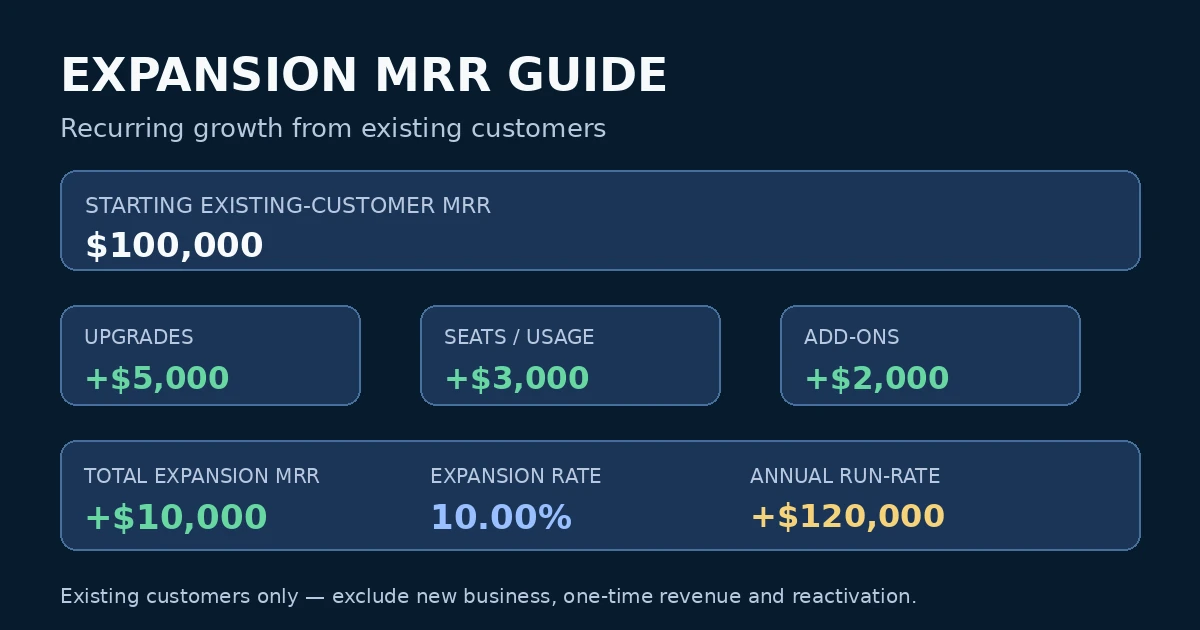
Assume the starting existing-customer cohort produces $100,000 of MRR. During the period, plan upgrades add $5,000, extra seats and usage add $3,000, and recurring add-ons add $2,000. Total Expansion MRR is therefore $10,000.
Dividing $10,000 by $100,000 gives a 10.00% expansion rate. If no other movements existed, MRR after expansion alone would be $110,000. The annualized run-rate contribution of the $10,000 monthly increase is $120,000.
| Metric | Example value |
|---|---|
| Starting existing-customer MRR | $100,000 |
| Upgrade MRR | $5,000 |
| Seat / usage expansion | $3,000 |
| Add-on / cross-sell MRR | $2,000 |
| Total Expansion MRR | $10,000 |
| Expansion rate | 10.00% |
| MRR after expansion only | $110,000 |
| Annual run-rate contribution | $120,000 |
Expansion MRR Rate
Expansion rate scales the dollar increase to the starting existing-customer revenue base: Expansion MRR ÷ Starting Existing-Customer MRR × 100. This allows a $10,000 increase to be interpreted differently for a $100,000 base than for a $2 million base.
The rate is most useful when the denominator, time period and movement definitions stay consistent. There is no universal good expansion rate because pricing model, customer size, product maturity and usage structure all change the opportunity to expand.
MRR After Expansion Only
The calculator adds Expansion MRR to starting existing-customer MRR to show an expansion-only scenario. This is not necessarily the company’s ending MRR because contraction, churn, new business and reactivation may also occur during the same period.
The label is intentionally narrow. Use the Net New MRR or ending-MRR reconciliation workflow when you need the complete movement bridge.
Annual Run-Rate Contribution
Multiplying Expansion MRR by 12 annualizes the current monthly recurring increase. In the default example, $10,000 of Expansion MRR corresponds to a $120,000 annualized recurring run-rate contribution.
This is a run-rate translation, not a guarantee that $120,000 will be recognized over the next twelve months. Customers can later contract, churn, expand again or change usage.
Expansion MRR vs New MRR
New MRR is created by first-time paying customers; Expansion MRR is created when existing active customers increase recurring spend. Both are positive movements, but they point to different growth engines.
A company can have modest new business but strong expansion if customers start small and grow. Another can rely on acquisition while existing accounts remain flat. Separating the two reveals that operating mix.
Expansion MRR vs Net New MRR
Expansion MRR is one movement. Net New MRR is a broader bridge that combines positive and negative recurring-revenue movements according to the company’s reporting convention. A common framework includes New MRR, Expansion MRR and Reactivation MRR, then subtracts Contraction and Churn MRR.
Use Expansion MRR when diagnosing installed-base growth. Use Net New MRR when reconciling the overall change in recurring revenue.
Expansion MRR and NRR
Expansion raises Net Revenue Retention because it adds recurring revenue within the starting customer base. Under a movement-based NRR formula, expansion and potentially reactivation offset contraction and churn.
Expansion can push NRR above 100% when gains from the existing cohort exceed losses. But a strong NRR number can still hide meaningful gross churn, so pair it with GRR or gross revenue churn.
Expansion MRR and GRR
Gross Revenue Retention deliberately ignores expansion. That is the point of GRR: it measures how much starting recurring revenue survives after churn and contraction before upsells or other positive movements can mask losses.
Reviewing GRR beside Expansion MRR separates defense from offense. GRR shows how well the base is preserved; expansion shows how much additional value is monetized from retained customers.
Expansion and Negative Net Revenue Churn
Net revenue churn can become negative when expansion from the existing cohort exceeds churn and contraction under the selected definition. Negative net churn therefore represents net installed-base growth even before new customers are added.
That does not mean no customers churned. Expansion can offset revenue losses, so gross churn should still be monitored separately.
Seat-Based SaaS
Seat-based pricing creates a natural expansion path when customers hire, deploy the product to more teams or increase adoption. Track both paid-seat growth and the MRR actually created because volume discounts can make seat growth faster than revenue growth.
For forecasting, segment accounts by likely seat-growth drivers rather than applying one company-wide expansion assumption to every customer.
Usage-Based SaaS
Usage-based SaaS can produce strong expansion as customer activity grows, but it also makes expansion more volatile. Normalize usage consistently and distinguish persistent higher consumption from temporary spikes where possible.
FX changes, pricing adjustments and minimum commitments can also change normalized MRR without a proportional change in product usage. Keep the billing logic documented.
Expansion by Segment or Cohort
Company-wide Expansion MRR can hide very different behavior across SMB, mid-market and enterprise accounts. Segmenting by plan, acquisition cohort, industry, geography or customer size can reveal where adoption and monetization are strongest.
Use the same starting-cohort definition within each segment. Movement between segments can otherwise create apparent expansion in one bucket and loss in another without changing total company MRR.
Expansion Concentration
Expansion quality matters as much as total expansion. If most Expansion MRR comes from one or two large customers, the result is less diversified than the same dollar increase spread across many accounts.
Track the share of expansion contributed by top customers, products or segments. Concentration is especially important in enterprise SaaS where one contract amendment can dominate a monthly result.
What Is a Good Expansion MRR Rate?
There is no universal good expansion rate. Products with seat-based or usage-based pricing can have more natural expansion than flat-price products, while enterprise accounts may expand in larger but less frequent steps than SMB customers.
Benchmark the rate against your own history and comparable customer segments. A rising expansion rate is positive only if the classification policy and starting-base definition stayed consistent.
How to Increase Expansion MRR
Expansion usually improves when customers reach value faster and discover reasons to deepen usage. Common levers include packaging higher-value capabilities, designing sensible seat or usage tiers, creating recurring add-ons and making upgrade paths easy to understand.
Use customer behavior rather than generic upsell pressure. Expansion is more durable when the additional spend corresponds to real adoption, business growth or broader workflow coverage.
Product-Led Expansion
Product-led expansion uses in-product signals to identify natural upgrade moments: approaching limits, inviting teammates, adopting advanced workflows or repeatedly using premium capabilities. These signals can support contextual upgrade prompts and sales outreach.
Measure the incremental MRR created after the trigger and avoid crediting unrelated price changes to the product-led program.
Customer Success and Expansion
Customer success teams can influence expansion by improving adoption, identifying new use cases and connecting business outcomes to additional seats or modules. Expansion should still be recorded from the resulting recurring-revenue movement, not from pipeline or opportunity value.
For analysis, compare expansion by customer-health cohort while remembering that correlation does not prove the success activity caused every increase.
Common Expansion MRR Mistakes
The most common errors are including new business, counting one-time revenue, treating standard renewals as expansion, mixing MRR and invoice values, double counting one increase across multiple buckets, or changing the reactivation policy without documenting it.
Another mistake is reading expansion in isolation. Strong upsells can coexist with high contraction or churn, so always reconcile the positive movement against the rest of the recurring-revenue bridge.
Practical Expansion MRR Reporting Workflow
Start with the billing system’s customer-level MRR at the beginning of the period. Identify customers whose normalized MRR increased, calculate each net increase, classify it once, and reconcile the sum back to the movement report. Then divide by starting existing-customer MRR if an expansion rate is required.
Save the reporting period, currency, MRR normalization policy and reactivation convention with the result. Those notes make period-over-period and tool-to-tool comparisons much safer.
Frequently Asked Questions
Sources and Methodology
The definitions in this guide were cross-checked against current SaaS recurring-revenue methodology. Expansion, reactivation and other MRR movements can be classified differently across systems, so always document the convention used for internal reporting.
Use the Expansion MRR Calculator
Enter starting existing-customer MRR and mutually exclusive expansion components to calculate total Expansion MRR, expansion rate and annualized run-rate contribution.
Open the Expansion MRR Calculator