Cost per click is one of the clearest paid-media efficiency ratios: it tells you what each click cost on average. The difficulty is not the arithmetic. The difficulty is interpreting CPC without confusing average cost, actual auction charges, maximum bids, traffic quality and downstream profitability.
The matching Cost Per Click Calculator calculates average CPC from ad spend and clicks, then shows clicks per dollar, clicks per $100 and an optional constant-CPC budget scenario.
What CPC Means in Marketing
Cost per click (CPC) is the average amount paid for a click in a selected advertising scope. In marketing reporting, CPC answers a traffic-acquisition question: how much did each paid click cost on average? It does not tell you whether the visitor converted, how valuable the conversion was, or whether the campaign produced profit. Those questions belong to metrics such as conversion rate, CPA, ROAS and ROI.
CPC becomes useful when the numerator and denominator refer to the same campaign, network and date range. If total advertising cost covers one month but the click count covers only one week, the ratio is not comparable. The same rule applies when comparing campaigns: keep the platform, network, geography, device mix and bidding context reasonably consistent before treating a CPC change as meaningful.
CPC Formula
The standard average CPC formula is simple and transparent.
Google Ads defines Avg. CPC in the same way: total cost of clicks divided by total clicks. The formula is historical measurement when you use observed cost and click totals. The budget-to-click formula is different because it is a scenario that assumes the observed average CPC stays constant.
How to Calculate CPC
To calculate CPC, first choose one reporting scope. Add the advertising cost charged for that scope, then count the clicks recorded in the same scope. Divide cost by clicks and express the answer in the currency used by the advertising account.
For example, a $1,200 campaign with 600 clicks has a $2.00 average CPC. If another campaign spends $900 for 300 clicks, its average CPC is $3.00. That does not automatically make the first campaign better. The second campaign may attract higher-intent visitors, convert more efficiently, or generate more value per click.
Worked Cost Per Click Calculation
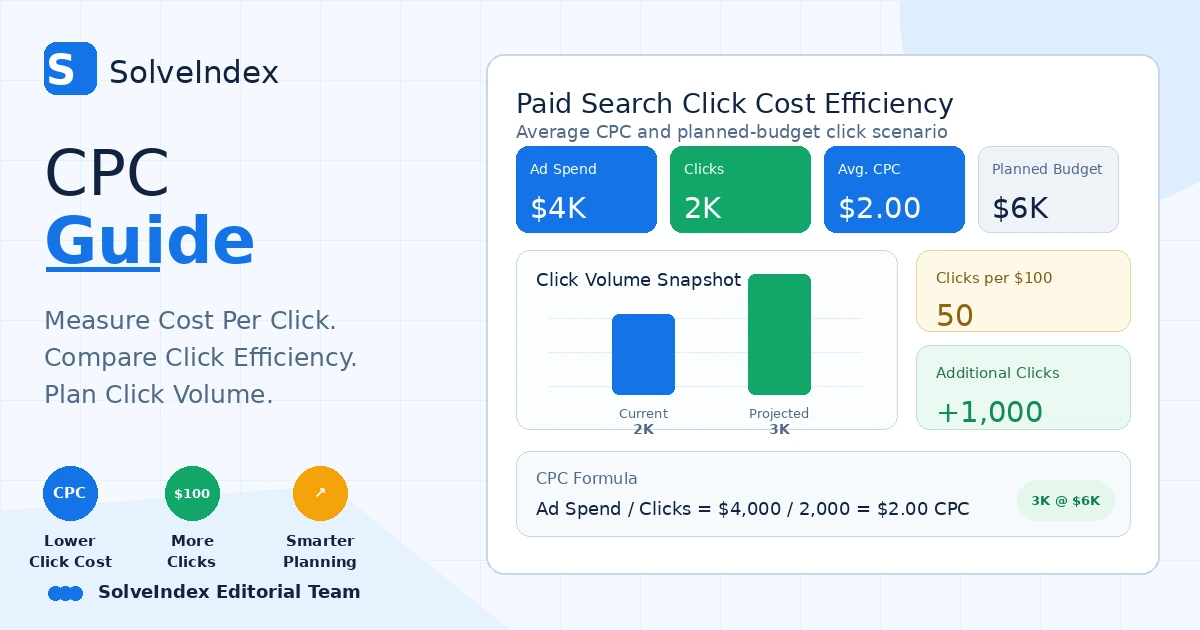
The calculator defaults provide a reproducible example: $4,000 in advertising cost and 2,000 clicks. Average CPC is $4,000 / 2,000 = $2.00. At that rate, every $1 of spend corresponds to 0.5 clicks and every $100 corresponds to 50 clicks.
If planned budget is $6,000 and average CPC stayed exactly $2.00, the scenario would imply 3,000 clicks. That is 1,000 more clicks than the current 2,000-click volume. This is not a promise that the auction will supply 3,000 clicks at the same price; it is a sensitivity calculation that holds CPC constant.
CPC Calculator Inputs
The CPC calculator uses three inputs. Advertising cost should be the total cost associated with the selected clicks. Clicks should come from the same reporting period and scope. Planned budget is optional and is used only for a constant-CPC click-volume scenario.
Do not enter impressions in place of clicks. Doing so would calculate a different metric that is closer to cost per impression. Likewise, do not use conversions as the denominator; cost divided by conversions is CPA, not CPC.
Cost Per Click vs Pay Per Click
CPC and PPC are related but not identical terms. Pay per click (PPC) describes a pricing or advertising model in which advertisers pay for clicks. CPC is the measured or bid-related price associated with those clicks. A PPC campaign can therefore have a $2.00 average CPC, a $3.00 max CPC bid, and a collection of individual actual CPCs that vary from auction to auction.
In everyday marketing language, people often use PPC and CPC close together. For measurement, keep the distinction clear: PPC describes the paid-click model; CPC is a price or average cost metric within that model.
Average CPC vs Actual CPC
Average CPC combines many click charges into one ratio. Actual CPC is the final amount charged for an individual click. Google explains that actual CPC is often lower than the max CPC bid because the auction generally charges the amount needed to clear Ad Rank thresholds and beat the advertiser below, subject to bidding rules and auction conditions.
If two clicks cost $1.50 and $2.50, their average CPC is $2.00 even though neither individual click cost exactly $2.00. For account analysis, use the platform-reported Avg. CPC or calculate it from total cost and clicks. Use actual CPC only when discussing the charge for a specific click or auction outcome.
Average CPC vs Maximum CPC
Maximum CPC is a bid control, not the historical average you paid. Under Manual CPC, a max CPC is the highest amount you are generally willing to pay for a click. Google notes that actual click charges are often lower than that maximum. Average CPC, by contrast, reflects the average amount charged across the clicks that actually happened.
The distinction matters because a $4 max CPC does not mean your average CPC is $4. If the actual click prices were $1.70, $2.10 and $2.20, the average would be $2.00. Comparing a bid limit directly with an average charged cost can create misleading optimization decisions.
Google Ads CPC
Google Ads reports Avg. CPC in the campaign statistics table and defines it as total click cost divided by total clicks. CPC can be relevant in Search and other campaign contexts, but the interpretation depends on campaign type and bidding strategy. The same account can show very different CPCs across brand vs non-brand traffic, high-intent vs research queries, devices, geographies and audience segments.
Google also uses CPC terminology for bidding. In Manual CPC, you can set maximum CPC bids. In automated strategies, the system can set or adjust bids based on the strategy objective. That means a page about average CPC should not treat every Google Ads CPC value as the same concept.
Manual CPC and Maximize Clicks
Manual CPC lets an advertiser set maximum CPC bids directly. Google also offers Maximize Clicks, an automated strategy designed to get as many clicks as possible within the budget, with an optional maximum CPC bid limit in supported contexts.
This distinction matters when diagnosing CPC changes. Under manual bidding, CPC can move because of bid changes, competition, Ad Rank and query mix. Under automated bidding, the system may change bids across auctions to pursue its objective. Google deprecated Enhanced CPC for Search and Display campaigns in 2025, so current guidance should not present ECPC as a default modern Search/Display strategy.
Why Actual CPC Changes in the Google Ads Auction
Google explains that actual CPC is influenced by auction-time ad quality, Ad Rank thresholds, competition, search context, the expected impact of assets and the advertiser immediately below you. This is why CPC is not simply a fixed list price for a keyword.
A higher CPC can occur when you enter more competitive auctions or win more prominent placements. A lower CPC can occur when competition falls, your traffic mix changes, or your ads qualify more efficiently. Because CPC is auction-dependent, the calculator's planned-budget projection is best treated as a scenario rather than a forecast.
What Is a Good CPC?
There is no universal good CPC. A click is economically attractive when the value it can create supports the price you pay for it. A $10 click can be excellent for a high-value legal lead and unacceptable for a low-margin product. Conversely, a $0.50 click is not good if the traffic is irrelevant and never converts.
A stronger target starts with your own conversion rate, conversion value, gross margin, lead-to-customer rate and customer economics. Compare CPC across similar segments and then ask whether the resulting CPA, ROAS or profit meets the business goal.
Average CPC Benchmark Context
External benchmarks can provide context, but they should not become a universal pass/fail threshold. WordStream and LocaliQ's 2026 search advertising benchmark analyzed more than 13,000 campaigns across 23 industries from April 2025 through March 2026 and reported an overall average CPC of $5.42. Industry averages in the same report ranged widely, from $1.63 for Arts & Entertainment to $9.87 for Attorneys & Legal Services.
Those figures illustrate why one benchmark cannot define a good CPC for every advertiser. They are search-ad benchmark data, not a guarantee for a specific account, market, device, bidding strategy or campaign type. Your closest internal comparable segment is usually more actionable.
Why CPC Varies by Industry
Industry affects CPC because advertiser economics and auction competition differ. A business that can earn thousands of dollars from one qualified lead can rationally bid more than a business selling a low-margin item. Search intent, sales cycle, customer lifetime value and competitive density all influence how much advertisers are willing to pay.
Even inside one industry, product category and query intent can create large gaps. Brand terms, competitor terms, informational queries and urgent service queries may each produce different CPC and conversion behavior. Avoid averaging them together when you need a decision at keyword or campaign level.
CPC by Keyword Intent
High commercial intent often supports higher CPC because advertisers expect a stronger probability of conversion or higher downstream value. Research-oriented queries can be cheaper, but they may also sit earlier in the funnel. Brand keywords can behave differently from non-brand keywords because relevance and competition patterns differ.
When comparing keyword CPC, group terms by intent and business role. A higher CPC on a purchase-ready keyword can be acceptable if conversion rate and value are strong. A low CPC on broad informational traffic can still be inefficient if it consumes budget without creating qualified outcomes.
CPC by Network and Campaign Type
Search, Display, Shopping, video and other campaign environments should not be treated as one CPC benchmark. Search clicks often represent explicit query intent. Display and video interactions can occur in different user contexts. Shopping traffic has product and feed dynamics that differ from standard text ads.
If you compare CPC across networks, document the objective and downstream metric. A lower CPC on one network does not prove better economics if the resulting conversion rate, order value or lead quality is weaker.
CPC by Device and Geography
Device and geography can materially change auction pressure, user intent and conversion behavior. Mobile traffic may dominate one campaign while desktop traffic drives higher-value conversions in another. Local markets can have very different advertiser density and click value.
Segment CPC by device and location when the mix changes materially. If overall CPC rises while the campaign shifts toward a higher-value city or more desktop traffic, the change may reflect mix rather than deterioration. Always pair the segment CPC with conversion and value metrics.
CPC vs CTR
CTR measures clicks relative to impressions, while CPC measures advertising cost relative to clicks. CTR can affect the economics of impression-based delivery, but it is not the same metric. A campaign can have high CTR and high CPC, or low CTR and low CPC, depending on the auction and inventory.
Use the Google Ads CTR Calculator when the question is how often impressions become clicks. Use the CPC calculator when the question is what those clicks cost on average.
CPC vs CPM
CPM measures cost per 1,000 impressions. CPC measures cost per click. The two can be connected when CTR is known, but neither should be substituted for the other. At a $10 CPM and 2% CTR, 1,000 impressions cost $10 and generate about 20 clicks, implying roughly $0.50 per click under that simplified scenario.
Use the CPM Calculator for impression delivery cost and CPC for click acquisition cost. Differences in viewability, reach and engagement can make the same CPM produce very different CPC outcomes.
CPC vs CPA
CPA moves one step further down the funnel. CPC is cost divided by clicks; CPA is cost divided by conversions or acquisitions. If average CPC is $2 and conversion rate is 4%, a simplified click funnel needs about 25 clicks per conversion, implying a $50 CPA before other adjustments.
This relationship shows why lowering CPC can help CPA, but only if conversion quality remains stable. Use the CPA Calculator when the decision is about conversion cost rather than traffic cost.
CPC and Conversion Rate
CPC and conversion rate jointly determine how expensive a conversion can become. When conversion rate improves, a business can sometimes tolerate a higher CPC while maintaining the same CPA. When conversion rate falls, even a stable CPC can produce worse acquisition economics.
For diagnosis, do not ask only whether CPC rose. Ask whether the rise came with stronger conversion rate, better lead quality, higher order value or more valuable customers. This prevents teams from optimizing toward cheap traffic instead of profitable traffic.
CPC vs ROAS and ROI
ROAS compares attributed conversion value with ad spend, while ROI goes further into profit or return after relevant costs. CPC is upstream of both. A higher CPC may still be financially attractive when the clicks generate stronger value. A lower CPC can still be unprofitable when the traffic does not convert or margins are weak.
Use the ROAS Calculator for value-per-spend analysis and the Google Ads ROI Calculator when you need margin and profit context.
How to Estimate Clicks From Budget and CPC
A simple planning scenario divides planned budget by expected average CPC. At a $2 average CPC, a $1,000 budget corresponds to about 500 clicks. At $4 CPC, the same budget corresponds to about 250 clicks.
This is useful for sensitivity analysis, not for promising traffic. As budget changes, the campaign can enter different auctions, exhaust cheaper inventory, change query mix or face seasonal competition. For full conversion-based budget planning, combine CPC with conversion rate and target conversions in the Google Ads Budget Calculator .
How to Lower CPC
Lowering CPC responsibly usually starts with segmentation rather than a blanket bid cut. Identify expensive search terms, weak geographies, devices, placements or audiences, then compare their conversion quality with cheaper segments. Improve ad relevance and landing-page alignment where possible, and remove traffic that is expensive without creating value.
Bid strategy and match choices also matter. Manual bids can be adjusted directly, while automated strategies respond to their objectives and constraints. The goal is not the lowest possible CPC; it is a click price that supports the required downstream economics.
How to Lower CPC Without Losing Conversion Quality
A common failure mode is cutting bids or removing high-CPC keywords without checking whether those clicks are also the best converters. Before reducing exposure, compare CPC with conversion rate, CPA, ROAS, lead quality and customer value.
If a keyword costs 30% more per click but converts twice as well, it may be more efficient than a cheaper keyword. Use controlled changes, compare similar periods and watch for mix shifts. Optimizing CPC in isolation can reduce spend while also reducing qualified demand.
When a Higher CPC Can Be Acceptable
Higher CPC is not automatically a problem. It can be justified when the traffic has stronger intent, higher conversion rate, larger order value, better lead quality or greater lifetime value. It can also accompany more prominent ad positions or more competitive auctions.
The correct question is whether the incremental click cost is supported by incremental business value. If CPA, ROAS and profit remain healthy, a higher CPC may be a rational cost of accessing better demand.
Common CPC Analysis Mistakes
Common mistakes include treating max CPC as average CPC, comparing cost and clicks from different periods, mixing Search and Display benchmarks, assuming lower CPC always means better performance, and using a constant-CPC budget scenario as a traffic guarantee. Another mistake is comparing different currencies without conversion.
Also avoid interpreting CPC before checking traffic mix. A shift toward brand, non-brand, device, geography or higher-intent keywords can move the average without any underlying problem in auction efficiency.
Practical CPC Reporting Workflow
Start with one campaign or coherent segment and a fixed reporting period. Record cost, clicks, Avg. CPC, CTR, conversions, conversion rate, CPA and conversion value. Then segment by network, campaign type, device, geography and keyword intent where the data is large enough to interpret.
Compare against your own prior comparable period before reaching for an external benchmark. Investigate large CPC changes with auction and mix context, then decide whether the correct action is bid adjustment, targeting cleanup, ad improvement, landing-page improvement or no change at all. After a material change, allow enough data to accumulate before judging the new average.
Frequently Asked Questions
Sources and Methodology
SolveIndex cross-checked CPC definitions and bidding behavior against current first-party Google Ads documentation: Google Ads Avg. CPC definition , actual CPC definition , CPC bidding definition , and Maximize Clicks bidding . Google documentation is used for platform definitions and auction/bidding behavior.
For external benchmark context, SolveIndex reviewed WordStream/LocaliQ 2026 search advertising benchmarks , which analyzed more than 13,000 campaigns across 23 industries running from April 2025 through March 2026. Those averages are context only and are not used as a universal target. Reviewed September 6, 2026.
Use the Cost Per Click Calculator
Calculate average CPC from your own ad spend and clicks, then test a planned-budget click scenario without treating it as a forecast guarantee.
Open the Cost Per Click Calculator