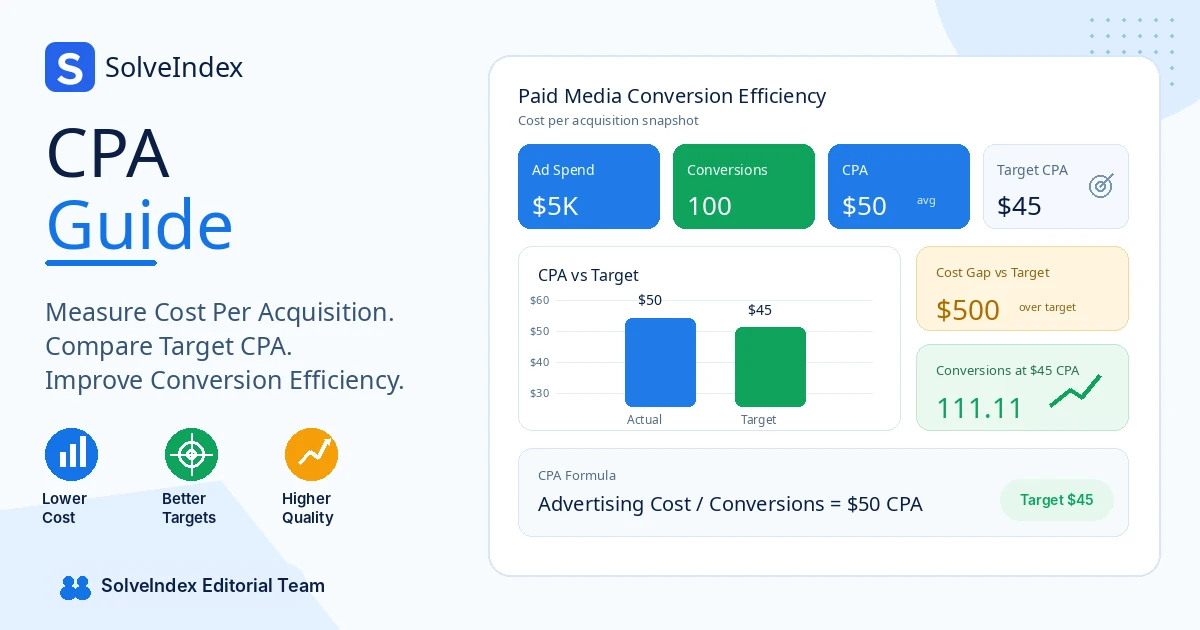
CPA is a core advertising efficiency metric because it converts spend into a cost for the outcome you care about. In a simple campaign, $5,000 of advertising cost and 100 attributed conversions produce a $50 average CPA. That arithmetic is easy. The harder part is deciding what counts as a conversion, keeping spend and conversions in the same scope, and judging whether $50 is economically acceptable for that specific outcome.
The matching CPA Calculator calculates cost per acquisition from ad spend and conversions, then compares an optional Target CPA. This guide owns the informational questions around CPA meaning, formula, interpretation, bidding context, CPA vs CAC, benchmark limitations and practical improvement.
What CPA Means in Marketing
In marketing, CPA commonly means cost per acquisition or cost per action. It answers a cost-efficiency question: how much advertising or marketing cost was associated with each counted outcome? The outcome might be a purchase, signup, registration, booked appointment, app install, qualified lead or another conversion action.
Google Ads defines average CPA as the total cost of conversions divided by the total number of conversions. The platform also uses the broader phrase cost per action for the cost required to generate a selected customer action. In practice, the exact business meaning depends on the conversion action being counted. A $40 CPA for a product purchase is not directly comparable with a $40 CPA for a newsletter signup.
Cost Per Acquisition vs Cost Per Action
The phrases cost per acquisition and cost per action are often used interchangeably in advertising reports, but they can imply different levels of the funnel. "Action" is broad and can refer to any configured conversion. "Acquisition" is often understood as a stronger outcome, sometimes a new customer. Because platforms and teams use the acronym differently, reports should name the actual conversion action beside the CPA.
A practical label is more useful than arguing over the acronym. For example: "Purchase CPA," "Qualified Lead CPA," or "Booked Demo CPA." That makes comparisons safer and prevents a low-cost upper-funnel action from being mistaken for a low-cost paying customer.
Cost Per Acquisition Formula
The standard formula needs only two historical inputs: cost and conversions. A Target CPA adds scenario outputs but does not change the historical CPA. Keep the numerator and denominator aligned to the same campaign set, date range, conversion definition and attribution scope.
How to Calculate CPA
To calculate CPA, first choose the conversion action you are evaluating. Next, collect advertising cost and the attributed conversions for the same reporting scope. Divide cost by conversions. If a campaign spent $8,400 and generated 168 conversions, CPA is $8,400 / 168 = $50.
Do not mix a total account cost with conversions from one campaign, or spend from one month with conversions from a different date window. Conversion delay can also matter when a recent reporting period has not fully matured. When you compare periods, use the same methodology each time.
CPA Calculator Inputs
| Input | Use | Common error |
|---|---|---|
| Advertising cost | Cost for the same campaigns and reporting period as the conversions. | Using all-channel spend with one-channel conversions. |
| Conversions or acquisitions | The selected action count from the same scope. Decimal values are acceptable when attribution creates fractional credit. | Combining purchases, leads and micro-conversions without a deliberate reason. |
| Target CPA | An optional planning target grounded in business economics and realistic campaign performance. | Copying a generic benchmark without checking conversion value or close rate. |
Worked CPA Example
Suppose a campaign spends $5,000 and records 100 conversions. Average CPA is $50. If the business sets a $45 Target CPA, 100 conversions would support $4,500 of cost at that target. The current spend is therefore $500 above the cost level implied by the target.
Hold spend at $5,000 instead. At a $45 average CPA, the same budget would support about 111.11 conversions. That is a scenario gap of roughly 11.11 conversions. The calculation does not forecast that those extra conversions will occur. It only shows the efficiency level implied by the target.
CPA From CPC and Conversion Rate
In a simplified click-based funnel, CPA can be decomposed into two major levers: cost per click and conversion rate. If CPC is $2.50 and 4% of clicks convert, the implied CPA is $2.50 / 0.04 = $62.50. If CPC remains $2.50 but conversion rate improves to 5%, implied CPA falls to $50.
This relationship is useful diagnostically. A rising CPA may be caused by more expensive traffic, weaker conversion rate, or both. Use the CPC Calculator for click cost and the relevant conversion-rate reporting before assuming the bidding strategy itself is the problem.
Define the Conversion First
CPA is only meaningful when the denominator represents a clearly defined action. For ecommerce, the action might be a purchase. For lead generation, it might be a submitted form, qualified lead, booked meeting or closed customer. Those actions have different downstream values, so each deserves its own interpretation.
When multiple conversion actions are grouped into one reporting column, document which actions are included and whether they are primary business outcomes or supporting actions. A lower blended CPA can be created simply by adding an easier micro-conversion, even if customer acquisition economics do not improve.
Fractional Conversions and Attribution
Google Ads can report fractional conversion credit. Under attribution methods that distribute credit across multiple ad interactions, a campaign or keyword may receive values such as 0.33 or 0.50 conversions rather than only whole numbers. That is why the SolveIndex CPA calculator accepts positive decimal conversion counts.
Fractional credit is not the same as a fractional customer in the real world. It is an attribution measurement choice. When you reconcile platform CPA with CRM or accounting data, be explicit about whether you are analyzing attributed conversion credit, raw lead count, or actual new customers.
CPA vs Cost Per Conversion
Cost per conversion is often mathematically identical to average CPA when the selected action is the conversion being analyzed: cost divided by conversions. The phrase is useful because it avoids implying that every conversion is a customer acquisition. A form submission can be a conversion without being a new customer.
SolveIndex keeps this CPA page focused on advertising CPA and acquisition/action terminology. If a future dedicated cost-per-conversion tool is used, its primary intent should remain conversion-cost wording rather than duplicating the full CPA keyword set.
CPA vs CAC
CPA and customer acquisition cost are not automatically the same. CPA often uses advertising cost divided by a campaign conversion action. CAC usually asks what it costs to acquire a new paying customer and may include broader sales and marketing expenses. A lead-generation campaign can therefore have a $40 lead CPA but a much higher customer CAC after qualification and close rate are included.
For example, if lead CPA is $40 and 20% of those leads become customers, paid-media cost per closed customer is $200 before adding sales labor, software or other acquisition costs. Use dedicated CAC metrics when the denominator is a new customer rather than a campaign action.
CPA vs Cost Per Lead
Cost per lead is narrower: marketing cost divided by generated leads. CPA can refer to the same action if the advertiser defines a lead as the target acquisition, but many funnels continue past the lead stage. For B2B analysis, separate raw lead CPL, qualified-lead CPA and closed-customer CAC when the data allows.
This stage-based reporting explains why two campaigns with the same lead CPA can have very different business outcomes. One may produce more qualified opportunities or higher close rates even if its initial lead cost is slightly higher.
CPA vs CPC
CPC measures advertising cost per click, while CPA measures cost per conversion or acquisition. CPC is an earlier-funnel metric. A low CPC can still produce a high CPA if the traffic converts poorly, and a higher CPC can be acceptable when the clicks are more qualified and convert at a stronger rate.
Analyze both metrics together. If CPA rises while CPC is stable, investigate conversion rate, landing-page performance, audience mix or conversion tracking. If conversion rate is stable but CPC rises, auction cost and traffic mix may be the stronger explanation.
CPA vs ROAS
CPA measures how much a conversion costs. ROAS measures attributed value relative to advertising spend. A campaign can have a low CPA but poor ROAS when its conversions are low value. Conversely, a higher CPA may be sustainable when each conversion generates substantially greater revenue or contribution.
If conversions have different values, do not optimize only for the cheapest acquisition. Use conversion value, ROAS, margin and profit context to decide whether a CPA target supports the business objective.
What Target CPA Means
Target CPA is the desired average cost per conversion. In planning, it can be a business threshold used to compare current performance with the cost level you want to achieve. In Google Ads, Target CPA is also the name of a Smart Bidding strategy that uses automated auction-time bidding to pursue conversions around an average cost target.
The word "average" matters. A $45 Target CPA does not mean every conversion will cost exactly $45. Some conversions may cost more and some less. Evaluate the average over a sufficiently comparable period rather than treating every individual conversion as a pass/fail event.
Target CPA in Google Ads
Google Ads describes Target CPA as the average amount you would like to pay for a conversion. Google also warns that setting a target too low can cause the system to forgo traffic that could have produced conversions, reducing total conversion volume. Historical conversion data and business goals can inform the target.
Starting in June 2026, Google Ads began simplifying Smart Bidding labels. "Maximize conversions with a Target CPA" is transitioning to the standalone label "Target CPA" in Search campaign interfaces, while Google states that the underlying bidding behavior remains the same. This matters when older documentation, tutorials or account screenshots use the previous label.
Actual CPA vs Target CPA
Actual average CPA is a historical result calculated from cost and conversions. Target CPA is a goal or bidding input. They should not be confused. If actual CPA is $50 and target CPA is $45, the current period is $5 above target per conversion, but that does not prove the target is achievable at the same volume or traffic mix.
When the target changes, record the date and reason. Comparing a period that used a $70 target with a period using a $45 target without noting the change can make performance interpretation misleading.
How to Choose a Target CPA
A useful target starts with the value of the selected conversion. For a purchase, consider contribution margin, repeat purchase behavior, refunds and profit objectives. For a lead, consider qualification rate, close rate, expected customer value and the cost of sales follow-up. Then compare the economically supportable CPA with actual campaign history and realistic traffic conditions.
Avoid selecting a target only because an external benchmark sounds attractive. A target should be low enough to protect business economics but not so restrictive that it blocks valuable volume. Scenario analysis can show the spend or conversion count implied by a target before it is used operationally.
What Is a Good CPA?
There is no universal good CPA. A $100 CPA can be excellent for a high-margin service with strong close rates and poor for a low-value consumer product. The right question is whether the acquisition cost fits the value and contribution generated by the conversion, at the scale and quality the business needs.
For internal reporting, classify CPA relative to a business-specific target rather than an arbitrary market number: below the selected target, near the selected target, or above the selected target. Then check conversion volume and quality before deciding what action to take.
CPA Benchmarks and Context
External CPA benchmarks vary sharply by industry, geography, network, device, campaign objective, brand vs non-brand demand and the conversion event being counted. A benchmark based on form leads cannot be compared directly with one based on ecommerce purchases or qualified opportunities.
Your own comparable historical segments are often the strongest baseline. When you use third-party benchmark research, document the sample, date, market, platform, conversion definition and whether the figure represents lead cost, purchase cost or another action. Treat the number as context, not a universal pass/fail threshold.
Segment CPA Before Acting
A blended account CPA can hide important differences. Segment by campaign objective, brand vs non-brand search, audience, device, geography, product, landing page, new vs returning customer and conversion action when data volume is sufficient. Compare segments serving similar goals.
A prospecting campaign may intentionally have a higher CPA than a branded campaign because it reaches colder demand. That does not automatically make it worse. Judge each segment against its role, conversion quality and economics rather than ranking every campaign by one blended CPA.
CPA for Lead Generation
For lead generation, CPA should usually be connected to downstream funnel quality. Suppose lead CPA is $60, 50% of leads become qualified, and 20% of qualified leads close. Roughly 10% of raw leads become customers, so paid-media cost per closed customer is approximately $600 before broader sales and marketing costs.
This is why a cheaper lead is not automatically better. If a campaign reduces lead CPA from $60 to $40 but qualification and close rates collapse, customer economics may worsen. Track cost at several funnel stages when possible.
CPA for Ecommerce and Purchases
For ecommerce, purchase CPA should be compared with contribution generated by the order, not only revenue. Product margin, payment fees, shipping support, discounts, refunds and repeat purchase behavior can materially change how much acquisition cost the business can support.
ROAS and CPA answer different questions. A $30 purchase CPA might look efficient, but if average order value and contribution are too low, the campaign can still lose money. Use the Break-Even ROAS Calculator or Google Ads ROI Calculator when the decision moves from conversion cost to financial return.
How to Lower CPA
Lowering CPA means producing the same valuable conversion for less cost, or producing more valuable conversions from the same cost. The best lever depends on the diagnosis. Common paths include improving conversion rate, reducing wasted clicks, strengthening audience or keyword intent, improving landing-page relevance, fixing tracking, refining the conversion goal, and adjusting bidding or budget allocation.
Avoid optimizing for a lower number at the expense of conversion quality. Removing expensive but high-value segments can make blended CPA look better while reducing total profit or qualified pipeline. Monitor volume, value and quality alongside CPA.
Improve Conversion Rate
When CPC is stable, conversion-rate improvement can lower CPA directly. Improve message match between ad and landing page, reduce unnecessary form friction, make the offer clearer, strengthen trust signals, improve mobile usability and test the page against the specific intent that produced the click.
Measure the right conversion. Increasing an easy micro-conversion can reduce apparent CPA without improving the business outcome. Where possible, feed qualified or closed outcomes back into reporting so optimization is aligned with valuable actions.
Manage CPC and Traffic Quality
CPA can also improve when the same conversion rate is achieved at a lower average CPC. Review search terms, negative keywords, match types, audience exclusions, geography, device and daypart performance where appropriate. The goal is not simply cheaper clicks. It is less cost for the same or better conversion quality.
A higher CPC can still be rational if those clicks convert more often or produce higher-value outcomes. Do not optimize CPC in isolation from CPA, conversion value and downstream quality.
Improve Tracking and Conversion Quality
Tracking changes can move CPA even when user behavior does not. Adding or removing conversion actions, changing attribution, importing offline outcomes, changing primary conversion goals or correcting duplicate tracking can alter the denominator. Record measurement changes beside performance reports.
Google Ads Smart Bidding depends on the conversion goals selected for optimization. If the business moves from an upper-funnel action to a lower-funnel purchase or qualified-lead goal, evaluate performance over an appropriate transition period and avoid comparing the before and after CPA as if the conversion definition were unchanged.
Common CPA Mistakes
- Calling every conversion a customer acquisition even when the action is only a lead or signup.
- Mixing spend and conversions from different campaigns, filters, attribution scopes or date ranges.
- Using a universal good-CPA benchmark without checking the value of the selected conversion.
- Comparing CPA across different conversion actions as if their business value were identical.
- Ignoring lead qualification and close rate when evaluating B2B acquisition efficiency.
- Optimizing for the lowest CPA while conversion quality, order value or revenue falls.
- Setting a Target CPA substantially below realistic historical performance without considering the impact on volume.
- Forgetting that attribution and conversion-goal changes can move reported CPA even without a true efficiency change.
- Confusing campaign CPA with fully loaded customer acquisition cost.
Practical CPA Workflow
- Define the exact conversion action you want to evaluate.
- Select one coherent campaign scope and reporting period.
- Confirm that advertising cost and conversions use the same filters and attribution basis.
- Calculate current CPA and record conversion volume.
- Translate the conversion into downstream business value, close rate or contribution where possible.
- Set a business-specific Target CPA rather than copying an unrelated benchmark.
- Compare actual CPA with the target and calculate the implied spend or conversion gap.
- Diagnose changes through CPC, conversion rate, traffic mix, landing-page performance and tracking.
- Segment the result before making broad budget changes.
- Recheck volume and conversion quality after any CPA improvement, not only the headline cost.
For recurring reports, save the conversion definition beside the metric. "$52 CPA" becomes much more useful when the report also states "qualified demo request, Search non-brand, United States, data-driven attribution, August 2026." That context makes future comparisons defensible.
Frequently Asked Questions
Sources and Methodology
SolveIndex cross-checked platform definitions and bidding behavior against current first-party Google Ads documentation: Average CPA definition, cost per action definition, Target CPA bidding, 2026 Smart Bidding label changes, fractional conversion reporting, and changing conversion goals used for Smart Bidding.
Reviewed on September 4, 2026. The SolveIndex calculator uses transparent arithmetic and does not access a Google Ads account, predict auction outcomes or provide a universal good-CPA threshold. Benchmark guidance in this article is methodological: compare like-for-like internal segments first, then use external research only when the conversion definition and market are genuinely comparable.
Use the CPA Calculator
Calculate cost per acquisition from your own ad spend and conversions, then compare an optional Target CPA without confusing a campaign action with fully loaded customer acquisition cost.
Open the CPA Calculator