CPM is one of the core pricing and planning metrics in digital advertising. It converts total advertising cost into a normalized cost for every 1,000 impressions, which makes impression delivery easier to compare across campaigns, placements and periods with different volumes. The calculation is simple, but CPM becomes useful only when the impression definition, campaign objective and reporting scope are clear.
The matching CPM Calculator calculates cost per thousand impressions from ad spend and impressions, shows cost per impression, and can estimate impression volume from an optional planned budget while holding CPM constant.
What Is CPM in Marketing?
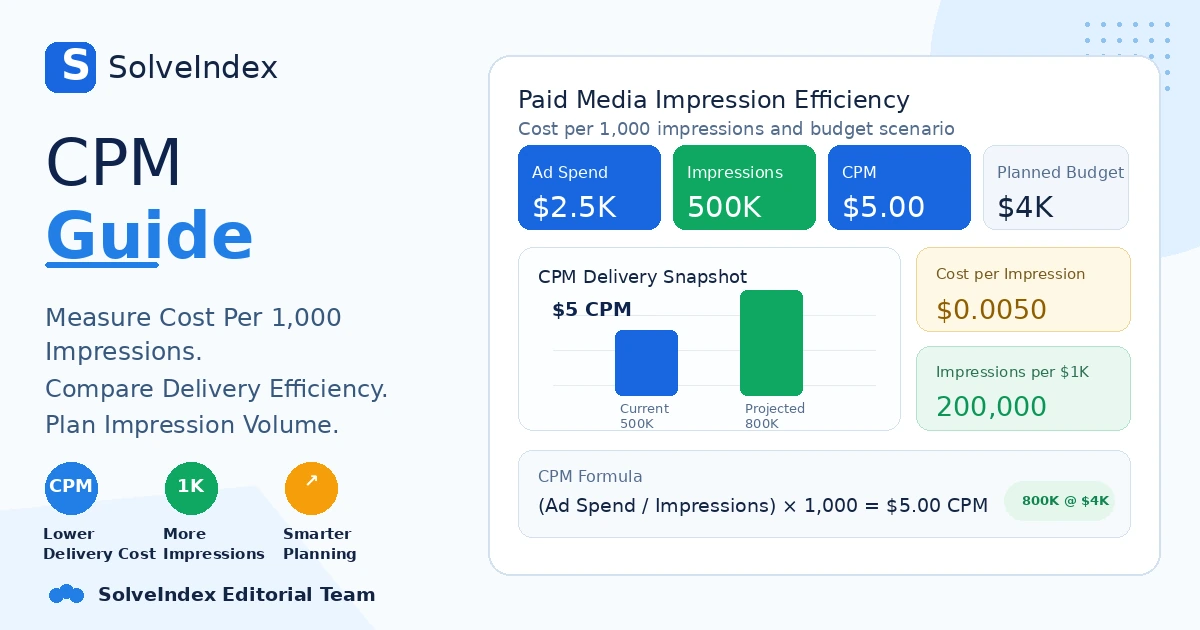
CPM means cost per mille, where mille means one thousand. In marketing, the metric expresses the average advertising cost for 1,000 recorded impressions. If a campaign costs $2,500 and produces 500,000 impressions, the CPM is $5. This does not mean each person saw the ad exactly once, and it does not mean all impressions were viewable or generated attention.
CPM is most useful when the primary question concerns the price of exposure. Brand and awareness teams often use it to compare delivery efficiency, while performance teams can use it as the first stage of a funnel analysis before connecting impressions to CTR, CPC, CPA and ROAS.
Cost Per Thousand and Cost Per Mille
Cost per thousand impressions and cost per mille describe the same mathematical concept. Both normalize advertising cost to 1,000 impressions. The terminology can vary by platform, media buyer or region, but the denominator remains impression volume rather than clicks, conversions, revenue or unique people.
This distinction matters because the acronym CPM is used outside advertising too. When reviewing keyword research or reporting, confirm that the context is paid media rather than project management, radiation measurement or another unrelated use of the acronym.
CPM Formula
The cost and impression count must come from the same reporting scope. If spend covers one campaign but impressions include the full account, the resulting CPM is not comparable or decision-useful.
How to Calculate CPM
- Choose one campaign, placement, channel or reporting segment.
- Use advertising cost for that exact scope and period.
- Use the matching impression count.
- Divide advertising cost by impressions.
- Multiply the result by 1,000.
For example, $1,200 of spend across 240,000 impressions produces $0.005 per impression. Multiplying by 1,000 gives a $5 CPM. This same calculation can be used for display, video, programmatic or other impression-based reporting as long as the definitions are consistent.
Worked CPM Example
Suppose a campaign has $2,500 in advertising cost and 500,000 impressions. Divide 2,500 by 500,000 to get $0.005 per impression. Multiply by 1,000 and the result is a $5.00 CPM. The same campaign therefore delivers 200,000 impressions for each $1,000 of spend at that observed rate.
If a future budget scenario uses $4,000 and assumes the same $5 CPM, the arithmetic implies 800,000 impressions. That is 300,000 more impressions than the current 500,000. The result is a scenario, not a guarantee that inventory will remain available at exactly the same price.
Calculate Impressions From CPM and Budget
A common planning question is how many impressions a budget could buy at a selected CPM. Rearranging the formula gives impressions = budget / CPM x 1,000. A $10,000 budget at an assumed $8 CPM implies 1,250,000 impressions. The estimate is useful for sensitivity analysis, but the assumed CPM can change as targeting, placements, auction conditions, geography and frequency change.
Do not describe this output as reach. Impressions count ad delivery events, while unique reach estimates the number of people shown an ad. One person can contribute multiple impressions, which is why reach and frequency should be reviewed separately when they are available.
CPM vs Cost Per Impression
Cost per impression is the spend divided by individual impressions. CPM is the same economics scaled to 1,000 impressions, which produces a more readable number. A $5 CPM equals $0.005 per impression. The calculator reports both so you can move between unit-level and thousand-impression views without changing the underlying cost definition.
CPM vs CPC
| Metric | Formula | Main question |
|---|---|---|
| CPM | Cost / impressions x 1,000 | What does 1,000 impressions cost? |
| CPC | Cost / clicks | What does an average click cost? |
CPM is an impression-stage metric, while CPC is a click-stage metric. Neither should replace the other. Use the CPC Calculator when clicks are the denominator and use CPM when you are measuring or planning impression delivery.
How CPM and CTR Affect CPC
CPM and CTR can be combined to understand the implied economics of clicks. At a $5 CPM and 1% CTR, 1,000 impressions cost $5 and produce about 10 clicks, so the implied CPC is roughly $0.50. If CPM stays at $5 but CTR falls to 0.5%, the same 1,000 impressions produce about five clicks and the implied CPC rises to about $1.00.
This relationship explains why a low impression price does not automatically produce cheap traffic. Use the Google Ads CTR Calculator for paid-search click-through analysis and compare like with like by network, device, audience and campaign type.
CPM vs vCPM
Standard CPM and viewable CPM do not use the same denominator. Google Ads describes viewable CPM bidding as paying for 1,000 impressions measured as viewable. That makes vCPM more closely tied to opportunities for the ad to be seen than a standard all-impressions CPM. Do not compare a standard CPM from one report directly with an average viewable CPM from another without identifying the denominator.
Viewability and Active View
Google Ads Active View treats a display impression as viewable when at least 50% of the ad area is visible for at least one second; video viewability uses a two-second duration. Google also distinguishes measurable, viewable and non-measurable impressions. These definitions are important when an advertiser is optimizing for visible exposure rather than simply served impressions.
A campaign can therefore have an acceptable standard CPM while producing weaker viewability than another placement. When visibility is a core objective, review viewable impressions, viewable rate and average viewable CPM rather than assuming all impressions carry equal opportunity to be noticed.
Impressions vs Unique Reach
Impressions count how many times ads were shown. Unique reach estimates how many people were shown the ads. Google Ads explains that unique reach uses models to deduplicate people across devices, formats and networks. As a result, 500,000 impressions do not imply 500,000 unique people.
This is why the calculator deliberately projects impressions rather than reach. A reach forecast needs additional information about audience size, duplication, frequency and the platform's modeling. Treating impressions as reach can materially overstate audience scale.
Frequency and Audience Saturation
Frequency describes how often the same person is shown an ad over a period. If impressions grow faster than unique reach, frequency rises. That can be useful when repetition reinforces a message, but excessive repetition can also signal audience saturation or wasted exposure depending on the campaign objective.
When comparing CPM across periods, check whether a cheaper CPM came from repeatedly serving the same audience. Impression efficiency and reach efficiency are related but not identical decisions.
What Is a Good CPM?
There is no universal good CPM. A useful CPM is one that buys the right type of impression at a cost that supports the next stage of the campaign objective. A narrowly targeted high-value B2B audience can rationally have a higher CPM than broad consumer inventory, while a low CPM can be unattractive if viewability, CTR or conversion quality is weak.
Start with your own comparable historical segments. Compare the same network, format, geography, audience type, device mix and objective. Then connect the result to reach, CTR or downstream value before deciding that a CPM is good or bad.
Average CPM and Benchmarks
Average CPM benchmarks are context, not a pass-fail threshold. CPM can vary by country, season, inventory, audience, placement, ad format and campaign objective. Google notes in its video metrics documentation that a good average CPM varies by country, reinforcing the need to avoid one universal benchmark.
If you use an external CPM benchmark, document the source, sample period, platform, country, format and audience definition. The closest internal comparable segment is often a stronger operational reference because it uses your own creative, targeting and measurement setup.
Display, Video and Search Context
CPM is naturally aligned with impression-based display and video buying. Search campaigns are more often managed around click, conversion and value goals, although you can still calculate an effective CPM from search cost and impressions for diagnostic comparison. Do not assume that a Search CPM and a Display CPM represent equivalent inventory or user intent.
Video and display also differ in viewability, creative experience, frequency and user attention. Compare CPM within a consistent environment before drawing conclusions across channels.
Google Ads CPM
Google Ads defines CPM around paying for one thousand impressions and positions impression-based bidding for visibility-focused goals on YouTube and the Google Display Network. The exact bidding options available depend on campaign type. Historical average CPM in a report should still be distinguished from a bid or target setting.
For reporting, use the actual campaign cost and impression columns that match your scope. If the objective changes from visibility to clicks or conversions, switch the primary evaluation metric rather than trying to make CPM answer a CPC, CPA or ROAS question.
Target CPM Is Not Historical CPM
Google Ads Target CPM, or tCPM, is a bidding target available for certain video campaigns. Google describes it as the average amount an advertiser is willing to pay per thousand impressions while the system optimizes bids to help reach more unique users. Some impressions can cost more or less than the target.
That is different from this calculator's historical CPM, which simply divides observed cost by observed impressions. A target is an input to a bidding strategy; a historical CPM is a measured result.
Why CPM Changes
- Audience competition: More advertisers competing for the same users or placements can increase impression cost.
- Geography: Inventory economics and advertiser demand differ across countries and regions.
- Placement and format: Premium inventory, video formats and viewable positions can have different prices.
- Seasonality: Commercial periods can change auction pressure and available supply.
- Targeting breadth: Narrow targeting can change both available inventory and auction competition.
- Creative and quality signals: Platform auction systems can react differently to ads and expected outcomes.
Segment CPM Before Comparing
A blended account CPM can hide meaningful differences. Segment by campaign type, country, device, placement, audience, creative format and brand versus prospecting objective where those distinctions matter. The most useful comparison keeps the impression definition and business purpose stable.
For example, a blended $7 CPM could combine a $4 broad-awareness segment with a $14 high-intent retargeting segment. Treating $7 as the target for both can lead to the wrong optimization decision.
How to Lower CPM
Lowering CPM is valuable only when the cheaper impressions remain useful. Practical tests can include broadening overly restrictive targeting, reviewing placement quality, refreshing creative, separating geographies, managing frequency, testing bidding strategy and moving budget toward inventory that delivers the required audience at a sustainable price.
Change one major variable at a time when possible. If audience, creative, bid strategy and placement all change together, you may see a lower CPM without knowing which change caused it or whether downstream quality improved.
When a Lower CPM Is Misleading
A lower CPM can be misleading when it comes from low-viewability inventory, weak audience fit, excessive frequency or placements that produce little downstream action. If CTR collapses while CPM falls, CPC can actually increase. If clicks stay cheap but conversions weaken, CPA and ROAS can deteriorate.
Use CPM as the cost of exposure, not as a complete score for campaign quality.
Connect CPM With CPA and ROAS
The advertising funnel moves from impressions to clicks to conversions to value. CPM prices impressions. CTR describes how impressions become clicks. CPC prices clicks. Conversion rate connects clicks to conversions. CPA prices conversions, while ROAS compares conversion value with ad spend.
For awareness campaigns, CPM, reach, frequency and viewability can be the primary decision set. For direct-response campaigns, CPM is usually an upstream diagnostic and the economic decision should eventually connect to CPA, ROAS or profit.
Budget and Impression Scenarios
The calculator can project impressions from a planned budget by holding the observed CPM constant. This is a sensitivity test. Real campaigns can move to different placements, audiences or auction conditions as spend changes, so the forecasted impression count should not be presented as guaranteed inventory.
If your planning question starts from target conversions, CPC and conversion rate instead of impression price, use the Google Ads Budget Calculator. It owns conversion-led budget planning rather than CPM-led impression scenarios.
Common CPM Mistakes
- Treating impressions as unique people or reach.
- Comparing standard CPM with viewable CPM without noting the denominator.
- Calling a low CPM profitable without checking downstream outcomes.
- Mixing spend and impressions from different date ranges or campaign scopes.
- Using one industry benchmark as a universal pass-fail target.
- Projecting much larger budgets at a constant CPM without scenario ranges.
- Ignoring frequency and audience saturation.
- Comparing Search, Display and Video CPM as if the inventory were equivalent.
Practical CPM Workflow
- Define the campaign, placement, channel and reporting period.
- Confirm the impression definition used by the platform.
- Match advertising cost to the same impression scope.
- Calculate CPM and cost per impression.
- Segment CPM by the dimensions that materially affect delivery.
- Review viewability, reach and frequency when awareness is the goal.
- Review CTR and CPC when traffic is the next stage.
- Review CPA, ROAS or profit when conversions and value are the goal.
- Use budget projections as scenarios and replace assumptions with actual results over time.
When to Recalculate CPM
Recalculate after meaningful changes in audience, geography, placement, format, bidding, seasonality or budget. Also recalculate when reporting definitions change, such as moving from all impressions to a viewable-impression view. Keep a note of the change so period-to-period comparisons remain interpretable.
Frequently Asked Questions
Sources and Methodology
SolveIndex cross-checked CPM, viewability, reach and Target CPM terminology against current first-party Google Ads documentation: CPM definition, Active View and viewability metrics, reach and frequency measurement, and Target CPM definition.
Reviewed September 5, 2026. The calculator uses transparent arithmetic and does not access an advertising account. Planned-budget outputs hold CPM constant and are scenarios, not forecasts of auction prices, reach or inventory availability.
Use the CPM Calculator
Calculate CPM from ad spend and impressions, then test a planned-budget impression scenario while keeping standard CPM separate from reach and viewability.
Open the CPM Calculator