Customer acquisition cost (CAC) measures the average acquisition expense required to add a new paying customer. A useful CAC calculation aligns sales and marketing costs with the same customer cohort, labels what is included, and connects the result to margin, retention, lifetime value and payback rather than treating a lower number as automatically better.
What Is Customer Acquisition Cost (CAC)?
Customer acquisition cost is the average cost of acquiring a new customer. In marketing and growth reporting, CAC is commonly calculated by adding the sales and marketing expenses assigned to acquisition and dividing them by the number of new customers acquired in the same measurement scope. Searchers also use phrases such as cost per customer acquisition or customer acquisition costs for the same general concept.
The numerator matters as much as the formula. A media-only number can be useful for a channel decision, while a fully loaded business CAC may also include marketing staff, sales compensation, agencies, creative production, software and allocated shared costs. Label the scope so a reader does not compare two ratios built from different cost policies.
Why CAC Matters in Marketing and Growth
CAC connects acquisition activity with business economics. It helps teams estimate how much growth costs, compare acquisition efficiency over time, plan customer volume from a budget and test whether gross profit or lifetime value can support the acquisition model. It is especially useful when paired with conversion rates, retention and payback.
A falling CAC can be a positive signal, but not if it comes from cutting high-quality demand, undercounting costs or changing the customer definition. Likewise, a rising CAC is not automatically bad when a business intentionally enters a more valuable segment or increases sales coverage. The useful question is whether the resulting customers generate enough economic value for the cost and cash required to acquire them.
Customer Acquisition Cost Formula
Core CAC formulas
Total Acquisition Cost = Marketing Cost + Sales Cost + Other Included Acquisition CostCAC = Total Acquisition Cost / New Customers AcquiredTarget Acquisition Budget = New Customers × Target CACCustomers Supported at Target CAC = Total Acquisition Cost / Target CACThe matching CAC Calculator uses these formulas and keeps marketing, sales and other acquisition costs visible as separate inputs. That makes the calculation easier to audit than entering one unexplained total.
How to Calculate Customer Acquisition Cost
- Choose a reporting period or customer cohort.
- Define which marketing, sales and other acquisition costs belong in the numerator.
- Add those included costs to get total acquisition cost.
- Count only new customers acquired under the same scope.
- Divide total acquisition cost by new customers.
- Compare the result with prior periods, customer economics and a documented target.
For long sales cycles, the most important step is often the first one. Calendar-month spend may create customers who close weeks or months later. A cohort approach can be more meaningful than dividing this month’s cost by this month’s closed customers when those groups do not correspond.
Worked CAC Calculation Example
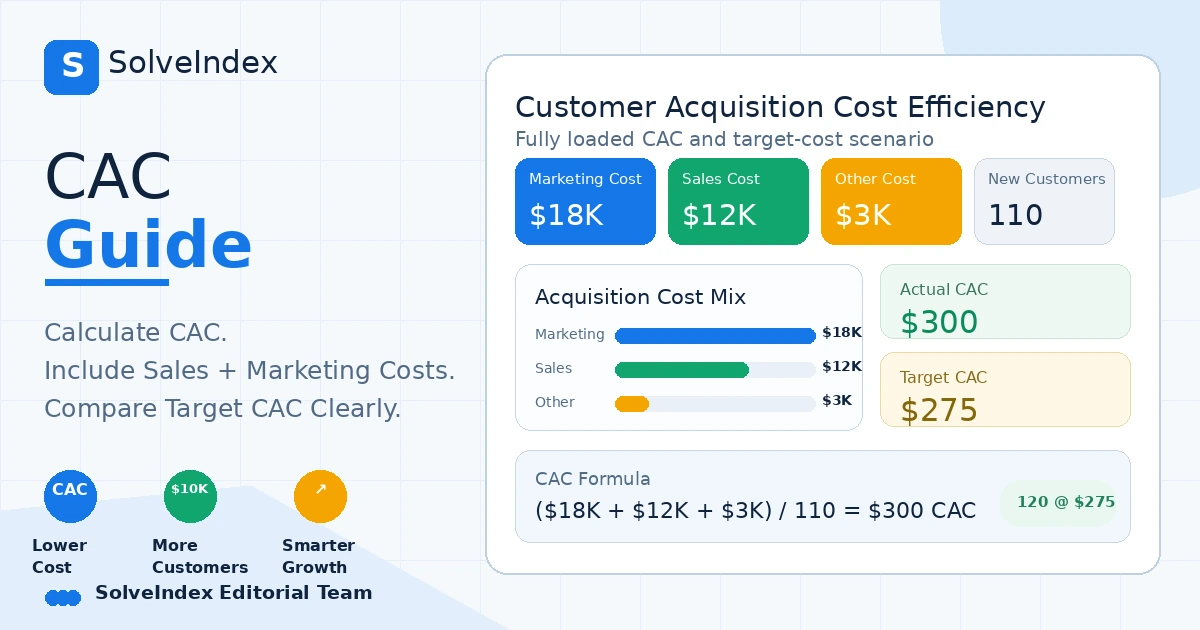
Suppose a company records $18,000 of marketing acquisition cost, $12,000 of sales acquisition cost and $3,000 of other included acquisition cost. Total acquisition cost is $33,000. If 110 new customers were acquired in the aligned period or cohort, CAC is $33,000 ÷ 110 = $300 per customer.
If the business has a $275 target CAC, the same 110 customers would support an acquisition budget of $30,250. The current $33,000 cost is therefore $2,750 above that target scenario. Looking at the scenario from the other direction, $33,000 divided by a $275 target CAC supports 120 customers mathematically, which is 10 more than the current 110.
| Example input or result | Value | Interpretation |
|---|---|---|
| Marketing cost | $18,000 | Included marketing acquisition expenses |
| Sales cost | $12,000 | Included acquisition-related sales expenses |
| Other cost | $3,000 | Software, agency, creative or other included costs |
| New customers | 110 | New paying customers in the same scope |
| Actual CAC | $300 | $33,000 / 110 |
| Target CAC | $275 | Business-specific planning target |
Which Costs Should Be Included in CAC?
There is no single cost list that fits every management question, but the policy should be explicit and repeatable. For a broad customer acquisition cost, include the sales and marketing resources used to win new customers. For a narrower channel CAC, include only costs that can be consistently assigned to that channel and label the result accordingly.
Avoid mixing a fully loaded numerator in one period with an ad-spend-only numerator in another. The ratio may appear to improve or deteriorate because the accounting policy changed, not because acquisition became more efficient.
Marketing Costs in CAC
Marketing costs can include paid media, sponsorships, content production, creative, agency fees, marketing software, campaign contractors and the relevant compensation of marketing staff. Whether brand investment or shared platform costs are included depends on the reporting policy and the decision being made.
If a business uses only paid-media spend, call the result media CAC or channel CAC rather than presenting it as a fully loaded customer acquisition cost. That distinction prevents undercounting and makes comparisons more defensible.
Sales Costs in CAC
Sales costs may include acquisition-related salaries, commissions, bonuses, sales-development resources, sales software and other costs required to convert qualified opportunities into new customers. This is particularly important in B2B models where the selling motion is a major part of the acquisition expense.
A sales-led business can materially understate customer acquisition cost if it measures only marketing spend. The correct level of inclusion depends on the scope, but the rule should remain stable across periods.
Other and Shared Acquisition Costs
Other acquisition costs can include agencies, creative production, referral fees, partnership fees, acquisition software or allocated shared expenses. Allocate shared costs using a documented method instead of changing the allocation whenever results are reviewed.
Not every operating cost belongs in CAC. Product delivery, general administration and customer-support costs usually answer different questions unless the company’s chosen finance policy deliberately includes part of them. Keep CAC focused on acquiring the customer and use margin, retention and lifetime value for the economics after acquisition.
How to Define New Customers
The denominator should be new paying customers, not leads, opportunities, all orders or the total active customer base. Returning customers are already acquired and should not normally be counted again in a new-customer CAC calculation.
Define the customer event clearly: first paid order, activated paid subscription, signed contract or another business-approved acquisition event. If the event changes, annotate the reporting series because the denominator has changed.
Match the Cost Period to the Customer Cohort
Same-period reporting is simple when the conversion cycle is short. With a long B2B sales cycle, however, the marketing and sales resources spent in January may produce customers who close in March. Dividing January cost by January closes can distort the relationship.
Cohort CAC follows a defined group of prospects or opportunities through enough of the sales cycle to associate acquisition effort with eventual new customers. The method takes longer to mature but can be more faithful when reporting lag is material.
What Is Blended CAC?
Blended CAC combines acquisition costs across channels or programs and divides by the total new customers acquired. It is useful for a high-level view of overall acquisition efficiency and for budget planning when exact channel attribution is incomplete.
A blended number can hide large differences between channels. Use it for company-level economics, then segment carefully when the data is reliable enough to support channel decisions.
What Is Fully Loaded CAC?
Fully loaded CAC aims to capture the broader resources required to acquire customers, commonly including relevant sales and marketing compensation, tools, agencies, creative and paid acquisition costs. The objective is a more complete economic view than ad spend divided by customers.
The term is useful only when the organization documents what “fully loaded” includes. Two companies can both report fully loaded CAC while using different allocation rules, so external comparisons require caution.
Blended CAC vs Channel CAC
Channel CAC focuses on a specific acquisition source such as paid search, paid social, events or partnerships. Blended CAC combines channels. A channel-level ratio is helpful for optimization, while blended CAC is often better for overall unit economics.
Attribution complicates channel CAC because customers can interact with several touchpoints before buying. Avoid false precision when channels work together. Use a consistent attribution method and show blended CAC alongside channel views where possible.
CAC vs CPA
CAC and CPA are related but should not be treated as synonyms. Cost per acquisition or cost per action can use any selected conversion event as the denominator, including a lead, trial, signup or purchase. Customer acquisition cost specifically focuses on new customers and can include broader sales and marketing expenses.
The dedicated CPA Calculator is the better tool when the denominator is an advertising conversion action. Use the CAC calculator when the goal is the broader cost of winning a new customer.
CAC vs CPL
Cost per lead ends earlier in the funnel. CPL divides lead-generation cost by leads, while CAC divides acquisition cost by new customers. A low CPL can still produce a high CAC if lead quality or lead-to-customer conversion is weak.
Use the CPL Calculator and Lead-to-Customer Conversion Rate Calculator together when you need to diagnose how lead cost and closing efficiency contribute to CAC.
CAC vs Customer Lifetime Value
CAC measures the cost of acquiring the customer. Customer lifetime value estimates the economic value generated over the relationship. A sustainable acquisition model needs enough gross profit or lifetime value to repay CAC and leave room for operating costs and profit.
Subscription businesses often analyze the LTV:CAC ratio, but the correct target depends on margin, retention, growth stage and cash constraints. Use the dedicated SaaS LTV:CAC Calculator when the question is specifically subscription lifetime value relative to acquisition cost.
CAC Payback and Cash Recovery
CAC payback estimates how long it takes the customer’s gross profit contribution to recover acquisition cost. Two companies can have the same CAC but very different cash profiles if one recovers it in a few months and the other takes much longer.
Use the CAC Payback Period Calculator when recovery time is the primary decision. Keeping payback separate from the general CAC page prevents the two intents from competing for the same search purpose.
What Is a Good CAC?
There is no universal good CAC. A sustainable level depends on first-order gross profit, repeat purchases, retention, customer lifetime value, payback requirements, sales capacity and the amount of cash the business can safely invest before recovery.
Compare actual CAC with your own economics and with comparable historical cohorts. A $300 CAC can be excellent for a high-margin customer with strong retention and unacceptable for a low-margin one-time purchase.
Average Customer Acquisition Cost and Benchmarks
Average customer acquisition cost benchmarks can be useful for orientation, but they should not become pass-or-fail targets. Published samples can differ by industry, geography, business model, channel mix, sales motion and cost-inclusion policy.
Your own segmented history is normally the stronger baseline. Compare similar products, geographies and acquisition motions, and record changes to the numerator or customer definition before interpreting a trend.
Customer Acquisition Cost by Industry
Industry CAC comparisons are especially sensitive to sales complexity and customer value. A long enterprise sales cycle can support a much higher acquisition cost than a low-ticket transactional purchase. Even within one industry, paid-search-heavy acquisition, partner-led acquisition and product-led growth can produce very different ratios.
If you use an external industry benchmark, document the source, sample period, geography and whether the benchmark includes sales cost. Do not copy a benchmark into a target without reconciling it with your own unit economics.
How to Set a Target CAC
A target CAC should begin with customer economics, not an arbitrary industry average. Estimate the gross profit or lifetime value available from a customer, decide how much must remain after acquisition for overhead and profit, and consider the acceptable payback period and cash requirement.
The calculator’s target field then turns that business target into two useful scenarios: the budget allowed for the current customer volume and the customer count the current acquisition cost would support at the target efficiency. These are mathematical planning outputs, not promises that customer volume will stay constant as spend changes.
How to Reduce Customer Acquisition Cost
- Improve targeting so acquisition spend reaches higher-intent audiences.
- Improve landing pages and offer clarity to raise qualified conversion rates.
- Reduce lead leakage between marketing, qualification and sales stages.
- Improve sales response time and follow-up quality.
- Shift budget toward channels and segments with stronger customer economics.
- Use retention, referrals and brand demand to reduce dependence on paid acquisition.
- Remove duplicated software, agency or workflow costs from the acquisition process.
Do not optimize CAC by simply removing costs from the formula. A genuine improvement should reduce the resources required per acquired customer or increase qualified customer throughput while preserving customer quality.
Improve CAC Through Conversion Efficiency
CAC often improves when conversion efficiency improves because the same acquisition resources produce more customers. Track the funnel from visitor or lead through qualification and closing instead of treating CAC as an isolated end metric.
The Marketing Funnel Calculator can help identify weak stage-to-stage conversion, while the lead-to-customer calculator isolates the closing stage. Diagnose the rate that changed before cutting spend or changing the CAC target.
Lead Quality, Sales Cycle and CAC
Cheaper leads do not automatically create cheaper customers. If lower-cost traffic produces weak qualification or slow sales progression, sales effort can increase and CAC can rise even while CPL falls.
Track lead quality, opportunity creation, close rate and sales-cycle length alongside CAC. In sales-led businesses, capacity constraints can make apparently cheap demand expensive when the sales team spends substantial time on low-probability opportunities.
Attribution, Channel Mix and CAC
Channel attribution can influence which costs and customers are assigned to each source. A customer may first discover the brand through content, return through paid search and convert after an email touch. A single-touch channel CAC can over-credit or under-credit one source.
Use a documented attribution rule, compare channel CAC with blended CAC and avoid interpreting small differences as precise economic truth when attribution is uncertain. For SEO-specific acquisition economics, use the dedicated SEO CAC Calculator instead of forcing organic costs into a generic channel comparison.
Common CAC Calculation Mistakes
- Dividing spend by leads or opportunities instead of new customers.
- Using ad spend only but labeling the result fully loaded CAC.
- Mixing different reporting periods or unmatched customer cohorts.
- Counting returning customers as new acquisitions.
- Changing the sales or marketing cost policy without annotating the trend.
- Comparing channel CACs built with different attribution rules.
- Using a universal “good CAC” without margin, LTV or payback context.
- Optimizing lower CAC while customer quality or retention deteriorates.
Practical CAC Reporting Workflow
- Write the exact CAC scope and cost-inclusion policy.
- Choose a period or cohort appropriate to the sales cycle.
- Total marketing, sales and other included acquisition costs.
- Count new paying customers under the same definition.
- Calculate CAC and compare it with prior comparable periods.
- Segment by channel, geography, product or customer type where sample size permits.
- Compare CAC with gross profit, LTV and payback.
- Investigate changes through CPL, funnel conversion, lead quality and sales cycle.
- Recalculate targets when margins, retention, pricing or acquisition mix materially change.
A useful CAC report includes the number itself, the numerator components, the customer count, the period or cohort, and the cost policy. That context makes the metric auditable and prevents future teams from comparing unlike ratios.
Frequently Asked Questions
Sources and Methodology
SolveIndex cross-checked the CAC definition, sales-and-marketing cost treatment and new-customer denominator against current guidance from Shopify: Customer Acquisition Cost, Shopify: Ecommerce Customer Acquisition, and HubSpot: Customer Acquisition Cost. The exact cost pool can vary by management purpose, so this guide emphasizes a documented, consistent scope rather than one universal accounting policy.
Reviewed September 9, 2026. Benchmark and “good CAC” discussions are methodological rather than universal numeric targets because industry, geography, channel mix, sales model, margin, retention and cost inclusion can materially change the result.
Use the CAC Calculator
Calculate fully loaded customer acquisition cost from marketing, sales and other acquisition expenses, then compare the result with your own target CAC.
Open the CAC Calculator