Total Contract Value measures the full value assigned to a SaaS contract across its signed term. This guide explains the TCV formula, what TCV means in sales, how to separate committed and estimated value, and how TCV differs from ACV, ARR, bookings, billings and recognized revenue.
What Is Total Contract Value (TCV)?
Total Contract Value, or TCV, is a contract-level metric that summarizes the value assigned to a customer agreement across its full signed term. In SaaS, it is commonly used by sales, finance and revenue operations teams to understand how much contract value was booked, how deal size is changing and how multiyear agreements compare with shorter contracts.
TCV is not an accounting standard with one mandatory definition. A company should document whether its version includes implementation fees, usage commitments, credits and other nonrecurring items. The safest interpretation is the value of the executed contract under a consistent reporting policy, with forecast-only components labeled separately.
What Does TCV Mean in SaaS Sales?
In sales reporting, TCV gives a full-term view of the economic size of a deal. A 24-month contract worth $29,400 in total can have a much larger TCV than a one-year contract even when the monthly recurring fee is similar. That makes TCV useful for bookings analysis, sales-credit policy, deal reviews and pipeline forecasting.
TCV should still be read with contract length. A higher TCV can come from a genuinely larger monthly commitment, a longer term, more services or higher expected usage. Sales teams should therefore pair TCV with ACV or another annualized measure when they want to compare deal economics on a like-for-like yearly basis.
Total Contract Value Formula
The SolveIndex calculator uses a transparent planning formula: TCV = (Monthly Recurring Fee x Contract Months) + One-Time Fees + (Monthly Variable Fees x Contract Months) - Discounts. The formula keeps recurring, one-time, variable and discount components visible rather than collapsing the contract into one unexplained total.
This approach matches common SaaS practice, but the variable-fee line needs a policy. A contractual usage minimum can be treated as committed value. A forecast of future overages is an estimate. If you include the estimate, label the resulting TCV as forecasted or planning TCV so readers do not confuse it with fixed signed commitment.
Recurring Contract Revenue
Recurring contract revenue is the fixed subscription component over the signed term. If a customer commits to $1,000 per month for 24 months, the recurring contract revenue is $24,000. This is the most comparable component with MRR and ARR, but TCV keeps the full contract term instead of converting the amount to a one-month or one-year run rate.
Use the recurring fee actually committed in the contract. If pricing changes during the term, model each pricing period correctly rather than multiplying one monthly price across the entire agreement. A ramp contract with $800 per month in year one and $1,200 in year two needs a staged calculation.
Contract Duration and Signed Term
Contract duration determines how long recurring and recurring-like components accumulate inside TCV. Use the enforceable signed term rather than a hoped-for customer lifetime. For a 24-month agreement, multiply monthly recurring value by 24 even if the customer could remain for five years.
Month-to-month or evergreen subscriptions need special care because there is no fixed future term. In that case, a long-horizon TCV can become arbitrary. ARR, MRR or a defined first-year value is often more useful than pretending an open-ended subscription has a known lifetime contract value.
One-Time Fees in TCV
One-time implementation, onboarding, setup, migration, training or professional-services charges can be included in TCV when they are part of the signed commercial agreement. This is one reason TCV can be higher than the recurring value of a contract.
Keep these charges visible as a separate component. They do not become recurring revenue simply because they are included in TCV. If you compare TCV with ARR or MRR, strip out nonrecurring amounts or explain the difference so the comparison does not overstate recurring economics.
Variable and Usage Fees
Usage-based SaaS contracts can contain consumption charges that vary with seats, transactions, storage, API calls or another usage driver. If the contract contains a minimum commitment, that minimum can be included as committed value. Variable amounts above the minimum may be less certain.
The calculator allows a monthly variable-fee estimate because planning teams often need a working contract forecast. The important control is labeling. Do not present an estimated usage amount as if it were guaranteed by the contract. When precision matters, report fixed TCV and estimated TCV side by side.
Committed TCV vs Estimated TCV
Committed TCV uses amounts the customer is contractually obligated to pay over the signed term, subject to the contract conditions. Estimated TCV adds assumptions such as expected usage or probable non-guaranteed components. Both can be useful, but they answer different questions.
For board reporting, commission calculations or signed-bookings dashboards, committed value is usually the cleaner base. For capacity planning and revenue forecasting, an estimated view may be useful. Store the distinction in CRM fields rather than relying on analysts to remember which number was used later.
Discounts, Credits and Concessions
Contract-level discounts reduce the economic value assigned to the agreement, so the SolveIndex formula subtracts them from gross contract value. Use the net amount the customer is expected to pay rather than the undiscounted list price when your goal is economic TCV.
Credits, rebates and concessions need the same policy discipline. If a credit is guaranteed in the signed agreement, include its effect. If it is a future discretionary concession, keep it separate until it becomes part of the commercial terms. This avoids overstating or understating signed deal value.
Gross vs Net TCV
Gross contract value is the sum of recurring, one-time and included variable components before discounts. Net TCV is the amount after contract-level discounts are deducted. Showing both is useful because it separates pricing power from discounting behavior.
A rising gross TCV with flat net TCV can indicate heavier discounting. Conversely, rising net TCV with stable contract length may show stronger pricing or larger product scope. Define which version your company calls simply TCV so dashboards and compensation reports do not mix gross and net numbers.
Worked TCV Example
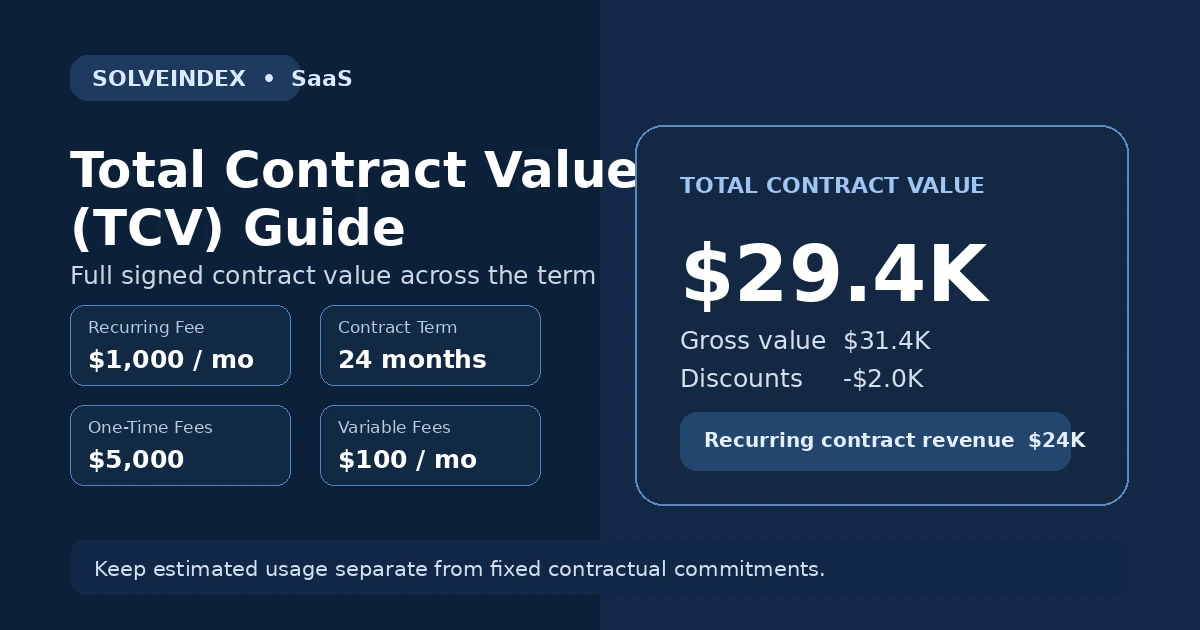
Consider the calculator defaults: a $1,000 monthly recurring fee for 24 months, $5,000 of one-time fees, $100 per month of variable fees and $2,000 of discounts. Recurring contract revenue is $24,000 and the variable component is $2,400.
Gross contract value is $24,000 + $5,000 + $2,400 = $31,400. After subtracting the $2,000 discount, TCV is $29,400. The average contract value per month is $1,225, but that monthly average includes the effect of one-time and variable items and is not the same as MRR.
| Metric | Example value |
|---|---|
| Monthly recurring fee | $1,000 |
| Contract length | 24 months |
| One-time fees | $5,000 |
| Variable fees | $100/month |
| Discounts | $2,000 |
| Gross contract value | $31,400 |
| Total Contract Value | $29,400 |
Average Contract Value per Month
Dividing net TCV by contract months gives a simple monthly average of the whole contract value. In the worked example, $29,400 divided by 24 equals $1,225 per month. This can help compare contracts of different lengths, but it should not be labeled MRR.
MRR is a recurring-revenue metric. A TCV monthly average can include one-time implementation fees, estimated usage and discounts spread mathematically across the term. Keep the label explicit so operating teams do not accidentally load nonrecurring value into recurring-revenue reporting.
TCV vs ACV
TCV measures the contract across its complete term, while Annual Contract Value normalizes contract economics to one year. For a three-year recurring contract, TCV answers how much value is associated with all three years; ACV answers what the recurring contract value looks like on an annual basis.
The distinction matters in deal comparisons. A long contract can have a high TCV simply because it lasts longer. ACV is usually better for comparing annualized deal size, while TCV is better for understanding the full signed commercial commitment. Use the dedicated ACV calculator when annualization is the main question.
TCV vs ARR
TCV is contract-specific and can include one-time or variable components. ARR is a company-level recurring-revenue run-rate metric that annualizes recurring revenue. A two-year customer contract can produce one TCV at signing while contributing only its recurring annual run rate to ARR.
Do not add one-time implementation fees to ARR merely because they are part of TCV. The metrics serve different purposes: TCV helps analyze signed contract economics and bookings, while ARR helps measure normalized recurring scale across the business.
TCV vs MRR
MRR normalizes recurring subscription revenue to a monthly run rate. TCV keeps the full signed term and may contain nonrecurring items. If a customer pays $1,000 per month for 24 months plus a $5,000 setup fee, recurring MRR may be $1,000 while TCV includes the full term and setup charge.
Because TCV and MRR use different time horizons and scopes, one should not be substituted for the other. MRR is better for recurring-revenue movement analysis; TCV is better for signed deal value, contract mix and bookings analysis.
TCV vs Recognized Revenue
TCV is not the same as recognized revenue. TCV can reflect the value of a signed agreement at booking, while revenue is recognized as performance obligations are satisfied under the applicable accounting rules. A large multiyear TCV therefore does not mean the entire amount becomes revenue on the signing date.
This distinction is especially important when customers prepay. Cash may arrive before revenue is recognized, creating deferred revenue or contract liabilities depending on the accounting treatment. Keep TCV in sales and planning analytics unless accounting policy explicitly maps it to financial-statement measures.
TCV vs Bookings
Bookings represent signed customer commitments, and many SaaS organizations use TCV as the amount attached to a booking.
Bookings are not a standardized GAAP metric, so document whether your policy includes one-time services, non-guaranteed usage, renewals or discounts.
TCV vs Billings
Billings are amounts invoiced to the customer during a period. TCV is the contract value across the signed term. A $120,000 annual contract billed quarterly may have $120,000 of TCV but only $30,000 billed on the first invoice date.
The two metrics converge only under specific billing structures. Tracking them separately helps finance teams understand future invoice schedules, receivables and deferred revenue without losing the full commercial context of the contract.
TCV vs Cash Collected
Cash collected measures payments actually received. TCV measures contract value. A customer can sign a large contract and pay monthly, quarterly or annually, so cash receipts can be far below TCV early in the term.
For liquidity and runway questions, use cash-flow metrics. For signed contract economics, use TCV and keep payment timing separate.
TCV vs Customer Lifetime Value
TCV is bounded by the signed contract term. Customer Lifetime Value estimates economic value across the expected customer relationship, often beyond the current agreement. That makes LTV more assumption-heavy and TCV more contract-grounded.
If a customer signs a one-year deal but is expected to stay five years, TCV should not automatically include all five years. LTV may incorporate expected retention under its own model. Keeping these metrics separate prevents forecast assumptions from leaking into signed-contract reporting.
Contractually Committed Renewals
If the agreement contractually commits the customer to an additional renewal period and the value is known, your policy may include that period in TCV. The key is whether the future obligation is truly part of the enforceable agreement rather than merely likely.
Review termination rights, opt-out clauses and renewal mechanics before adding future periods. A contract that automatically renews but can be cancelled freely may not provide the same certainty as a non-cancellable multiyear commitment.
Uncommitted Renewals
A conservative TCV calculation excludes optional future renewals because including them turns a signed-contract metric into a customer-lifetime forecast. Stripe specifically notes that assuming renewals introduces uncertainty and that excluding uncommitted renewals is the more conservative treatment.
You can still forecast likely renewals elsewhere. Keep renewal probability in pipeline or retention models and keep signed TCV focused on the current enforceable commitment. This makes historical win-size analysis more reproducible.
Ramp Pricing and Multi-Year Escalators
Multiyear SaaS contracts often have scheduled price ramps, seat increases or escalation clauses. Do not multiply one monthly price by the full term if the contract explicitly changes pricing. Sum each priced period instead.
For example, twelve months at $1,000 followed by twelve months at $1,200 produces $26,400 of recurring contract value, not $24,000. If your simple calculator inputs one monthly fee, use a blended value only when you understand that it is an approximation.
Usage Minimums and Overage Assumptions
A committed usage minimum is different from a forecast of overage revenue. Minimums are part of the signed economics when the customer must pay them. Overage forecasts depend on future behavior and may never occur.
For clean contract reporting, include guaranteed minimums in committed TCV and show expected overages separately. If management wants one planning number, label it forecast TCV and retain the committed value as a second field for auditability.
Early Termination, Cancellation and Opt-Out Clauses
Contract length is only meaningful when the customer is obligated for that period. Termination-for-convenience clauses, early cancellation rights, trial periods or opt-out windows can reduce the value that is truly committed.
A practical policy is to measure TCV through the non-cancellable term unless finance or legal has approved another convention. Sales teams should not receive the same TCV credit for a fully cancellable agreement as for an equivalent non-cancellable commitment without explicitly documenting that choice.
New, Renewal and Expansion TCV
TCV can be attached to new customer bookings, renewal contracts and expansions. Keeping those categories separate makes the sales story clearer. A rising total TCV number may come from new logos, larger renewals, upsells or longer contract terms.
Expansion amendments also require scope discipline. Measure only the incremental contract value created by the amendment when the goal is expansion reporting, or restate the whole contract when your reporting policy requires a consolidated TCV. Do not mix both methods in one trend line.
Contract Modifications
Upgrades, downgrades, added modules, seat changes and term extensions can change remaining contract value. Decide whether your system records a new TCV event, an incremental delta or a restated contract total. Each method can work if it is applied consistently.
Keep original booking value and amendment value available separately when possible. That preserves auditability and helps analysts distinguish commercial growth from a reporting-system rewrite of the original contract.
Currency and FX Policy
Global SaaS companies need a currency policy before aggregating TCV across contracts. Store each contract in its transaction currency and define the FX rate used for consolidated reporting, such as booking-date spot rate or a standardized planning rate.
Without a consistent FX method, TCV can change even when contract economics have not. Separate operational contract changes from translation effects so sales performance and currency movement are not confused.
TCV and Sales Commissions
Organizations may credit commissions using TCV, ACV, ARR or a weighted combination. The metric should match the behavior the plan is designed to reward.
If commissions use TCV, be explicit about one-time services, variable usage, cancellable terms and multiyear discounts. Otherwise reps may be rewarded for contract components that finance does not treat as reliable recurring value.
TCV in Forecasting and Pipeline
TCV helps translate signed and forecast deals into full-term commercial value. In pipeline reporting, expected TCV can be probability-weighted, but that should remain distinct from booked TCV after execution.
Forecast quality improves when CRM fields preserve recurring fees, term, one-time charges, usage assumptions and discounts so analysts can rebuild TCV.
CRM and Contract Source of Truth
The executed contract should ultimately control signed commercial terms, while CRM can serve as the operating system for sales reporting. Reconcile CRM fields to finance or billing records when contracts are amended or implementation fees are invoiced differently from the original opportunity.
Define whether a deal becomes booked at signature, countersignature, order-form activation or another event. Consistent cut-off rules prevent month-end TCV from shifting because teams use different ideas of when a contract is final.
How to Improve TCV
TCV can rise through higher recurring prices, broader product adoption, longer committed terms, more contracted usage or valuable services. But maximizing TCV alone is not always the right goal. Longer contracts with deep discounts can increase headline TCV while weakening annual economics.
Pair TCV with ACV, gross margin, retention and sales efficiency. The strongest contracts usually balance deal size with healthy pricing, manageable delivery obligations and a commitment structure that improves visibility without creating excessive concessions.
Common TCV Mistakes
Common errors include assuming optional renewals, treating forecast usage as guaranteed, forgetting discounts, mixing one-time fees into ARR, using the wrong contract term, ignoring cancellation rights and comparing gross TCV with net TCV. Another mistake is calling TCV recognized revenue.
Most problems are policy problems rather than arithmetic problems. Write a short TCV definition for sales, RevOps and finance, map every CRM field to the formula and make exception handling explicit for ramp deals, usage-based contracts and amendments.
Practical TCV Reporting Workflow
Start with the executed agreement. Record recurring price, term, one-time fees, committed usage, estimated usage, discounts, currency and relevant cancellation rights. Calculate recurring total and gross value before applying discounts, then store committed and estimated TCV separately when both are needed.
Next, reconcile booked TCV with billing and finance systems, classify the booking as new, renewal or expansion, and retain amendment history. Review unusual deals manually. Finally, compare TCV with ACV, ARR and recognized revenue only after making the scope differences explicit.
When TCV Is Not the Right Metric
TCV is less useful for open-ended month-to-month subscriptions with no defined commitment, for questions about current recurring scale, or for accounting revenue recognition. In those cases, MRR, ARR, billings, cash collections or recognized revenue may answer the business question more directly.
Use TCV when the signed contract term itself matters. It is strongest for contract comparison, bookings, pipeline and commercial commitment analysis, especially in B2B SaaS with defined terms and meaningful implementation or usage components.
Frequently Asked Questions
Sources and Methodology
The SolveIndex convention uses the signed contract term, recurring fees, one-time fees, included variable-fee assumptions and contract discounts. TCV is a management and sales metric rather than a universal accounting standard, so companies should document scope and apply it consistently.
Use the Total Contract Value Calculator
Enter recurring fees, contract length, one-time charges, variable-fee assumptions and discounts to reproduce the worked scenario and compare signed-contract cases.
Open the Total Contract Value Calculator