Annual Contract Value (ACV) turns a SaaS customer contract into a comparable one-year recurring value. This guide explains the formula, ACV meaning in sales, one-time fee treatment, multi-year normalization, and the measured high-interest comparisons with ARR and TCV.
What Is Annual Contract Value (ACV)?
Annual Contract Value (ACV) is the recurring value of a customer contract normalized to a one-year basis. In SaaS and subscription sales, it makes contracts with different terms comparable: a one-year contract and a three-year contract can be expressed as annualized deal values instead of being compared by their full multi-year totals.
ACV is a sales and contract metric rather than a standardized accounting measure. Teams should document what recurring components are included, how discounts or ramp schedules are handled, and which nonrecurring items are excluded. Consistency matters more than trying to force every contract into a definition another company uses.
What Does ACV Mean in SaaS Sales?
In SaaS sales, ACV usually means Annual Contract Value. It helps revenue teams answer a practical question: how much recurring contract value does this customer relationship represent per year? That annual view supports deal comparison, territory planning, quota analysis and segmentation by customer size.
This sales meaning is especially important because the acronym ACV has other meanings outside SaaS. A page, dashboard or CRM field should spell out Annual Contract Value at least once so sales, finance and customer-success teams are working from the same definition.
ACV Acronym: Annual vs Actual Cash Value
Searches for “ACV” are highly ambiguous. In insurance and vehicle claims, ACV often means Actual Cash Value, which is a completely different concept related to the depreciated value of property. That is why a SaaS metric should be labeled “Annual Contract Value (ACV)” rather than relying on the acronym alone.
SolveIndex uses ACV exclusively as Annual Contract Value on this page. The calculator does not estimate vehicle, property or insurance claim value. This distinction is important for both reporting accuracy and search intent.
Annual vs Average Contract Value
Annual Contract Value describes the annualized recurring value of a contract. “Average ACV” is a separate portfolio statistic: after calculating each deal on a consistent annual basis, a team can average those ACVs across customers, segments or sales periods.
Some materials use “average contract value” loosely for ACV. Avoid mixing the two ideas. First calculate Annual Contract Value for each contract; then use an average or median only when you intentionally want a summary of a group of deals.
Annual Contract Value Formula
The core formula annualizes recurring contract value: divide the recurring value committed across the contract by the number of contract years. If the term is stored in months, convert months to years first by dividing by 12.
An equivalent form is ACV = Recurring Contract Value × 12 ÷ Contract Months. Both approaches produce the same result when the recurring value covers the full committed term. One-time implementation, onboarding or setup charges should normally be kept outside recurring ACV.
Normalize Contract Length to Years
Normalization is what makes ACV useful. A $120,000 one-year recurring contract has a $120,000 ACV, while a $240,000 three-year recurring contract has an $80,000 ACV. Comparing only the contract totals would make the longer deal look larger even though its yearly recurring value is lower.
Use the committed term, not an assumed customer lifetime. Optional renewal periods should not automatically be added unless the organization’s contract policy treats them as committed value.
What Counts as Recurring Contract Value?
Recurring contract value normally includes subscription charges and other committed recurring fees that belong to the signed contract. For a seat-based SaaS product, that might include licensed seats and recurring platform fees. For a contracted usage model, it can include a committed minimum if the business treats that minimum as recurring contract value.
Do not automatically include every invoice line. The goal is to isolate the repeatable contract economics that are being annualized, using the same policy from deal to deal.
One-Time Fees and ACV
One-time setup, onboarding, implementation and migration fees are commonly excluded from recurring ACV. Including them can make a contract appear to have a higher repeatable annual value even though those charges do not recur in future contract years.
The SolveIndex calculator therefore shows one-time fees separately and adds them only to Total Booked Contract Value. This lets you see the full entered contract commitment without contaminating the recurring ACV result.
Implementation, Onboarding and Services
Professional services require an explicit policy. A one-off implementation project is usually excluded from recurring ACV, while a recurring managed-service fee may belong in recurring contract value if it is committed and repeatable under the agreement.
When sales compensation or quota credit depends on ACV, vague service treatment can create inconsistent incentives. Define which service lines are recurring before the contract is entered into the CRM.
Usage and Variable Commitments
Usage-based contracts can make ACV harder to define because actual revenue may vary. A committed annual minimum can be normalized as ACV, while purely variable usage is better kept outside a fixed ACV unless the organization has a documented forecast methodology.
If expected usage is included, label the result as an estimate rather than a hard contract commitment. Separating committed and variable portions makes deal comparison and forecast confidence easier to interpret.
Discounts and Ramp Pricing
Apply contracted discounts before annualizing if the discount changes the recurring value the customer actually committed to pay. Multi-year ramp deals require extra care because Year 1 may be discounted while later years step up.
A simple average across the committed term gives a normalized ACV, but finance or sales teams may also want year-specific ACV for ramp contracts. Document which view is used for quotas and forecasting so teams do not compare an average ACV with a first-year value.
Worked ACV Example
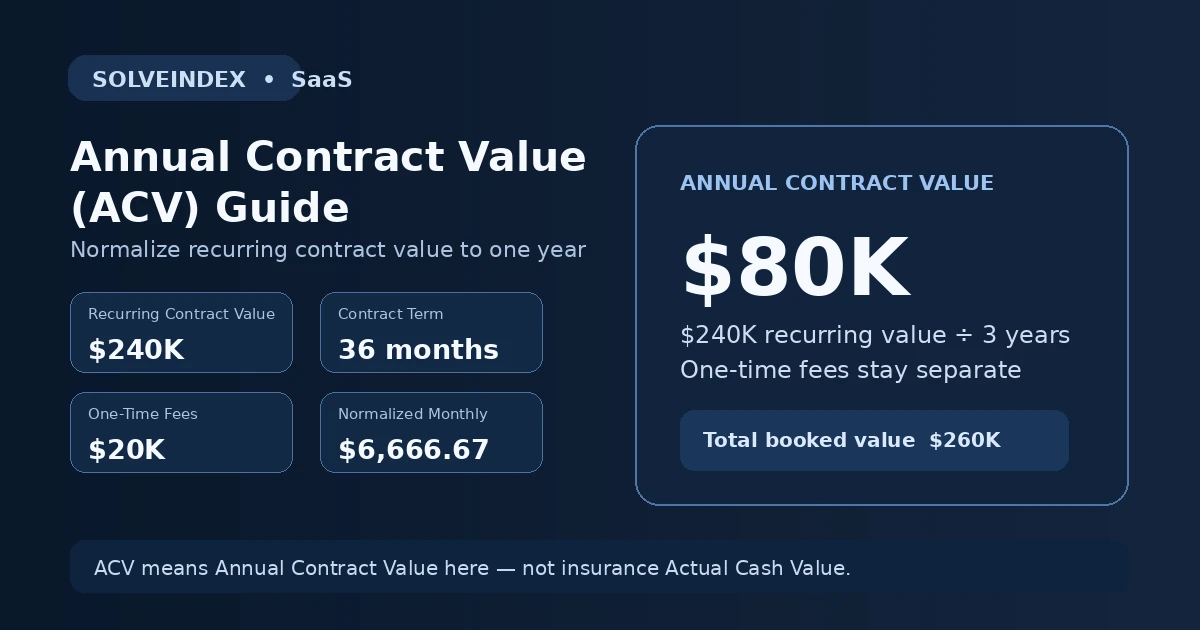
Assume a customer signs a 36-month agreement containing $240,000 of recurring contract value plus a $20,000 one-time implementation fee. The term is three years, so recurring ACV is $240,000 ÷ 3 = $80,000. The normalized monthly recurring contract value is $240,000 ÷ 36 = $6,666.67.
The $20,000 implementation fee does not change the $80,000 recurring ACV in this model. It is added to total booked contract value, producing $260,000 of total entered contract value. This keeps annual recurring deal size and full booked commitment visible as separate concepts.
| Metric | Example value |
|---|---|
| Total recurring contract value | $240,000 |
| Contract length | 36 months / 3 years |
| One-time fees | $20,000 |
| Annual Contract Value | $80,000 |
| Normalized monthly value | $6,666.67 |
| Total booked contract value | $260,000 |
Monthly Normalized Contract Value
Monthly normalized contract value is simply the recurring contract value divided by the contract months. It is useful for checking the annualization because multiplying the normalized monthly value by 12 should reproduce ACV for a level contract.
This output is contract-specific. It is not automatically MRR at the company level, because MRR aggregates recurring revenue across customers and may apply additional normalization or movement rules.
Contracts Shorter Than 12 Months
ACV can annualize contracts shorter than one year. A six-month recurring contract worth $30,000 has an annualized ACV of $60,000 because the six-month value is scaled to a 12-month basis.
That annualized figure does not mean the customer is contractually committed for 12 months. When using ACV for forecasting, keep contract duration visible so an annualized comparison is not mistaken for booked revenue beyond the signed term.
Multi-Year Contracts
Multi-year contracts are where ACV is most helpful. A three-year $300,000 recurring agreement becomes $100,000 ACV, making it directly comparable with a one-year $100,000 recurring agreement on an annual basis.
TCV still matters because the three-year customer has a larger total commitment. Use ACV for yearly deal-size comparison and TCV for full-term contract scope rather than trying to make one metric answer both questions.
Renewals and Contract Extensions
A renewal creates a new measurement decision. Many teams calculate ACV from the renewed committed term rather than carrying forward the original deal value. If pricing, seats or term length change at renewal, the renewed ACV should reflect the new contract economics.
Extensions added mid-contract should be handled consistently. If they modify the signed recurring value or term, recalculate the contract under the company policy rather than mixing old and new commitments.
ACV vs ARR
ACV and ARR are both annualized recurring-revenue concepts, but their scope is different. ACV focuses on one customer contract. ARR measures recurring revenue across the business or a broader customer base, incorporating the company’s active recurring relationships.
A company can have $10 million of ARR with a $20,000 average ACV, or the same ARR with far fewer six-figure enterprise contracts. ARR describes scale; ACV helps describe deal size and sales motion.
ACV vs TCV
ACV normalizes recurring contract value to one year. TCV measures the total contract commitment over the full term and commonly includes one-time fees and other contracted charges. The two metrics should therefore not be expected to match even on a one-year deal if TCV contains nonrecurring components.
Use ACV when comparing annualized deal economics and TCV when evaluating total bookings or long-term commitment. The dedicated SolveIndex TCV calculator handles recurring, variable, one-time and discount inputs at full-contract scope.
ACV vs MRR
ACV annualizes a specific contract, while MRR aggregates normalized monthly recurring revenue across the subscription business. For a simple level 12-month contract, ACV divided by 12 may resemble that customer’s monthly recurring value, but company MRR is a broader operating metric.
Expansion, contraction, churn, reactivation and customer additions affect company MRR over time. ACV is better suited to deal comparison at signing or renewal.
ACV vs ARPA
ARPA measures average recurring revenue per account across a customer population. ACV measures the annualized recurring value of a particular contract. When all customers have one stable contract, average ACV and annualized ARPA can look similar, but the metrics are built from different scopes.
Use ACV to understand contract economics and ARPA to understand the recurring-revenue average of the active customer base.
ACV vs Bookings
Bookings represent signed commercial commitments according to a company’s bookings policy. A multi-year booking can therefore be much larger than ACV because bookings may reflect the full contract term and may include nonrecurring components.
ACV deliberately compresses recurring commitment into a one-year comparable figure. For pipeline and quota reporting, state whether the organization credits salespeople on ACV, TCV or another bookings measure.
ACV vs Recognized Revenue
ACV is not the same as accounting revenue recognized in a period. A contract can be signed today, billed upfront, and recognized over time under the applicable accounting policy. ACV reflects contract economics rather than the timing of revenue recognition.
For audited financial reporting, use the finance team’s accounting systems and policies. ACV is best treated as an operating sales metric that complements, rather than replaces, recognized revenue.
Average ACV Across Deals
After each contract has been normalized, teams often calculate average ACV across a group of deals. Sum the individual ACVs and divide by the number of contracts in the cohort. This can reveal whether new customers are moving upmarket or downmarket over time.
Choose a coherent cohort such as new logos signed in a quarter, enterprise renewals, or one geographic region. Mixing renewals and new business without labeling the cohort can make the trend hard to interpret.
Median ACV and Deal Distribution
Average ACV can be distorted by a small number of very large enterprise contracts. Median ACV, the midpoint after sorting deal ACVs, can provide a better view of the typical contract when deal sizes are highly skewed.
For management reporting, consider showing both average and median ACV plus segment percentiles. A single average can hide whether growth comes from a broad improvement in deal size or a few unusually large contracts.
SMB vs Enterprise ACV
Low ACV is not inherently bad, and high ACV is not automatically good. SMB SaaS often combines lower contract values with short sales cycles and low acquisition costs. Enterprise SaaS can support much higher ACV but may require longer cycles, solution engineering, security review and higher service costs.
Evaluate ACV together with CAC, gross margin, sales-cycle length, retention and expansion potential. The sustainable sales model matters more than chasing a universal ACV benchmark.
Pricing and Packaging Effects
ACV reflects pricing architecture. Seat minimums, annual prepay discounts, bundled modules, committed usage and enterprise packaging can all change annualized contract value. Track ACV by product tier or segment to see where pricing decisions are shifting the deal mix.
A rising ACV can be healthy when it comes from durable expansion or better packaging, but it can also result from concentrating revenue in fewer large accounts. Pair the metric with customer concentration and retention data.
ACV and Customer Acquisition Cost
ACV provides context for how much acquisition effort a customer can economically support. A $5,000 ACV self-serve customer and a $250,000 ACV enterprise customer can justify very different sales motions and acquisition costs.
Do not compare ACV directly with CAC without considering gross margin, retention and contract duration. The relationship is useful for go-to-market design, but it is not itself a complete unit-economics formula.
ACV and CAC Payback
Higher ACV can improve CAC payback when the additional contract value translates into higher recurring gross-margin contribution. But a larger contract may also carry higher implementation cost, sales compensation and service burden.
Use the CAC Payback calculator for recovery-time analysis. ACV supplies useful contract-size context, while payback needs acquisition cost and recurring gross-margin economics.
Expansion, Upsells and ACV
Upsells can increase ACV when they change the recurring commitment of the contract. Additional seats, modules or usage minimums may raise annualized contract value if they are contractually committed for the remaining or renewed term.
For trend analysis, decide whether ACV is measured only at initial signature, at every amendment, or at renewal. Different choices answer different questions, so the policy should be explicit in CRM reporting.
Contract Modifications and ACV
Contract amendments can change term length, recurring price, quantity or scope. Recalculate ACV when a modification materially changes the recurring commitment, but keep an audit trail so historical dashboards can distinguish original ACV from current contract ACV.
Without versioning, a retroactive update can make prior-period sales reports appear to change even though the underlying business event happened later.
Currency and FX Policy
Multicurrency businesses need a consistent FX policy before aggregating ACV. Store the contract currency and local ACV, then convert to the reporting currency using a documented rate such as booking-date FX or a fixed planning rate.
Changing FX methodology between periods can create apparent ACV movement that has nothing to do with pricing or customer mix. Separate currency effects when they are material.
Forecasting, Quotas and Sales Reporting
ACV is often useful for annual sales quotas because it prevents a long multi-year term from receiving disproportionate credit solely due to duration. It also helps pipeline teams compare opportunities on an annualized recurring basis.
Finance may still need TCV, billing schedules and recognized revenue for forecasting. Align the CRM fields so ACV, TCV, one-time fees and contract term are stored separately rather than reconstructed from free-text notes.
How to Improve ACV
ACV can rise through stronger packaging, higher-value customer segments, expansion modules, additional seats, better monetization of usage or more effective enterprise selling. The objective should be economically healthy contract growth rather than maximizing ACV in isolation.
A higher ACV is attractive only if retention, gross margin, acquisition efficiency and service capacity remain sound. Track ACV alongside CAC, payback, churn, NRR and customer concentration to understand whether larger deals are actually more valuable.
Common ACV Mistakes
Common mistakes include using TCV as ACV, including one-time implementation charges in recurring ACV, annualizing optional renewal years, mixing signed commitments with expected usage, and changing how discounts or services are treated across deals.
Another frequent mistake is using “ACV” without defining the acronym, which invites confusion with Actual Cash Value or with average contract-value reporting. Spell out Annual Contract Value in documentation and keep the contract, ARR and TCV scopes separate.
Practical ACV Reporting Workflow
Start with the signed contract. Identify committed recurring value, contract start and end dates, term months, discounts, one-time fees and any variable components. Normalize the recurring commitment to one year, then store one-time fees and total booked value separately.
Next, reconcile ACV to the CRM and billing system, label the company policy for ramps and usage, and compare results by segment and period. For scenario planning, change one contract assumption at a time so you can see exactly what changes annualized deal value.
Frequently Asked Questions
Sources and Methodology
The methodology in this guide was cross-checked against current SaaS billing and subscription-metrics sources. ACV is a management metric rather than a universal accounting standard, so organizations should document their treatment of recurring value, one-time fees, discounts, usage and contract changes.
Use the Annual Contract Value Calculator
Enter total recurring contract value, contract length and any one-time fees to calculate ACV, normalized monthly contract value and total booked value.
Open the Annual Contract Value Calculator