Annual recurring revenue is one of the most common SaaS scale metrics. It gives a yearly view of the recurring subscription base so operators can compare recurring size, growth and targets without treating every invoice as annual revenue.
The useful part of ARR is consistency. A team should document what counts as recurring, how annual and quarterly contracts are normalized, how discounts and usage are handled, and whether ARR means annual recurring revenue or annualized run rate in its reporting system.
What Is Annual Recurring Revenue?
In common SaaS reporting, annual recurring revenue represents the annualized value of the active recurring subscription base. Stripe describes ARR as the annual amount a subscription business can reasonably expect to receive on a recurring basis and calculates it from monthly recurring revenue by multiplying MRR by 12.
ARR is forward-looking in the sense that it expresses the current recurring run rate at annual scale. It is not a promise that every customer will remain for twelve more months, and it is not the same as recognized accounting revenue, cash collections or the total value of signed contracts.
This guide uses ARR as a SaaS recurring-revenue operating metric. The SolveIndex ARR Calculator annualizes normalized MRR, compares it with a previous ARR baseline and translates a target ARR into the required MRR run rate.
Annual Recurring Revenue vs Annualized Run Rate
ARR terminology is not perfectly standardized. Stripe commonly uses ARR to mean Annual Recurring Revenue and calculates ARR as MRR multiplied by 12. ChartMogul notes that ARR is also widely used to mean Annualized Run Rate and uses MRR multiplied by 12 for that annualized metric.
ChartMogul also describes a stricter Annual Recurring Revenue definition for businesses that rely mainly on annual or multi-year contracts, where recurring contract value is annualized by contract duration. The practical lesson is not to argue over the acronym. State the definition used, then apply it consistently across periods.
SolveIndex follows the common SaaS calculator convention of annualizing normalized MRR. If a finance, billing or investor report uses another ARR definition, reconcile the methodology before comparing the numbers.
ARR Formula
When MRR has already been normalized, the core ARR formula is straightforward:
The formula is simple, but the input definition is where reporting quality is won or lost. If MRR includes one-time fees, duplicated annual invoices or inconsistent subscription statuses, multiplying by twelve only magnifies the error.
How to Calculate ARR from MRR
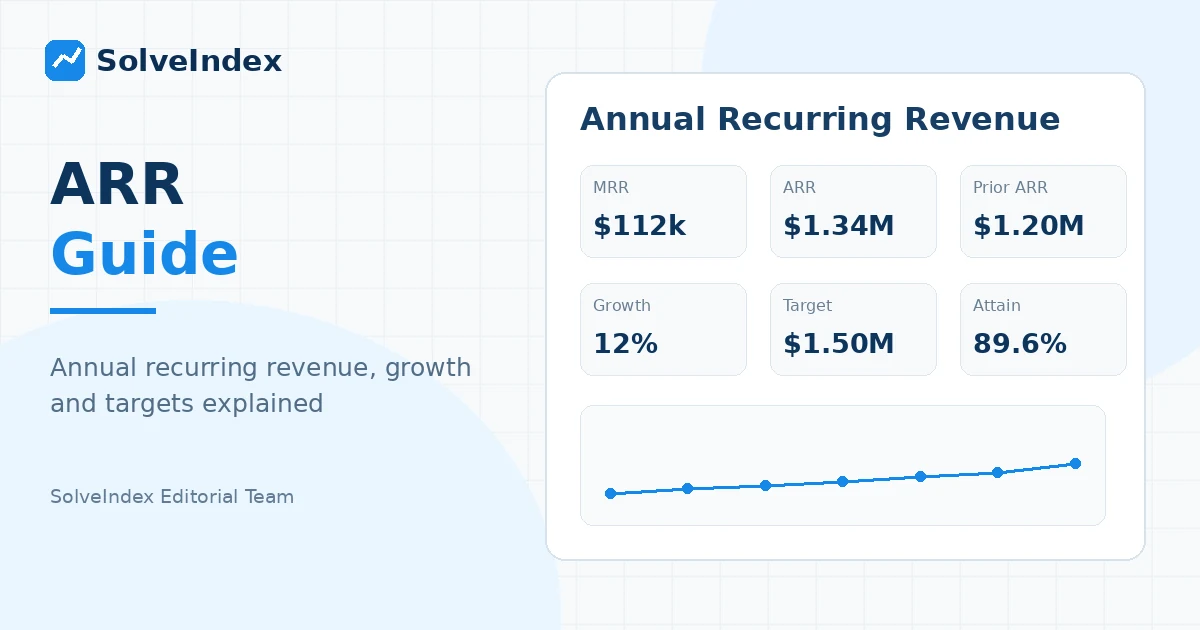
Start with current normalized MRR from active paid subscriptions. Suppose a SaaS company has $112,000 of MRR. Multiplying by 12 gives $1,344,000 of ARR.
If the previous comparable ARR was $1,200,000, ARR increased by $144,000. Dividing that increase by $1,200,000 gives 12% ARR growth. If the target is $1,500,000 ARR, divide by 12 to get a required MRR run rate of $125,000.
The remaining ARR gap is $156,000, equivalent to $13,000 of additional net MRR. That does not mean the company only needs $13,000 of new sales. Churn and contraction can reduce MRR while expansion and reactivation can increase it.
Worked ARR Calculation Example
| Metric | Example | How it is used |
|---|---|---|
| Current normalized MRR | $112,000 | Recurring monthly base |
| Current ARR | $1,344,000 | $112,000 x 12 |
| Previous ARR | $1,200,000 | Comparable growth baseline |
| ARR change | $144,000 | Current ARR - previous ARR |
| ARR growth | 12.0% | $144,000 / $1,200,000 |
| Target ARR | $1,500,000 | Planning goal |
| Target MRR | $125,000 | $1,500,000 / 12 |
This example shows the arithmetic, not a forecast guarantee. The business still needs to model new business, expansion, churn, pricing, foreign exchange and billing changes to understand how it might reach the target.
Normalize Monthly, Quarterly and Annual Contracts
Mixed billing cadences should be converted to comparable recurring amounts before ARR is calculated. A $1,200 annual recurring subscription equals $100 MRR and $1,200 ARR. A $300 quarterly recurring subscription also equals $100 MRR and $1,200 ARR.
Do not enter the full annual invoice as one month of MRR and then multiply it by 12. If the billing platform already normalizes annual subscriptions into MRR, use that normalized MRR once.
What Belongs in ARR
ARR should represent recurring subscription value under a documented operating definition. Typical components include active recurring plans, recurring seat charges and recurring contracted usage when the reporting system treats that usage as recurring.
Include expansion and contraction through the MRR system so current ARR reflects the active run rate. The number should change when recurring plan value changes, not merely because invoice timing changed.
What Does Not Belong in ARR
Exclude one-time implementation fees, consulting, hardware, nonrecurring usage, taxes and other items that are not expected to recur under the subscription definition. ARR should not become a container for every dollar associated with a customer.
Booked but not yet active contracts may be useful for pipeline or committed-revenue planning, but they should not be silently mixed into active ARR unless the company explicitly uses a committed ARR metric.
ARR vs MRR
MRR and ARR describe the same recurring base at different time scales when ARR is defined as MRR x 12. MRR is more useful for analyzing monthly movements such as new business, expansion, contraction and churn. ARR makes the recurring scale easier to communicate annually.
A business with $100,000 MRR has $1.2 million ARR under this convention. If MRR rises to $110,000, ARR becomes $1.32 million. Nothing extra is added to ARR - it is simply the annualized view of the current recurring base.
ARR vs Revenue
ARR is not the same as annual accounting revenue. Revenue recognition follows accounting rules and may include one-time items, timing adjustments and amounts recognized from contracts that do not match the ARR operating definition.
Stripe explicitly notes that MRR is not GAAP revenue. Since ARR is commonly calculated from MRR, the same reporting boundary matters. Use ARR for recurring-scale analysis and financial statements for recognized revenue and profitability.
ARR vs Cash Collected
Cash collection follows billing terms. An annual prepayment can bring twelve months of cash in at once while ARR remains an annualized recurring value. Monthly billing spreads cash over time without changing the underlying recurring economics by the same proportion.
Use cash flow for liquidity planning and ARR for recurring run-rate planning. Mixing the two can make a strong prepayment month look like recurring growth when no subscription value changed.
ARR vs Bookings
Bookings generally measure signed contract commitments. A three-year contract can create a large booking today even though ARR reflects only the annual recurring value under the company's metric definition.
Bookings are useful for sales pipeline and contracted business. ARR is useful for recurring run-rate scale. They should not be compared as interchangeable revenue numbers.
ARR vs ACV and TCV
Annual Contract Value, or ACV, usually describes the annualized value of a contract. Total Contract Value, or TCV, represents the total contract commitment across its full term. Definitions vary, and either metric can include nonrecurring components depending on the company.
ARR is usually a portfolio-level recurring metric, while ACV and TCV are often contract-level sales metrics. Reconcile one-time fees and contract start dates before using them together.
ARR vs CARR - Committed or Contracted ARR
CARR is commonly used to mean committed ARR or contracted ARR. Stripe describes committed ARR as active recurring revenue plus signed future recurring commitments, adjusted for known future losses. Other reporting systems can apply different implementation details, so the company definition still needs to be documented.
The Semrush data for this guide shows meaningful low-difficulty interest in ARR vs CARR terminology. Treat CARR as a separate planning layer rather than quietly adding future contracts into active ARR. Document whether your CARR includes signed-not-started contracts, scheduled churn or other future changes.
ARR Growth Rate
ARR growth rate compares current ARR with a previous comparable ARR. If ARR rises from $1.2 million to $1.344 million, the $144,000 increase equals 12% growth.
The comparison period must be explicit. Month-over-month annualized run-rate change is not the same as year-over-year ARR growth. A dashboard should label whether it compares last month, last quarter or the same date one year earlier.
What Is a Good ARR Growth Rate?
There is no single healthy ARR growth rate for every SaaS company. Growth typically changes with company size, age, ARPA, funding model, product category and market conditions. ChartMogul publishes peer benchmarks across ARR ranges rather than one universal target.
Compare your growth with companies at a similar recurring-revenue scale and business model. Also inspect the quality of growth. ARR can rise through expensive acquisition while retention weakens, or it can compound through expansion and strong NRR.
New Business, Expansion, Churn and ARR Growth
ARR is an output of recurring-revenue movement. New customers add MRR, existing customers can expand, contractions reduce recurring value and churn removes recurring value completely. Annualizing the resulting MRR produces current ARR.
Use the MRR Calculator when you need to explain which movements created the change. ARR tells you the scale. MRR movement tells you why the scale changed.
Translate Target ARR into Required MRR
Divide target ARR by 12 to convert an annual goal into the monthly recurring run rate required. A $1.5 million ARR target corresponds to $125,000 MRR.
The net MRR gap is not automatically a new-business quota. If the company expects churn, it may need more gross new MRR to offset losses. Expansion and reactivation can reduce the amount that must come from new logos.
ARR, MRR, NRR and Churn
These metrics answer different questions. ARR measures annualized recurring scale. MRR shows the monthly recurring base and its movements. NRR measures how the existing customer cohort changes after churn, contraction and expansion. Customer churn measures lost accounts.
A company can grow ARR even with weak NRR if new customer acquisition is strong. That growth may be harder to sustain because the business keeps replacing lost recurring revenue. Review ARR growth with NRR, gross revenue retention and customer churn before judging growth quality.
Segment ARR by Product and Customer Type
Company-wide ARR can hide meaningful differences between enterprise, mid-market, SMB, self-serve, geography or product lines. Segment recurring revenue when the pricing and retention economics differ.
Use the same ARR methodology inside each segment. Otherwise differences in billing rules can look like differences in business performance.
Usage-Based and Hybrid SaaS ARR
Usage-based pricing makes ARR more definition-sensitive because monthly usage can vary. Some teams use committed recurring minimums, some normalize recent recurring usage, and some exclude highly variable usage from core MRR.
Hybrid businesses should separate committed subscription value from variable usage where useful. The chosen treatment should be documented and applied consistently rather than changed to produce a smoother ARR trend.
FX, Discounts and Subscription Status Rules
Multi-currency businesses need a documented foreign-exchange policy. Changing exchange rates can move reported ARR even when the underlying customer contracts did not change.
Discounts, pauses, delinquency, scheduled cancellations and free plans also need consistent treatment. Stripe and other billing platforms apply specific status rules to MRR calculations, so dashboard ARR may differ from a manually maintained spreadsheet if the rules do not match.
Use ARR in Forecasting Carefully
ARR is a useful starting run rate, not a full forecast. A forecast should separately model new business, expansion, contraction, churn, pricing, usage and contract starts. Multiplying current MRR by 12 assumes the current run rate for scale reporting, not that the customer base will remain unchanged.
For scenario planning, create a base case and alternative cases for retention and acquisition. This makes the gap between current ARR and target ARR operational rather than purely arithmetic.
ARR for Board and Investor Reporting
ARR is widely used for SaaS scale, board reporting and growth discussions because it makes recurring revenue easy to compare at annual scale. The number becomes more credible when the reporting package includes the definition, comparison period and supporting MRR or retention movements.
Avoid switching between annual recurring revenue, annualized run rate and CARR without labels. If the company reports multiple versions, give each one a distinct name and reconciliation.
Common ARR Calculation Mistakes
Common mistakes include multiplying total monthly cash receipts by 12, including one-time implementation fees, double counting annual contracts already normalized into MRR, mixing signed bookings with active subscriptions and comparing ARR values built from different status rules.
Another common error is treating ARR growth as a complete measure of business health. Growth can be acquisition-heavy while churn remains high. Pair ARR with NRR, customer churn, gross margin and unit economics.
ARR Review Checklist
Confirm that MRR is normalized, recurring and measured in one currency. Confirm that previous ARR uses the same methodology. Separate active ARR from CARR or bookings. Reconcile annual and quarterly contracts only once.
Report ARR change in dollars and percentages, label the comparison period, and use MRR movement and NRR to explain the drivers. Save the metric definition so finance, billing and growth dashboards stay aligned.
Annual Recurring Revenue Frequently Asked Questions
Sources and Methodology
SolveIndex cross-checks SaaS metric definitions against current primary or specialist documentation. This guide uses Stripe MRR and ARR guidance, Stripe annual recurring revenue guidance, ChartMogul ARR methodology, ChartMogul Annual Run Rate documentation, Stripe committed ARR guidance, and ChartMogul SaaS benchmark research. Definitions can differ between billing systems, so reconcile the methodology used in your source of truth before publishing or comparing ARR.