SaaS valuation often starts with a recurring-revenue multiple, but the multiple is an assumption that needs evidence. This guide explains how ARR-based valuation works, how enterprise value bridges to equity value, what can move the multiple, and where a simple revenue-multiple model stops being sufficient.
What SaaS Valuation Means
A SaaS valuation estimates what a subscription software business may be worth under a defined set of assumptions. In this SolveIndex model, the starting point is annual recurring revenue (ARR). A user selects an ARR multiple to estimate enterprise value, then adds cash and subtracts interest-bearing debt to reach a simplified equity-value estimate. The model is useful for scenario planning because each assumption is visible and easy to change.
The result is not a fairness opinion, appraisal, financing quote or transaction price. A real valuation can depend on growth, retention, revenue quality, margins, customer concentration, company size, product risk, market conditions, buyer synergies and deal structure. Treat the calculator as a transparent first-pass model that helps you understand how an assumed multiple flows through to enterprise and equity value.
Scope of the SolveIndex ARR-Multiple Model
The calculator answers a narrow question: if a SaaS company has a given ARR and the business is valued at a selected ARR multiple, what enterprise value does that imply, and what simplified equity value results after a cash-and-debt bridge? It does not independently determine the correct multiple. That distinction matters because the multiple is the most judgment-sensitive input in the model.
SaaS Valuation Formula
The core calculation is straightforward: enterprise value equals ARR multiplied by the selected ARR multiple. The calculator then converts enterprise value to a simplified equity estimate by adding cash and subtracting interest-bearing debt. ARR yield is shown as ARR divided by enterprise value, which is mathematically the reciprocal of the selected multiple when enterprise value is calculated only from ARR × multiple.
That arithmetic is transparent, but the interpretation requires care. Multiples are shorthand for many expectations about the future. Two SaaS companies with identical ARR can deserve very different valuation multiples if one has stronger growth, better retention, cleaner recurring revenue, higher margins or less customer concentration.
Define ARR Before You Value the Company
ARR should represent recurring revenue expected over a normalized 12-month period. Stripe describes ARR as recurring revenue components generated over one year and distinguishes recurring subscription or contract revenue from one-time revenue. For valuation work, write down the internal ARR policy before choosing a multiple so that the numerator in your operating reports and the revenue base implied by the valuation are consistent.
Be especially careful with implementation fees, professional services, hardware, pass-through revenue, usage charges without committed minimums, and other nonrecurring items. They may be economically valuable, but they should not automatically be inserted into ARR simply because they appear on an invoice or income statement.
ARR vs Total Revenue
ARR and total revenue answer different questions. ARR is a run-rate view of repeatable subscription or contract revenue. Total revenue reported under accounting rules can include nonrecurring services, implementation work, usage spikes or other items that may not repeat. An ARR multiple therefore should not be treated as interchangeable with a total-revenue multiple.
What Enterprise Value Represents
Enterprise value is the modeled value of the operating business before the simplified cash-and-debt bridge used here. In the calculator, enterprise value is the direct output of ARR × selected ARR multiple. This makes it useful for comparing operating businesses with different amounts of cash or debt because those financing balances are introduced only after the operating value is estimated.
In professional valuation work, the enterprise-value concept can require additional adjustments depending on the transaction and accounting facts. Lease liabilities, preferred instruments, non-operating investments, minority interests, debt-like obligations or excess assets may matter. The SolveIndex calculator deliberately limits the bridge to cash and interest-bearing debt so the model remains transparent.
What Equity Value Represents
Equity value is the residual value attributed to shareholders after moving from enterprise value through the selected balance-sheet adjustments. The simplified formula used here is enterprise value plus cash minus debt. With positive net cash, modeled equity value is higher than enterprise value; with net debt, modeled equity value is lower.
Do not read the output as proceeds available to common shareholders without further diligence. Actual proceeds can be affected by transaction expenses, working-capital adjustments, option pools, preferred liquidation rights, earn-outs, taxes and other deal-specific items that are outside this calculator.
Cash, Debt and the EV-to-Equity Bridge
Cash and debt should be measured consistently with the purpose of the valuation. The calculator labels cash as cash and cash equivalents and debt as interest-bearing debt. That is intentionally simple. In a transaction, advisers may classify some balances differently, and a buyer may distinguish operating cash from excess cash or treat certain liabilities as debt-like items.
What an ARR Multiple Means
An ARR multiple expresses enterprise value relative to annualized recurring revenue. If a company with $1.2 million of ARR is modeled at 6.0x ARR, the implied enterprise value is $7.2 million. The same company modeled at 4.0x would imply $4.8 million, while 8.0x would imply $9.6 million.
The multiple is not a performance score by itself. It is a valuation convention that compresses market conditions and company-specific expectations into one assumption. A higher multiple can reflect stronger expected growth or revenue durability, but it can also reflect a more favorable market environment at the valuation date.
Valuation vs Revenue-Multiple Calculation
This page solves the valuation direction of the equation: start with ARR and an assumed multiple, then estimate enterprise value. The separate SaaS Revenue Multiple Calculator solves the reverse problem: start with enterprise value and ARR, then calculate the implied EV/ARR multiple. Keeping these intents separate prevents the two tools from competing for the same search and user task.
The Selected Multiple Is an Assumption
The default 6.0x multiple is an illustrative scenario input, not a universal benchmark and not a statement that a particular SaaS company should trade or transact at 6.0x. Users should replace it with a multiple supported by current market evidence and company-specific analysis.
SaaS Capital’s 2026 valuation methodology explicitly says there is no one-size-fits-all multiple. Its framework uses the current SaaS Capital Index, company ARR growth and net revenue retention as primary inputs. That is a useful reminder that the multiple should come from evidence rather than being treated as a constant.
What Drives SaaS Valuation Multiples
Valuation multiples respond to both market-level and company-level factors. Market risk appetite can re-rate the whole SaaS sector even if an individual company changes very little. At the company level, investors and buyers commonly examine growth, retention, recurring-revenue quality, profitability potential, gross margin, customer concentration, product differentiation and operating scale.
ARR Growth and Valuation
Growth matters because a revenue multiple is a price paid today for a stream of future economic potential. Faster recurring-revenue growth can support a higher multiple when the growth is credible and durable. SaaS Capital’s 2026 private-company research reports meaningful variation in growth across private B2B SaaS businesses, which reinforces the need to compare a company with peers of similar scale and funding profile rather than using one market-wide growth number.
NRR, Retention and Revenue Durability
Net revenue retention (NRR) summarizes how recurring revenue from an existing customer base changes after churn, contraction and expansion. Stronger retention can make future ARR more durable and can support growth because the company loses less revenue that must be replaced. SaaS Capital’s 2026 valuation framework includes NRR as one of its primary company-specific inputs.
A valuation review should also inspect gross revenue retention and customer or logo churn. Expansion can lift NRR even while many customers leave, so revenue-weighted and customer-count retention provide different views of risk. The valuation calculator does not generate these metrics; use the related SolveIndex retention calculators before deciding which multiple is reasonable.
Revenue Quality Beyond ARR Size
Two businesses can report the same ARR while having very different revenue quality. Contract length, renewal history, customer concentration, implementation dependence, usage variability, discounting and the proportion of truly recurring software revenue can all affect how durable the reported ARR appears.
Document whether the ARR base consists of active subscriptions, contracted commitments or another internal definition. If a company has large professional-services revenue or one-time project income, keep those amounts separate from the recurring base unless the comparable valuation evidence explicitly uses a broader revenue definition.
Gross Margin and Profitability Potential
Gross margin shows how much revenue remains after the direct costs required to deliver the service. A higher-quality recurring-revenue stream generally has more economic value when it can produce attractive gross profit and fund product development, sales, marketing and administration. Gross margin therefore provides context for the multiple even though it is not an input to this calculator.
Profitability also matters differently across stages. A high-growth company may intentionally invest ahead of current profit, while a mature company may be judged more heavily on operating margin and cash generation. Pair the valuation scenario with gross-margin, Rule of 40 and burn-efficiency analysis rather than relying on ARR alone.
Company Size and Comparability
A valuation multiple observed for a large public SaaS company is not automatically appropriate for a smaller private company. Scale can affect liquidity, customer diversification, access to capital, product breadth and operating resilience. Public-market comparables can still provide useful context, but they usually need interpretation before being applied to a private business.
Customer Concentration and Contract Risk
A company whose ARR depends heavily on one or two accounts can have greater revenue risk than a company with the same ARR spread across many independent customers. A large renewal, renegotiation or loss can materially change the revenue base used in the valuation. Review concentration by customer, industry and channel before treating ARR as equally durable.
Market Conditions Change the Multiple
SaaS valuation multiples are not fixed through time. Interest rates, public-market risk appetite, expected growth, financing conditions and changes in technology can move sector pricing. SaaS Capital’s public index is updated regularly for this reason, and its 2026 materials emphasize that current market conditions are part of the valuation process.
When saving a SolveIndex scenario, record the date and the source of the multiple you used. A valuation built from market evidence six or twelve months ago may no longer represent current pricing even if the company’s ARR is unchanged.
Public vs Private SaaS Valuation Context
Public-company multiples are observable and timely, which makes them useful starting points, but a private company can differ in scale, liquidity, disclosure quality, customer mix and access to capital. Applying a public multiple directly to a private business without adjustments can therefore overstate or understate value.
Worked SaaS Valuation Example
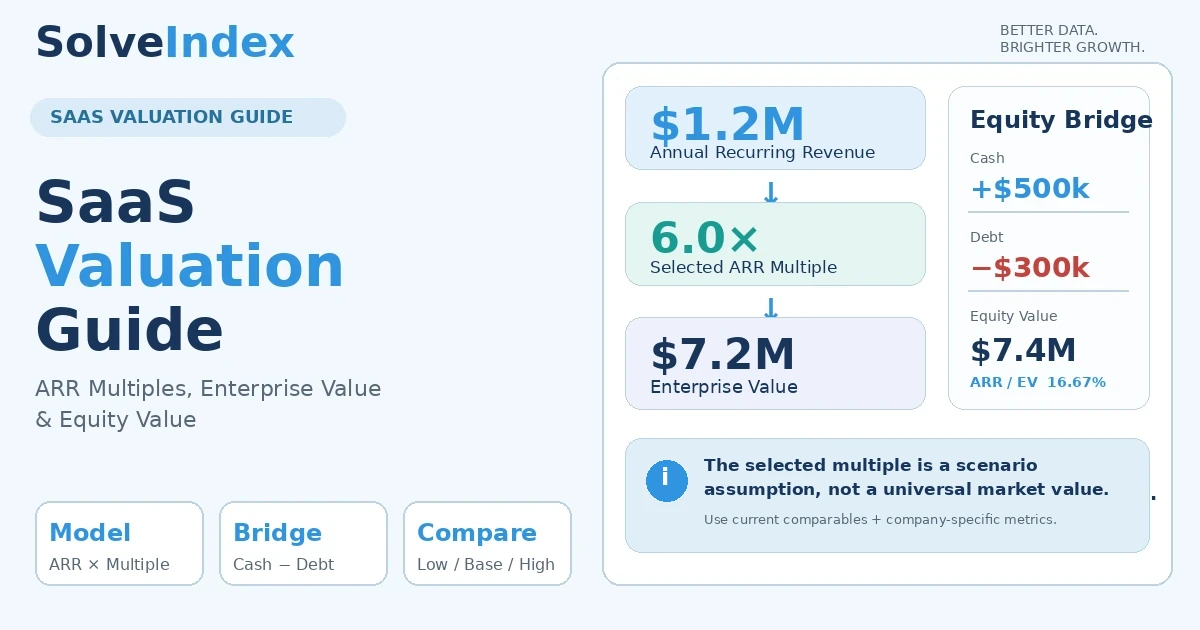
Using the calculator defaults, ARR is $1,200,000 and the selected ARR multiple is 6.00x. Enterprise value is therefore $7,200,000. Cash of $500,000 minus debt of $300,000 creates $200,000 of net cash, so the simplified equity-value estimate becomes $7,400,000.
ARR divided by enterprise value equals 16.67%. This is simply the reciprocal of a 6.00x multiple. It can help you check the arithmetic, but it should not be interpreted as an earnings yield, cash yield or expected investment return because ARR is revenue, not profit or free cash flow.
| Metric | Example value |
|---|---|
| ARR | $1,200,000 |
| Selected ARR multiple | 6.00x |
| Enterprise value | $7,200,000 |
| Cash | $500,000 |
| Debt | $300,000 |
| Net cash | $200,000 |
| Estimated equity value | $7,400,000 |
| ARR / enterprise value | 16.67% |
How to Interpret ARR as % of Enterprise Value
ARR as a percentage of enterprise value is a reciprocal view of the multiple. At 5.0x ARR, the ratio is 20%; at 10.0x, it is 10%. The metric is useful as a mathematical cross-check and as another way to compare scenarios, but the word “yield” can be misleading if it is confused with an income return.
Scenario Analysis: Change the ARR Multiple
Multiple sensitivity shows how strongly valuation depends on the assumption you choose. With ARR fixed at $1.2 million, a 4.0x multiple implies $4.8 million of enterprise value, 6.0x implies $7.2 million, and 8.0x implies $9.6 million. The difference between the low and high cases is $4.8 million even though ARR itself does not change.
This is why it is better to model a reasonable range than to present a single multiple as certainty. A low/base/high table can also make discussions with founders, boards or investors more transparent because the valuation assumption is visible rather than hidden inside the result.
| ARR multiple | Enterprise value on $1.2M ARR | Equity value with $200k net cash |
|---|---|---|
| 4.00x | $4,800,000 | $5,000,000 |
| 6.00x | $7,200,000 | $7,400,000 |
| 8.00x | $9,600,000 | $9,800,000 |
Scenario Analysis: Change Cash or Debt
Cash and debt do not change the enterprise value generated by the ARR-multiple assumption in this calculator; they change the equity-value bridge. If enterprise value is $7.2 million, adding $200,000 of net cash produces $7.4 million of equity value. If the company instead had $500,000 of net debt, the simplified equity estimate would be $6.7 million.
SaaS Valuation vs SaaS Revenue Multiple
The terms are related but the user intent is different. A valuation calculator estimates value from ARR and a chosen multiple. A revenue-multiple calculator measures the multiple implied by a known enterprise value. SolveIndex keeps them as separate tools so each page answers one primary question.
ARR-Multiple Valuation vs DCF
A discounted cash flow (DCF) valuation estimates value from projected cash flows and a discount rate rather than applying a revenue multiple. DCF can be useful when forecasts are sufficiently reliable and the business has a credible path to cash generation. It also makes assumptions about margins, reinvestment and terminal value explicit.
The ARR-multiple approach is faster and often practical for growing SaaS businesses, but it can hide those assumptions inside the multiple. Using both methods can reveal whether a selected revenue multiple implies cash-flow expectations that are difficult to support.
ARR-Multiple Valuation vs EBITDA Multiples
EBITDA-based valuation is often more relevant for mature, profitable businesses because it relates value to operating earnings rather than revenue. Many growth-stage SaaS companies prioritize recurring-revenue growth and may have deliberately low or negative current EBITDA, which can make a revenue multiple easier to use for scenario analysis.
Early-Stage SaaS and Low ARR
A very early SaaS company can have valuable product, technology or market potential while reporting little ARR. An ARR-multiple model can still calculate a number, but the result may not capture the factors investors actually use for a pre-scale company. Team quality, product evidence, market size, pipeline, intellectual property and financing conditions can dominate the decision.
If ARR is small or unstable, treat this calculator as a sensitivity exercise rather than a primary valuation method. The model becomes more informative as recurring revenue becomes a meaningful, measurable base.
Pre-Revenue SaaS Is Outside This Model
A pre-revenue company has no meaningful ARR base to multiply, so the formula is not an appropriate standalone valuation method. Setting a tiny placeholder ARR merely to force a result creates false precision. Pre-revenue valuation usually relies on financing terms, comparable early-stage transactions, option-style reasoning, milestone analysis or negotiated investor expectations.
Fundraising Valuation vs Sale Price
A fundraising valuation and an acquisition price are related to company value but are not identical concepts. Financing rounds can involve preferred securities, option pools, liquidation preferences and negotiated dilution. Acquisitions can include strategic synergies, earn-outs, working-capital adjustments and other terms that do not appear in a simple enterprise-to-equity bridge.
SaaS Valuation Multiples in 2026: Benchmark Context
There is no universal “good” SaaS valuation multiple. SaaS Capital’s 2026 methodology specifically states that the suitable multiple depends on company characteristics and broader market conditions. Its framework references the current SaaS Capital Index together with ARR growth and NRR rather than publishing one permanent multiple for all private SaaS companies.
If you use an industry benchmark, record the provider, date, company population and metric definition. Public B2B SaaS, private B2B SaaS, vertical SaaS, consumer subscription software and small bootstrapped products can have very different economics and should not be compared as though they were one market.
Common SaaS Valuation Mistakes
Common errors include mixing ARR with total revenue, applying a stale or unsupported multiple, confusing enterprise value with equity value, using cash and debt from a different date, and treating one benchmark as a rule. Another frequent mistake is using the same multiple for companies with very different growth or retention profiles.
False precision is also a risk. A model that produces $7,400,000 does not mean the business is worth exactly that amount. Present a reasonable range, show the assumptions and explain which operating metrics could move the multiple up or down.
Practical SaaS Valuation Workflow
Start by defining ARR and reconciling it to billing or subscription data. Record the valuation date, cash, debt and any important exclusions. Next, review current comparable-market evidence and company-specific metrics such as ARR growth, NRR, GRR, gross margin, concentration, profitability and capital efficiency. Choose a low/base/high multiple range rather than a single unexplained number.
Run each scenario, compare enterprise and equity values, and save the assumptions with their source date. If the valuation will support fundraising, board decisions, M&A or audited reporting, reconcile the model with finance and obtain qualified valuation, accounting, tax and legal advice.
Limitations of the ARR-Multiple Model
This model does not forecast future ARR, estimate a discount rate, calculate terminal value, model taxes, value options, allocate purchase price or assess liquidation preferences. It also does not decide whether cash is excess cash or whether a liability should be treated as debt-like. Those questions can materially affect a transaction.
Frequently Asked Questions
Sources and Methodology
SolveIndex cross-checked the arithmetic and valuation terminology against the current sources below. Valuation multiples are market-based assumptions rather than accounting standards, so benchmark claims should always be tied to a provider, date and comparable-company population.
- SaaS Capital - What's Your SaaS Company Worth? (2026 Update)
- SaaS Capital Index - current public SaaS market reference
- SaaS Capital - 2026 Private B2B SaaS Growth Rate Benchmarks
- Stripe - Annual Recurring Revenue for SaaS businesses
- CFI - Enterprise Value vs Equity Value
Reviewed September 25, 2026. The calculator does not connect to a valuation database or automatically select a market multiple. It calculates from the ARR, multiple, cash and debt values entered by the user.
Use the SaaS Valuation Calculator
Enter ARR, a selected scenario multiple, cash and debt to estimate enterprise value and a simplified equity-value bridge.
Open the SaaS Valuation Calculator