Burn Multiple measures how much net cash a SaaS company burns to create each dollar of Net New ARR. This guide explains the formula, Net Burn and Net New ARR definitions, current benchmark ranges, company-stage limits, worked examples and the differences between Burn Multiple, burn rate and Rule of 40.
What Burn Multiple Measures
Burn Multiple is a SaaS capital-efficiency metric that asks a simple question: how much net cash did the company burn to create one dollar of Net New ARR? It connects growth with the capital required to fund that growth. A 1.5x result means the company consumed $1.50 of net cash for every $1.00 of additional ARR created over the same period.
The metric is most useful when the business is intentionally burning cash and still adding ARR. It does not replace growth, retention, gross margin, CAC payback, runway or profitability analysis. Treat it as a diagnostic of growth efficiency rather than a complete score for company quality.
Burn Multiple Formula
The standard formula is Burn Multiple = Net Burn / Net New ARR. SolveIndex uses Net Cash Burn as the numerator and derives Net New ARR as Ending ARR minus Beginning ARR. Both values must cover the same measurement period. If ARR increased from $5.0 million to $6.5 million, Net New ARR is $1.5 million.
The denominator must be positive for the traditional interpretation. When Net New ARR is zero or negative, dividing burn by that number does not produce a useful growth-efficiency multiple. The calculator therefore reports the multiple only when ARR increased.
Why Net Burn Is the Numerator
Net Burn captures the capital consumed after considering cash coming into the business. That makes the ratio different from simply dividing operating expenses by growth. The original Burn Multiple framework from Craft Ventures uses Net Burn because the purpose is to evaluate how much incremental capital was consumed to create recurring-revenue growth.
Using a net figure matters because two companies with the same expense base can have very different cash consumption. Keep the numerator policy stable across periods so an improving multiple reflects genuine efficiency rather than a changed accounting or cash-flow definition.
What Counts as Net Burn
For this calculator, Net Cash Burn means non-negative cash consumed during the period after cash inflows. Use the same internal cash-burn measure used for runway planning where possible. Do not substitute capital raised, gross operating expenses or total cash outflows unless your reporting policy explicitly defines them as the burn metric.
Some benchmark studies use operating loss as a proxy when cash-burn data are inconsistent. That can be useful for standardized datasets, but an operating-loss-based multiple is not automatically comparable with a cash-burn-based multiple. State the convention beside the result.
Net Burn vs Burn Rate
Burn rate answers how much cash a company consumes per month, quarter or year. Burn Multiple answers how much cash was consumed per dollar of Net New ARR. A company can have a high monthly burn rate and still show an efficient Burn Multiple if ARR is growing very quickly; the reverse can also happen.
This distinction matters because broad search results often mix “burn multiple” with “burn rate.” Use burn rate and runway for liquidity planning. Use Burn Multiple when the decision is whether the cost of recurring-revenue growth is efficient.
Net New ARR
Net New ARR is the recurring-revenue growth created during the period. In the simple bridge used here, Net New ARR equals Ending ARR minus Beginning ARR. At a more detailed operating level, that change is driven by new business and expansion, offset by churn and contraction, with reactivation treatment depending on the reporting system.
Burn Multiple needs the net result because the cash invested supports the whole business, not only newly acquired customers. Using gross new-business ARR while ignoring churn would overstate the denominator and make the company look artificially efficient.
Net New ARR vs New ARR
New ARR usually means recurring revenue from newly acquired customers. Net New ARR measures the total change in ARR after all recurring-revenue gains and losses. Those terms are not interchangeable. A company might add $3 million of new ARR but lose $1 million through churn and contraction, leaving only $2 million of Net New ARR.
For Burn Multiple, use the net change. If you want to analyze acquisition productivity specifically, use CAC, CAC payback or the SaaS Magic Number instead of replacing the Burn Multiple denominator with gross new sales.
Align the Measurement Period
Net Burn and Net New ARR must cover the same period. A quarterly cash-burn number divided by annual ARR growth is not meaningful. Choose monthly, quarterly, annual or trailing-twelve-month measurement and apply that window to Beginning ARR, Ending ARR and Net Burn.
Quarterly measurement reacts faster to hiring or go-to-market changes but can be noisy. Annual or trailing-twelve-month measurement smooths timing effects but responds more slowly. The best cadence depends on the operating review, not on changing the formula.
Worked Burn Multiple Example
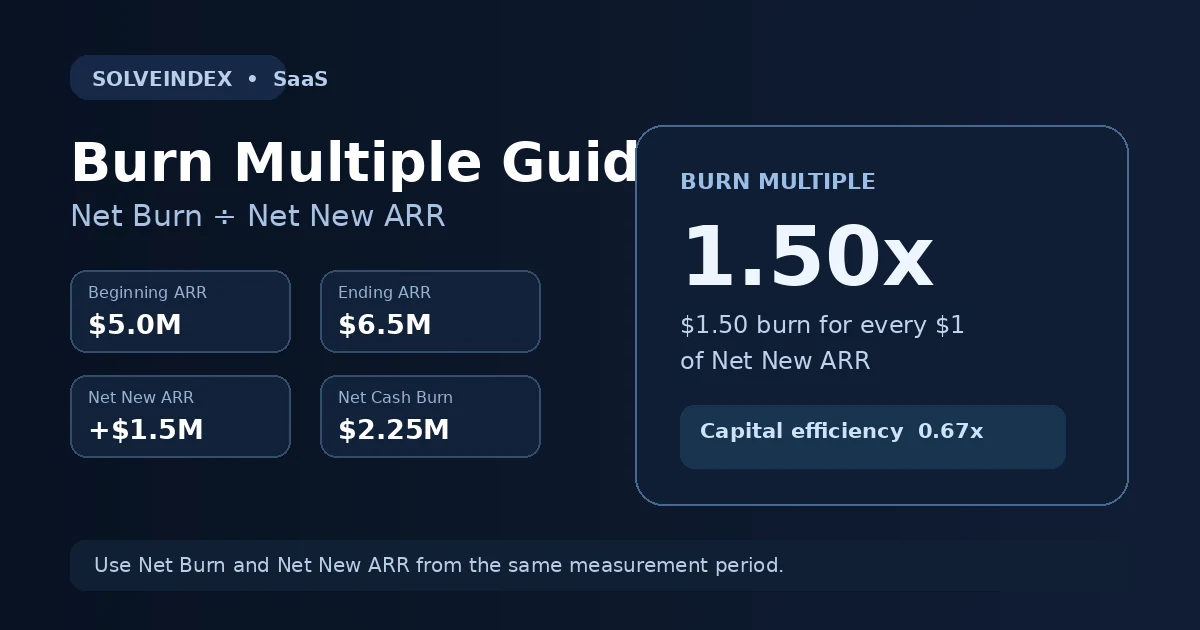
Using the calculator defaults, Beginning ARR is $5,000,000 and Ending ARR is $6,500,000, so Net New ARR is $1,500,000. Net Cash Burn is $2,250,000. Dividing $2,250,000 by $1,500,000 gives a Burn Multiple of 1.50x.
The inverse capital-efficiency ratio is $1,500,000 divided by $2,250,000, or about 0.67x. ARR growth is 30%. These outputs describe different dimensions: Burn Multiple is cash consumed per growth dollar, while ARR growth shows how quickly the recurring-revenue base expanded.
| Metric | Example value |
|---|---|
| Beginning ARR | $5,000,000 |
| Ending ARR | $6,500,000 |
| Net New ARR | $1,500,000 |
| Net Cash Burn | $2,250,000 |
| Burn Multiple | 1.50x |
| Capital Efficiency | 0.67x |
| ARR Growth | 30.00% |
Capital Efficiency Inverse
The inverse ratio, Net New ARR / Net Cash Burn, expresses how much ARR growth was created per dollar of burn. A 1.50x Burn Multiple corresponds to roughly 0.67x on this inverse basis. Mathematically they contain the same information, so choose one as the primary reporting convention and avoid presenting them as separate performance wins.
What Is a Good Burn Multiple?
Lower positive values are generally better because less cash is consumed for each dollar of ARR growth. Current ChartMogul guidance updated in September 2026 describes under 1x as exceptional, roughly 1x to 2x as good to great, 2x to 3x as an area to investigate, and above 3x as a warning sign.
These are directional bands, not universal grades. Compare against similar-stage peers and the company’s own trend.
Benchmarks Change by Company Stage
Early-stage SaaS companies usually have higher Burn Multiples because fixed engineering and go-to-market costs are large relative to a small ARR base. As the company scales, Net New ARR can grow faster than the fixed-cost base and the multiple should generally improve.
This stage effect is one reason a direct comparison between a pre-scale startup and a $50 million ARR company can be misleading. Track the company against its own prior periods and against peers with similar scale and growth profile.
Burn Multiple by ARR Scale
Scale Venture Partners’ historical SaaS dataset illustrates the size effect: companies in the $0-$1 million ARR band averaged materially higher Burn Multiples than companies in the $25-$50 million ARR band. Their analysis used operating income as a burn proxy for comparability, which is another reason to avoid copying a benchmark without checking methodology.
The practical lesson is not a single target by ARR bucket; it is that maturity changes what efficient burn looks like. State both company scale and burn convention when benchmarking.
Early-Stage Interpretation
An early-stage company may accept a higher Burn Multiple while funding product development, establishing distribution or building the first repeatable sales motion. A temporarily high number is less concerning when the business is deliberately investing into strong retention and accelerating growth than when burn rises while Net New ARR stalls.
At very low or pre-revenue ARR, the denominator can be tiny or zero, making the metric unstable. Product-market-fit evidence, runway and milestone progress may be more useful than forcing a benchmark.
Growth-Stage Interpretation
At growth stage, Burn Multiple becomes more useful because the ARR base is large enough to evaluate whether additional operating spend is translating into recurring-revenue growth. Management should expect the ratio to improve over time unless a clearly documented investment cycle explains the change.
Persistent deterioration can signal weak sales productivity, higher churn, lower gross margin, excessive hiring or spending that is not producing enough Net New ARR. Use the ratio as a prompt to inspect the underlying drivers.
Profitable or Cash-Generating Companies
When a SaaS company generates cash instead of burning it, the traditional Burn Multiple framing loses usefulness. Mathematically a negative burn numerator could create a negative multiple, but that value no longer answers the original question of how much cash is being consumed to fund growth.
SolveIndex therefore keeps Net Cash Burn non-negative in the calculator. For profitable businesses, emphasize free cash flow margin, Rule of 40, growth, NRR and return on invested capital rather than interpreting a negative Burn Multiple as “better than zero.”
Zero Net Cash Burn
If Net Cash Burn is zero and Net New ARR is positive, the Burn Multiple is 0.00x: the business added ARR without consuming net cash over the period. The inverse efficiency ratio is undefined because it would divide by zero.
A zero-burn period can be genuinely strong, but verify that it is not created by working-capital timing, financing flows or a one-time cash event. Keep the burn definition focused on operating cash consumption.
Zero or Negative Net New ARR
If Ending ARR equals Beginning ARR, Net New ARR is zero and the Burn Multiple denominator is zero. If Ending ARR is lower, Net New ARR is negative. In both cases the standard Burn Multiple is not decision-useful, even though the company may still be burning substantial cash.
Do not convert those cases into a misleading positive ratio. Focus on the ARR decline, churn, contraction, pipeline and runway. The calculator intentionally returns N/A for the multiple when Net New ARR is not positive.
Burn Multiple vs Burn Rate
Burn rate measures cash consumption itself, often monthly. Burn Multiple measures cash consumption relative to Net New ARR. If two companies both burn $500,000 per month but one adds twice as much ARR, their burn rates are identical while their Burn Multiples are very different.
For treasury and runway decisions, burn rate is primary. For capital-efficiency analysis, Burn Multiple is usually more informative because it links the cash outflow to the recurring-revenue result.
Burn Multiple vs Rule of 40
Rule of 40 adds a growth rate to a profitability or free-cash-flow margin. Burn Multiple divides Net Burn by Net New ARR. Rule of 40 rewards growth directly; Burn Multiple asks what that growth cost in cash. A company can clear Rule of 40 through fast growth while still spending inefficiently to achieve it.
Use Rule of 40 for the growth-profitability balance and Burn Multiple for pure capital efficiency. The metrics are complementary rather than substitutes.
Burn Multiple vs SaaS Magic Number
The SaaS Magic Number focuses on sales-and-marketing efficiency by comparing revenue growth with prior-period sales and marketing spend. Burn Multiple uses total Net Burn, so it captures inefficiency anywhere in the cost base, including R&D, G&A, infrastructure and low gross margin.
If Magic Number looks strong but Burn Multiple is poor, spending outside sales and marketing may be the issue. If both are weak, inspect go-to-market efficiency and retention together.
Burn Multiple vs CAC Payback
CAC payback asks how long contribution margin from a new customer takes to recover acquisition cost. Burn Multiple asks how much total cash the company burns for each dollar of Net New ARR. CAC payback is customer-acquisition focused; Burn Multiple is company-wide.
Use both when diagnosing growth efficiency. Strong CAC payback does not guarantee a strong Burn Multiple if overhead, R&D, gross-margin pressure or churn consume too much cash.
Burn Multiple and Gross Margin
Gross margin affects Burn Multiple indirectly. A lower gross margin means more recurring revenue is absorbed by hosting, support and other direct delivery costs, increasing the cash required to fund the same level of growth. Improving gross margin can therefore improve capital efficiency even if top-line growth is unchanged.
Keep gross margin separate from the Burn Multiple formula; use it as a driver analysis metric rather than inserting it directly into the numerator or denominator.
Burn Multiple, NRR and Churn
Retention quality strongly affects Net New ARR. Higher NRR and lower churn allow more of new-business growth to remain in the ending ARR base, improving the denominator without requiring equivalent acquisition spend. Poor retention can make a large sales budget look productive on gross bookings while Net New ARR remains weak.
When Burn Multiple deteriorates, inspect NRR, GRR and revenue churn before assuming the problem is only spending. Fixing retention can improve both growth quality and capital efficiency.
Burn Multiple and Valuation Context
Burn Multiple can influence investor views of growth quality because it reveals the capital cost behind ARR expansion, but it is not a valuation formula. Valuation also depends on growth durability, retention, gross margin, market opportunity, profitability, scale and current market multiples.
Use the metric as operating evidence supporting a valuation discussion. Direct EV/ARR or enterprise-value analysis belongs in a dedicated SaaS valuation or revenue-multiple model.
Quarterly vs Annual Burn Multiple
Quarterly Burn Multiple is responsive and useful for board operating reviews, but it can be distorted by hiring waves, annual bonus payments, collections timing or one large enterprise contract. Annual calculation smooths those effects but can hide a recent deterioration or improvement.
For active management, many teams track quarterly and trailing-twelve-month views together. Whatever cadence you choose, keep numerator and denominator on the same time window.
Trailing-Twelve-Month Burn Multiple
A trailing-twelve-month calculation rolls the latest four quarters into one measurement window. This reduces seasonality and timing noise while updating each quarter. It is especially useful when cash flows and enterprise sales are lumpy.
Do not average four quarterly Burn Multiples; ratios should be recomputed from aggregate Net Burn divided by aggregate Net New ARR for the full trailing period. Averaging ratios can produce a different and less meaningful result.
One-Time Investment Spikes
A product launch, geographic expansion, data-center migration or major hiring wave can temporarily worsen Burn Multiple before the associated ARR arrives. Label those periods rather than hiding them. The key question is whether the investment has a credible path to future recurring-revenue growth.
If the multiple stays high after the expected payoff window, the spending may not be producing enough incremental ARR. Track the ratio over several periods and connect it to the operating initiative.
How to Improve Burn Multiple
There are only two mathematical paths: reduce Net Burn, increase Net New ARR, or improve both. Operationally, that can mean better retention, stronger expansion, higher sales productivity, better pricing, improved gross margin, disciplined hiring, lower infrastructure cost or fewer low-return projects.
Avoid optimizing the ratio mechanically. Cutting every growth investment may improve burn immediately while damaging product quality, pipeline and future ARR. The goal is efficient durable growth, not the lowest possible numerator at any cost.
Improve the Net New ARR Denominator
Increase Net New ARR by improving new-business conversion, expansion revenue, retention and pricing. Because the denominator is net, reducing churn can be as important as adding more bookings. A dollar of retained ARR and a dollar of new ARR both affect the ending ARR bridge, although their economics may differ.
Use Net New MRR, NRR, pipeline conversion and expansion metrics to determine which recurring-revenue movement offers the best improvement opportunity.
Reduce Net Burn Intelligently
Net Burn can improve through better gross margin, more efficient cloud infrastructure, stronger sales productivity, disciplined hiring, lower overhead and elimination of low-return projects. Separate structural savings from temporary cuts so the board can understand whether the efficiency gain is repeatable.
Preserve investments that are demonstrably producing durable ARR. Burn Multiple is intended to connect spending with growth, not to reward underinvestment that suppresses future performance.
Do Not Improve the Ratio by Breaking Growth
A company can lower burn by stopping product development, customer success or pipeline investment, but if Net New ARR falls faster than burn, the Burn Multiple can actually worsen. Even when the ratio improves, the company may be creating less long-term value.
Evaluate the ratio alongside ARR growth, NRR, gross margin and product milestones. Efficient growth means maintaining a productive relationship between investment and recurring-revenue output.
Common Burn Multiple Mistakes
Common mistakes include using gross burn instead of Net Burn, mixing quarterly burn with annual ARR change, using New ARR instead of Net New ARR, treating negative Net New ARR as a normal denominator, comparing cash-burn and operating-loss methodologies without adjustment, and reading one benchmark as universal across all stages.
Another mistake is confusing Burn Multiple with burn rate. Always show the formula, period and burn convention beside the reported number.
Burn Multiple Reporting Workflow
Choose the reporting period, lock the ARR definition, reconcile Beginning and Ending ARR, calculate Net New ARR, pull Net Cash Burn for the same period, and compute the ratio. Save the source values with the result so the number can be reproduced later.
Report Burn Multiple beside ARR growth, NRR, gross margin, runway and Rule of 40. Track the trend over time and annotate major investment cycles. That context makes the ratio useful for operating decisions rather than a standalone score.
When Burn Multiple Is Not the Right Metric
Do not rely heavily on Burn Multiple for pre-revenue businesses, periods with zero or negative Net New ARR, sustainably cash-generating companies, or situations where ARR and cash burn cannot be aligned to the same period. In those cases the ratio is mathematically unstable or no longer answers the relevant question.
Use runway, free cash flow, Rule of 40, growth, retention and unit-economics metrics directly until Burn Multiple becomes meaningful again.
Frequently Asked Questions
Sources and Methodology
Burn Multiple is a management and investor metric rather than a universal accounting standard. The formula, benchmark context and stage caveats in this guide were cross-checked against the following sources. Always confirm the burn convention and measurement period before comparing companies.
Use the Burn Multiple Calculator
Enter Beginning ARR, Ending ARR and Net Cash Burn from one aligned period to calculate Burn Multiple, Net New ARR, the inverse efficiency ratio and ARR growth.
Open the Burn Multiple Calculator