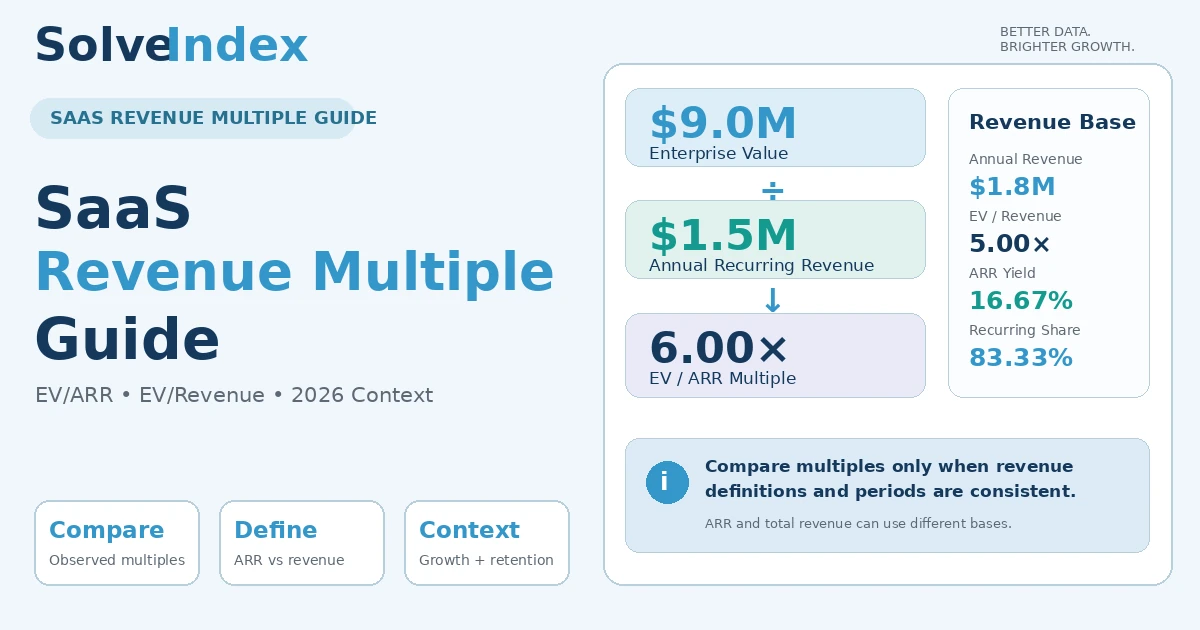
SaaS revenue multiples compare enterprise value with recurring or total revenue. This guide explains EV/ARR, EV/revenue, ARR yield, revenue-mix diagnostics, current 2026 comparison context and the operating factors that make one multiple more or less comparable with another.
What SaaS Revenue Multiples Measure
SaaS revenue multiples compare enterprise value with a revenue denominator. They are relative valuation ratios: the multiple tells you how many units of enterprise value correspond to one unit of ARR or annual revenue. The number becomes meaningful only after you know exactly which value and revenue definitions were used.
The two ratios in this SolveIndex model answer different questions. EV/ARR focuses on recurring subscription revenue, while EV/revenue uses the broader annual revenue base. Neither ratio by itself says whether a valuation is fair; it is a starting point for comparison with similar companies, periods and market conditions.
What Is an ARR Multiple?
An ARR multiple is enterprise value divided by annual recurring revenue. In SaaS analysis it is commonly used because ARR isolates revenue expected to recur from active subscription or contract relationships. CFI describes ARR multiple as EV divided by ARR and notes that the recurring-revenue denominator is intended to exclude one-time or nonrecurring sales.
Because ARR is a management metric rather than a universal accounting line item, the analyst still has to confirm how the company defines active contracts, usage-based revenue, discounts, pauses and committed but not yet live customers. Two businesses can report the same ARR label while applying different internal policies.
EV/ARR Formula
With a $9.0 million enterprise value and $1.5 million of ARR, the observed EV/ARR multiple is 6.00x. The reciprocal ARR yield is 16.67%. ARR yield is useful as another way to express the same relationship, not as a cash yield or investment return.
EV/Revenue Formula
EV/revenue replaces ARR with a broader annual revenue denominator. For the default example, $9.0 million divided by $1.8 million equals 5.00x. This ratio may be more suitable when a comparable set reports total revenue consistently or when recurring and nonrecurring revenue are both economically important.
Why Enterprise Value Is the Numerator
Enterprise value is intended to represent the value of the operating business independent of how it is financed. For public-company analysis it is commonly derived from equity value plus debt and debt-like claims minus cash and cash equivalents, subject to the analyst’s definition.
Use one enterprise-value convention across a comparison set. Mixing market capitalization for one company with enterprise value for another can distort revenue multiples because cash and debt are being treated differently.
Define ARR Before Using the Multiple
ARR measures recurring revenue annualized over a 12-month period. Stripe describes ARR as recurring revenue from subscriptions, contracts and other regular income streams. One-time setup fees, implementation work and other nonrecurring sales should not be treated as ARR simply because they were billed alongside a subscription.
The current run rate matters. A rapidly growing SaaS company can have a current ARR level that differs materially from the revenue recognized over the prior 12 months. That difference is one reason the revenue denominator must be labeled precisely.
ARR vs Total Revenue
ARR is a recurring-revenue run-rate measure; total revenue is a broader accounting or management measure that can include services, implementation, hardware, training, usage, or other nonrecurring items. For a pure subscription business they can be close. For a mixed-revenue model they can diverge.
This difference explains why EV/ARR and EV/revenue should not be used as interchangeable labels. If total revenue is larger than ARR on a comparable annualized basis, the EV/revenue multiple will normally be lower because the denominator is larger.
Keep ARR and Annual Revenue on Comparable Bases
The calculator also shows recurring-revenue share and implied nonrecurring revenue. Those secondary outputs are interpretable only when ARR and total annual revenue refer to comparable annualized periods. A point-in-time ARR run rate should not automatically be compared with a trailing 12-month revenue number as if both measured the same window.
If a high-growth business has current ARR above trailing recognized revenue, the arithmetic difference can be negative. That does not mean the company has negative nonrecurring revenue. It means the inputs are not directly comparable for that diagnostic.
Recurring Revenue Share
Using the default comparable-basis example, $1.5 million of ARR divided by $1.8 million of annual revenue equals 83.33%. This can help explain why EV/ARR and EV/revenue differ, but it is not a substitute for a revenue-recognition reconciliation.
Implied Nonrecurring Revenue: Use With Care
For the default example, the arithmetic difference is $300,000. Treat this as a planning diagnostic only. Accounting revenue categories can be more complex, and ARR can be a point-in-time run rate rather than a recognized-revenue subtotal.
ARR Yield Is the Reciprocal of EV/ARR
ARR yield expresses ARR as a percentage of enterprise value. A 6.00x EV/ARR multiple corresponds to a 16.67% ARR yield because 1 divided by 6 equals approximately 16.67%.
The term “yield” here should not be confused with free-cash-flow yield, earnings yield or an investor distribution yield. It simply restates the valuation relationship in percentage form.
Worked SaaS Revenue Multiple Example
| Input / output | Example |
|---|---|
| Enterprise value | $9,000,000 |
| ARR | $1,500,000 |
| Annual revenue | $1,800,000 |
| EV / ARR | 6.00x |
| EV / revenue | 5.00x |
| ARR yield | 16.67% |
| Recurring share | 83.33% |
The example shows why the denominator matters. The enterprise value is unchanged, but using ARR produces a 6.00x multiple while using broader annual revenue produces 5.00x. The difference is not a contradiction; the ratios measure value against different revenue bases.
Why EV/ARR Can Be Higher Than EV/Revenue
When ARR is smaller than total revenue, dividing the same enterprise value by ARR produces the larger multiple. This often occurs when professional services, implementation, hardware or other nonrecurring revenue contribute to total revenue.
The gap between the two multiples can therefore provide useful context about revenue mix, but only when the two denominators are measured consistently.
Revenue Multiple vs SaaS Valuation
This page calculates an observed multiple from a known enterprise value. The separate SaaS Valuation Calculator performs the reverse scenario: it starts with ARR and an assumed multiple, then estimates enterprise value and bridges to equity value.
That ownership boundary matters for search intent and for analysis. EV divided by ARR answers “what multiple is implied?” ARR multiplied by a selected multiple answers “what enterprise value would that assumption imply?”
The Reverse Relationship
The two equations are mathematical inverses. Keeping them on separate tools prevents an observed market multiple from being confused with an assumed valuation multiple.
SaaS Revenue Multiples in 2026: Market Context
There is no universal “good” SaaS revenue multiple. SaaS Capital’s 2026 valuation methodology emphasizes that the appropriate multiple depends on market conditions plus company characteristics such as growth and revenue quality. Its public SaaS index is updated monthly to provide a market reference.
Treat any benchmark as dated evidence from a defined population, not a permanent target. A public B2B SaaS median, a private financing, a strategic acquisition and a small founder-owned SaaS sale can all produce different valuation relationships.
Run-Rate Revenue vs Trailing Revenue
SaaS Capital states that its index uses annualized current run-rate revenue rather than trailing or projected revenue. That choice highlights a broader comparison rule: do not compare one company’s run-rate multiple with another company’s trailing-revenue multiple without understanding the difference.
For fast-growing or shrinking businesses, the denominator choice alone can move the reported multiple materially even if enterprise value does not change.
Public vs Private SaaS Multiples
Public SaaS companies offer frequent market prices and standardized financial reporting, while private-company values come from financing rounds, M&A transactions or negotiated appraisals. Liquidity, scale, reporting depth and transaction terms differ.
Public-company multiples can still be useful as a reference point, but private-company analysis usually requires adjustments for size, growth, retention, concentration, profitability, governance and marketability.
Growth Rate and Revenue Multiples
Faster recurring-revenue growth can support a higher multiple because a buyer or investor is paying for a larger expected future revenue base. But growth quality matters: discount-heavy acquisition or growth paired with weak retention may be less valuable than the headline rate suggests.
Compare growth using the same period and denominator across companies. ARR growth, GAAP revenue growth and bookings growth are not interchangeable.
Retention and NRR
Net revenue retention helps explain the durability and expansion of the installed customer base. Strong NRR can support revenue quality because existing customers are maintaining or expanding recurring spend; weak retention can make current ARR less durable.
SaaS Capital’s private-company valuation methodology specifically uses growth and NRR alongside the broader market level. That does not make NRR a direct term in the EV/ARR formula; it is a factor investors may use when deciding what multiple is appropriate.
Gross Margin and Revenue Quality
Two SaaS companies with the same ARR can produce very different gross profit if hosting, support, implementation and third-party service costs differ. Higher gross margin can make each dollar of revenue economically more attractive, while lower margin can reduce the quality of a headline revenue multiple.
Use the dedicated SaaS Gross Margin Calculator for the operating calculation rather than trying to fold gross margin into the EV/ARR formula itself.
Profitability and the Rule of 40
Growth is only one part of valuation context. Profitability, free-cash-flow generation and the trade-off between growth and margin can affect how investors compare SaaS businesses. The Rule of 40 is one framework for examining that balance.
A revenue multiple remains a revenue multiple; profitability metrics should be used as explanatory context rather than changing its numerator or denominator.
Company Scale
Larger SaaS businesses may receive different market treatment from very small companies because revenue diversification, sales efficiency, management depth, liquidity and financing options can change with scale. Comparables should therefore be reasonably similar in size as well as business model.
An ARR multiple observed for a large public company should not automatically be applied to a much smaller private SaaS company.
Customer Concentration
High customer concentration can make recurring revenue less diversified. Losing one large account can materially change ARR, growth and retention, so the same headline ARR may carry different risk depending on how it is distributed across customers.
When using transaction or public comparables, consider customer concentration alongside NRR and contract structure where reliable data is available.
Contract Length, Pricing and Revenue Quality
Longer contracts, committed minimums, prepayments and pricing structures can affect the predictability of revenue without changing the EV/ARR arithmetic. Usage-heavy or highly variable revenue can also require more judgment about what qualifies as recurring.
Document the ARR policy before comparing multiples so contract mechanics do not create artificial differences in the denominator.
Professional Services and Other Nonrecurring Revenue
Implementation, consulting, training, hardware and professional services can increase total revenue without increasing ARR. That can make EV/revenue lower than EV/ARR for the same company.
This is not automatically positive or negative. Services may support customer success or implementation, but they can have different margins and scalability from subscription software.
Market Conditions and the Valuation Date
Valuation multiples move with interest rates, risk appetite, public-market pricing, growth expectations and the supply of capital. A comparable multiple from a different market regime may be less informative even if the companies look similar operationally.
Always attach a date to benchmark evidence. The calculator deliberately asks for an enterprise value but does not claim that any particular multiple is current or appropriate.
B2B vs B2C and Business-Model Comparability
SaaS Capital’s public index focuses on pure-play B2B SaaS and excludes B2C and mixed-revenue businesses because acquisition, retention and revenue characteristics can differ. That illustrates why a broad “SaaS multiple” can hide major population differences.
Use comparables that match customer type, revenue model and go-to-market structure as closely as practical.
Sensitivity to Enterprise Value
If ARR and annual revenue stay constant, a higher enterprise value raises both EV/ARR and EV/revenue proportionally. For example, increasing EV from $9 million to $10 million would raise the default EV/ARR multiple from 6.00x to about 6.67x.
This sensitivity is useful when comparing financing or transaction scenarios, but it does not explain why the value changed.
Sensitivity to ARR
If enterprise value stays fixed while ARR grows, EV/ARR falls mechanically. A lower multiple in that case does not necessarily mean market sentiment deteriorated; the denominator simply increased faster than value.
This is one reason trend analysis should separate changes caused by enterprise value from changes caused by revenue growth.
Sensitivity to Revenue Mix
When total annual revenue grows because nonrecurring services increase while ARR is unchanged, EV/revenue can fall even though EV/ARR is unchanged. Conversely, a shift toward recurring revenue can bring the two ratios closer if total revenue stays similar.
Comparing both ratios can therefore help identify whether revenue mix is influencing the headline valuation comparison.
How to Compare Revenue Multiple Benchmarks
Before using a benchmark, record at least five items: valuation date, company population, numerator definition, denominator definition and company scale. Then add growth, retention, gross margin and profitability context where available.
A benchmark without these labels can look precise while comparing fundamentally different measurements.
Common SaaS Revenue Multiple Mistakes
- Using market capitalization for one company and enterprise value for another.
- Calling EV/ARR and EV/revenue the same metric.
- Mixing current ARR with an incomparable trailing revenue period.
- Including one-time fees in ARR without a documented policy.
- Applying public-company multiples directly to small private businesses.
- Treating a historical multiple as a current benchmark.
- Assuming a high multiple automatically means a better company.
- Using the observed-multiple calculator as if it were a valuation appraisal.
Practical Revenue Multiple Comparison Workflow
- Choose a valuation date and enterprise-value definition.
- Reconcile ARR to the current recurring-revenue policy.
- Choose a comparable annual or annualized total-revenue measure.
- Calculate EV/ARR and EV/revenue separately.
- Check recurring-share outputs only if the revenue periods are comparable.
- Label public/private status, company scale and business model.
- Add growth, NRR, gross margin and profitability context.
- Use dated comparable evidence rather than a universal target.
When a Revenue Multiple Is Not Enough
Revenue multiples are convenient because they can be used before a company is profitable, but they compress many business characteristics into one ratio. They do not explicitly model cash flows, capital needs, taxes, dilution, debt structure or the timing of future growth.
For material valuation decisions, analysts may supplement revenue multiples with transaction comparables, public comparables, discounted cash flow, profitability-based methods and detailed diligence.
Frequently Asked Questions
Sources and Methodology
SolveIndex uses transparent formulas and treats valuation multiples as contextual comparison tools rather than universal targets. The methodology and current market context in this guide were cross-checked against the sources below.
- CFI - ARR Multiple: Definition, Formula, and Examples
- SaaS Capital - SaaS Capital Index
- SaaS Capital - What’s Your SaaS Company Worth? 2026 Update
- Stripe - Annual Recurring Revenue guide
Reviewed September 25, 2026. Market multiples change over time. Re-check the date, company population and revenue definition before using an external benchmark.
Use the SaaS Revenue Multiple Calculator
Enter enterprise value, ARR and a comparable annual revenue base to calculate EV/ARR, EV/revenue, ARR yield and revenue-mix diagnostics.
Open the SaaS Revenue Multiple Calculator