A marketing budget is a resource-allocation plan, not a single benchmark percentage. Start with a business objective, separate committed marketing costs from variable acquisition capacity, connect spend with CAC and funnel economics, and reforecast as real performance replaces assumptions.
What Is a Marketing Budget?
A marketing budget is the amount an organization plans to invest in marketing during a defined period. It may include paid media, employees, agencies, marketing technology, content, creative, events, research and other costs that the business classifies as marketing. The exact contents vary, so a useful budget document should state what is included rather than presenting one unlabeled total.
Searches for marketing budget, marketing spend and marketing budget plan often sound interchangeable, but a plan should connect dollars to objectives, timing, responsibilities and measurable outcomes. The number itself is only the starting point.
What a Marketing Budget Should Answer
A practical budget should answer five questions: how much total spend is available, which costs are already committed, how much remains flexible, what outcome the flexible budget is expected to support, and what evidence would cause the allocation to change. Those questions make budget discussions more useful than simply debating whether a percentage is high or low.
For acquisition-focused teams, Target CAC gives the budget an economic anchor. Brand, retention, research and product-marketing programs may need different outcome measures, which is why a complete marketing budget usually contains more than acquisition media alone.
The SolveIndex Marketing Budget Model
The SolveIndex calculator uses a transparent channel-agnostic planning model. It applies a user-selected marketing budget percentage to a revenue target, subtracts fixed marketing costs, and then divides the remaining acquisition budget by Target CAC to estimate new-customer capacity. The planning period converts the same total into average monthly amounts.
This structure is intentionally simple. It does not claim that revenue percentage is the only budgeting method, that CAC remains constant as spend scales, or that the acquisition budget will definitely produce the calculated customer count. Each output is a scenario created from the inputs you choose.
Marketing Budget Formula
The core percentage-of-revenue formula is revenue target multiplied by the chosen marketing allocation rate. After fixed marketing costs are deducted, the remainder becomes the acquisition budget in this model. Dividing acquisition budget by Target CAC estimates how many new customers that budget could support if the target cost were achieved.
Core formulas
Total Marketing Budget = Revenue Target × Marketing Budget %Acquisition Budget = Total Marketing Budget − Fixed Marketing CostsCustomers Supported = Acquisition Budget / Target CACAverage Monthly Budget = Total Marketing Budget / Planning MonthsIf your organization budgets from gross profit, cash flow or a fixed board-approved amount instead, use that framework directly. The calculator's revenue-percentage input is a planning convenience, not an accounting requirement.
Marketing Budget as a Percentage of Revenue
Marketing budget percentage of revenue is popular because it scales the plan with the size of the business and creates a common comparison point. It is easy to calculate, but it can hide important differences. Two companies with the same revenue can have very different gross margins, growth targets, sales models, brand maturity and available channels.
Use the percentage as a constraint or reference point, then test whether the resulting dollars can support the actual strategy. If an 8% plan cannot fund required fixed capabilities and realistic acquisition costs, changing the spreadsheet percentage does not solve the economic problem.
How Much Should You Spend on Marketing?
There is no universal answer to “how much should I spend on marketing?” A defensible budget depends on growth objectives, gross margin, retention, average customer value, current CAC, sales capacity, cash runway and the amount of demand that available channels can absorb efficiently.
A mature company protecting an established category may spend differently from a startup trying to create awareness. A high-margin subscription business may tolerate a larger acquisition budget than a low-margin transactional business even if both report the same revenue. Start with economics and strategic priorities, then use benchmarks as a reasonableness check.
2026 Marketing Budget Benchmark Context
Gartner's 2026 CMO Spend Survey reported average marketing budgets of 7.8% of company revenue, up slightly from 7.7% in 2025. The survey covered 401 CMOs and marketing leaders, with the vast majority representing companies above $1 billion in annual revenue. That makes the figure useful enterprise context, not a universal recommendation for every startup or small business.
Gartner also reports meaningful allocation differences by industry and resource category. A single average therefore should not replace peer comparison, margin analysis or your own historical return data. The SolveIndex calculator leaves the percentage editable for exactly this reason.
Revenue Percentage vs Profitability
Revenue is simple to measure, but it is not the same as gross profit or cash available for marketing. A company with 80% gross margin can fund growth differently from a company with 20% gross margin. When marketing decisions are constrained by contribution profit, model that constraint alongside the revenue percentage.
This is also why a high marketing budget is not automatically aggressive and a low percentage is not automatically efficient. The meaningful question is whether the spend level supports profitable, cash-manageable growth while maintaining required brand, retention and operational capabilities.
Fixed Marketing Costs
Fixed marketing costs are expenses that are committed for the planning period or do not vary directly with each incremental customer. Depending on your budgeting policy, they can include salaries, retainers, software, research subscriptions, core content production, creative infrastructure and recurring agency commitments.
Separating these costs prevents the common mistake of assuming the whole marketing budget is available for media. In the calculator, fixed costs are deducted before customer-acquisition capacity is estimated. If some costs are partly fixed and partly variable, document the allocation method and use it consistently.
Acquisition Budget
Acquisition budget is the portion of the plan available to generate new customers in the selected model. It can include media and other directly scalable acquisition spending, but its definition should match the Target CAC you use. If Target CAC includes sales costs while the acquisition budget does not, the capacity calculation is not like-for-like.
Keep the cost scope consistent. The more fully loaded the CAC target, the more carefully you should decide which fixed costs belong above the acquisition-budget line and which acquisition costs belong inside the CAC denominator.
Use Target CAC to Estimate Capacity
Target CAC translates dollars into a customer-capacity scenario. A $60,000 acquisition budget at a $300 Target CAC supports 200 customers mathematically. This does not mean 200 customers will appear; it means the budget and target are internally consistent at that volume.
As spend increases, CAC may worsen because the highest-intent audience saturates, or improve because creative, brand and conversion investments compound. Recalculate capacity at several CAC assumptions instead of treating one target as a permanent constant.
Worked Marketing Budget Example
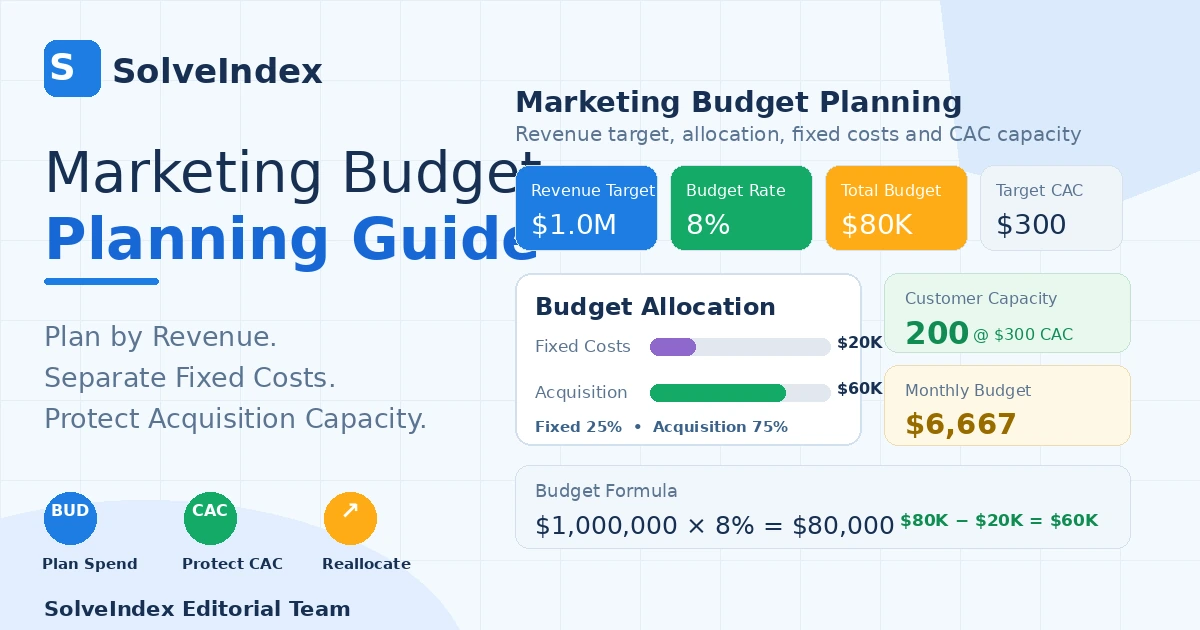
Suppose the planning-period revenue target is $1,000,000 and the business chooses an 8% marketing allocation. Total marketing budget is $80,000. If $20,000 is committed to fixed marketing costs, $60,000 remains in the acquisition-budget scenario.
At a $300 Target CAC, $60,000 supports 200 new customers mathematically. Over 12 months, the average total marketing budget is $6,666.67 per month and the average acquisition budget is $5,000 per month. Fixed costs represent 25% of the total marketing budget.
Example calculation
$1,000,000 × 8% = $80,000 Total Marketing Budget$80,000 − $20,000 = $60,000 Acquisition Budget$60,000 / $300 = 200 Customers Supported$80,000 / 12 = $6,666.67 Average Monthly BudgetMonthly vs Annual Marketing Budget
An annual marketing budget sets the full-year constraint, while a monthly budget helps with pacing and cash management. Dividing the annual figure by 12 is useful as a baseline but rarely represents the ideal operating schedule. Launches, renewals, events and seasonal demand can justify uneven monthly spending.
If your planning period is shorter than a year, keep the revenue target and fixed costs on the same horizon. Do not combine annual revenue with quarterly fixed costs and then interpret the result as a quarterly budget.
Seasonality and Budget Pacing
Budget pacing should follow opportunity, not the calendar alone. Ecommerce businesses may weight spend toward high-demand periods, while B2B teams may reduce spend when target accounts are inactive or sales capacity is constrained. Keep enough flexibility to move money when evidence changes.
Use monthly actuals against the annual plan, but judge pacing with pipeline and customer outcomes as well as spend. Underspending can be a problem if it means missed profitable demand; overspending can be acceptable only when economics remain within guardrails.
Marketing Budget Allocation
Marketing budget allocation is the process of dividing the total plan among activities, channels, resources and strategic priorities. Strong allocation starts with roles: some spending creates near-term demand, some builds brand or future pipeline, some supports retention, and some funds the people and systems required to execute.
Avoid allocating every dollar by last-click return. That can starve upper-funnel, creative, research and measurement activities whose value appears indirectly or with a longer lag. Instead, define a portfolio of objectives and give each category an appropriate measurement horizon.
How to Allocate Marketing Budget Across Channels
Start with proven baseline channels, strategic experiments and required non-channel investments. Give established channels enough budget to reach the point where marginal returns begin to weaken, then compare the next dollar across channels rather than comparing historical averages.
A simple allocation framework is to classify spending as protect, grow or test. Protect funding maintains essential brand and demand infrastructure. Grow funding scales channels with validated economics. Test funding is deliberately limited and evaluated with pre-defined success criteria.
Digital vs Offline Budget
Digital channels can be easier to measure and reallocate, but offline activities such as events, sponsorships, direct mail or field marketing may be important for some markets. Do not force every business into a digital-only allocation because a benchmark says digital is dominant overall.
Compare channels using the outcome they are designed to influence. A trade show that creates qualified enterprise pipeline should not be judged by the same short-window conversion metric as a branded paid-search campaign.
Paid Media, Labor, Technology and Agencies
A marketing budget is broader than media. Gartner's 2026 analysis reports paid media at 31.4% of surveyed marketing budgets, with the remainder spread across other resources and programs. The exact mix is organization-specific, but the statistic illustrates why “marketing budget” and “advertising budget” should not be treated as synonyms.
Classify labor, technology and agency costs according to the decision you are making. A finance budget may include them all, while a campaign-level media plan may not. The SolveIndex calculator exposes fixed costs separately so users can make that policy explicit.
Small Business Marketing Budget
Small businesses often have less room for measurement noise and fixed-cost mistakes. Rather than copying an enterprise percentage, start with cash available, gross margin, capacity to serve new customers and a realistic acquisition target. Protect essential website, CRM and creative infrastructure before assuming the remainder can go to ads.
If the business has little historical data, build a conservative base plan and a clearly capped test budget. Update the plan after enough leads or customers have accumulated to estimate CPL and CAC with useful confidence.
Startup Marketing Budget
Startups may intentionally spend ahead of current revenue, which makes percentage-of-revenue budgeting less useful. In that case, runway, funding milestones, product-market fit and customer payback can be more appropriate constraints. A revenue percentage can still be displayed for context, but it should not become an artificial ceiling.
Separate learning spend from scale spend. Early experiments should answer whether a channel and message can acquire the right customer; only after those economics become repeatable should the budget assume scale.
B2B and SaaS Marketing Budgets
B2B and SaaS teams often have longer sales cycles, significant content and sales-support costs, and a larger gap between lead generation and recognized revenue. Budget planning should therefore connect marketing spend with pipeline stages, lead-to-customer conversion, CAC, payback and retention rather than using only immediate closed revenue.
Search data shows interest in SaaS and B2B SaaS marketing budgets, but those terms describe business-model context rather than a different formula. Use model-specific benchmarks only after confirming that company size, growth stage and sales motion are comparable.
Marketing Budget by Industry
Industry benchmarks can reveal whether a plan is unusual, but they are not targets. Industry averages combine companies with different margins, maturity, distribution models and strategic priorities. Even within one sector, a challenger brand may rationally spend much more than an established incumbent.
When comparing marketing budgets by industry, match the denominator first. Some studies report marketing as a percentage of revenue, others as a percentage of total company budget, and others report channel shares of the marketing budget. Those percentages answer different questions and should not be mixed.
How to Create a Marketing Budget
- Define the planning period and business objective.
- Choose the economic constraint: revenue, gross profit, cash or a fixed approved amount.
- List committed marketing costs using one consistent policy.
- Estimate the flexible budget available for acquisition and growth programs.
- Set Target CAC, CPL or another outcome guardrail where appropriate.
- Allocate spend across protect, grow and test priorities.
- Map monthly pacing to seasonality, launches and sales capacity.
- Define measurement rules before spend begins.
- Build base, upside and downside scenarios.
- Reforecast when actual performance materially differs from the assumptions.
This process answers the search intent behind “how to create a marketing budget” more reliably than starting with a template percentage. The spreadsheet or calculator should reflect a decision process, not replace it.
Best, Base and Downside Scenarios
A single budget hides uncertainty. Build a base case from realistic current economics, an upside case with improved CAC or stronger revenue, and a downside case with weaker conversion, slower sales or higher acquisition cost. Keep fixed costs visible in every scenario.
For example, the $60,000 acquisition budget supports 200 customers at $300 CAC, 171.43 customers at $350 CAC, or 240 customers at $250 CAC. This sensitivity is often more useful than arguing about whether 8% is the correct top-line percentage.
How to Optimize a Marketing Budget
Budget optimization means reallocating toward the highest-value marginal use of the next dollar while protecting required capabilities. It is not simply cutting the lowest-ROI line item. Some activities enable other channels, and cutting measurement or creative can make apparently efficient channels deteriorate later.
Review performance by objective, channel and customer quality. Move flexible dollars when a channel saturates, a new test reaches evidence thresholds, or sales capacity changes. Preserve a documented reason for each reallocation so future analysis can distinguish strategy changes from performance changes.
Marketing Budget vs Google Ads Budget
The general Marketing Budget Calculator starts with revenue, a marketing allocation, fixed costs and Target CAC. The Google Ads Budget Calculator starts with target conversions, expected CPC and conversion rate to estimate paid-search spend. They solve different planning problems.
Use the general budget first when deciding the overall envelope and customer capacity. Use channel-specific tools after deciding how much of that envelope belongs to Google Ads or another paid channel.
Connect Budget With CPL, CAC and Funnel Rates
Budget becomes more actionable when it is reconciled with the funnel. If acquisition budget is $60,000 and Target CPL is $50, the plan implies 1,200 leads. If 20% of those leads become customers, that implies 240 customers and a media-only cost of $250 per customer before broader acquisition costs.
Compare that path with the Target CAC used in the budget calculator. Large disagreements can reveal inconsistent cost definitions, unrealistic conversion assumptions or missing sales and acquisition costs.
Connect Budget With Marketing ROI
A budget answers how much you plan to invest; Marketing ROI asks whether the profit attributed to that investment justified the cost. Do not use a high ROI from a small channel as proof that the channel can absorb the entire budget at the same return.
Use ROI, ROAS, CAC and contribution margin after launch to update the next forecast. The planning model should become more empirical over time as actual customer economics replace assumptions.
Common Marketing Budget Mistakes
- Treating an industry average as a universal spending recommendation.
- Assuming the entire marketing budget is available for advertising.
- Mixing annual revenue with monthly or quarterly costs.
- Using Target CAC with a different cost scope from the acquisition budget.
- Assuming CAC remains constant as spend scales.
- Ignoring gross margin, cash flow or sales capacity.
- Allocating channels by historical average return without considering marginal return.
- Cutting brand, creative or measurement because they do not have immediate last-click revenue.
- Planning an even monthly budget despite meaningful seasonality.
- Failing to update the budget after actual CPL, CAC, conversion or ROI changes.
Marketing Budget Reporting and Reforecasting
Track planned budget, committed cost, flexible spend, actual spend and forecast-to-complete separately. Add the operating outcomes that explain performance: qualified leads, customers, CPL, CAC, pipeline, revenue and ROI where appropriate. This creates a bridge between finance control and marketing decision-making.
Reforecast on a regular cadence and after material changes in revenue outlook, acquisition cost, sales capacity or channel availability. A useful marketing budget is a living allocation system rather than a document that is approved once and ignored.
Frequently Asked Questions
Sources and Methodology
SolveIndex cross-checked current benchmark context against Gartner's 2026 CMO Spend Survey, Gartner's 2026 CMO spend analysis and the Gartner Marketing Budget & Efficiency Benchmark. Broader survey context was checked against The CMO Survey 2026 Topline Report.
Reviewed September 12, 2026. External percentages are benchmark context only. The calculator does not recommend a budget percentage, access financial systems or forecast actual customer acquisition. All scenario results come from user-entered revenue, allocation, fixed-cost, Target CAC and planning-period assumptions.
Use the Marketing Budget Calculator
Apply your own revenue target, marketing percentage, fixed costs and Target CAC to compare total budget, acquisition capacity and average monthly spend.
Open the Marketing Budget Calculator