SaaS break-even analysis turns a cost structure into a revenue threshold. This guide explains the operating model, how gross margin and MRR interact, where cash flow can differ, and how to avoid double counting costs.
What SaaS Break-Even Means
SaaS break-even is the recurring-revenue level at which the gross profit generated by the modeled MRR is just enough to cover the fixed monthly operating costs included in the analysis. At that point, this operating model shows neither an operating surplus nor a shortfall for the selected cost scope. It is a planning threshold rather than a complete accounting statement, valuation method or cash forecast.
For a subscription business, the threshold is useful because it translates a cost structure into a recurring-revenue target. The number becomes more actionable when the team can also express it as customers, compare it with current MRR and repeat the calculation under different margin, pricing and expense assumptions.
Operating Break-Even in This SolveIndex Model
This calculator uses a deliberately narrow operating model: gross margin represents the share of recurring revenue left after direct service-delivery costs, and fixed operating costs represent the monthly expenses that the remaining gross profit must cover. The result therefore answers, “How much normalized monthly recurring revenue would be required for modeled gross profit to cover this fixed operating-cost base?”
That question is narrower than “When is the whole company profitable?” A full income statement can include nonrecurring revenue, nonrecurring expenses, depreciation, amortization, interest, taxes and accounting policies that are outside this calculator. Keep that boundary explicit when using the result in planning or board reporting.
SaaS Break-Even Formula
The core revenue threshold divides monthly fixed operating costs by gross margin expressed as a decimal. The logic is that each dollar of MRR contributes only the gross-margin portion toward the fixed-cost base after direct service costs have been absorbed.
The calculator then divides break-even MRR by monthly ARPA to estimate an account threshold. It also applies the same gross-margin percentage to current MRR to show modeled current monthly gross profit and compares current MRR with the break-even threshold.
Core formulas
Break-Even MRR = Fixed Operating Costs / Gross MarginBreak-Even Customers = Break-Even MRR / Monthly ARPACurrent Gross Profit = Current MRR x Gross MarginMRR Coverage = Current MRR / Break-Even MRR x 100Why the Formula Works
Generic break-even analysis is built around contribution margin: the portion of each revenue dollar available to cover fixed costs after variable or direct costs. Xero describes revenue break-even as fixed costs divided by the contribution-margin ratio. In this SaaS model, gross margin is used as the available revenue share because it already subtracts the direct costs associated with delivering the subscription service.
That is why a lower gross margin raises the required break-even MRR. If only 60 cents of each recurring-revenue dollar remains after direct service costs, more revenue is required to fund a fixed operating-cost base than when 80 cents remains.
Why Gross Margin Matters
Gross margin determines how much of recurring revenue is available after cost of goods sold. Stripe describes SaaS gross margin as revenue retained after the direct costs associated with delivering and maintaining the service. Those direct costs can include hosting, infrastructure, support and other service-delivery costs depending on the company’s accounting policy.
For break-even planning, use the same gross-margin definition that finance uses in the recurring-revenue model. Switching between product gross margin, blended company margin and a non-GAAP adjusted margin can materially change the threshold even when fixed operating costs remain unchanged.
Gross Margin vs Contribution Margin
Gross margin and contribution margin are related concepts but are not always identical. Generic break-even analysis commonly uses a contribution-margin ratio that removes costs that vary with sales. A SaaS gross-margin percentage can be a practical proxy when COGS captures the direct service-delivery economics relevant to the revenue being modeled.
The approximation becomes weaker when important variable costs sit outside COGS or when COGS contains large fixed components that do not move with revenue. For a more detailed operating model, finance teams may separate truly variable costs, step costs and fixed expenses instead of relying on one blended gross-margin percentage.
What Counts as Fixed Operating Costs
Fixed operating costs are the monthly expenses that the model expects gross profit to cover. Depending on the company and planning scope, this can include general and administrative payroll, office and corporate software, recurring management overhead, research and development expense, and a planned level of sales and marketing spend.
The key is not the label “fixed” by itself but consistency. If a cost is already included in COGS and therefore embedded in gross margin, adding it again to fixed operating costs double counts it. If a cost is excluded from the threshold, document that exclusion so the result is not mistaken for a broader profitability target.
Avoid Double Counting COGS
Double counting is one of the easiest ways to overstate break-even MRR. Suppose hosting, support and other direct service costs are already reflected in the 80% gross-margin input. Adding those same costs again to the fixed-cost field would reduce the modeled contribution twice.
A practical control is to build the model from the income-statement structure: start with recurring revenue, identify the direct costs that determine gross profit, then identify the operating expenses below gross profit that the break-even threshold is intended to cover. Reconcile each category once before entering the inputs.
Use Normalized MRR, Not Total Monthly Revenue
MRR is a recurring-revenue metric, not a synonym for every dollar collected in a month. Stripe defines MRR as predictable recurring income on a monthly basis and distinguishes it from total revenue that can include one-time fees, hardware, setup charges and other nonrecurring sources.
For this calculator, current MRR and break-even MRR should use the same recurring-revenue definition. Mixing total recognized revenue or cash receipts into the current MRR field can make coverage look stronger than the recurring subscription base actually supports.
Normalize Annual and Multi-Month Contracts
Annual billing should normally be converted to a monthly-equivalent recurring amount before it is included in MRR. ChartMogul explains that a non-monthly contract should be normalized across its billing interval; for example, a $12,000 annual subscription contributes $1,000 of MRR rather than $12,000 in the month when cash is collected.
This distinction matters in break-even analysis because annual prepayments can create strong cash inflows without changing normalized MRR by the same amount. Use normalized recurring revenue for the operating threshold and a separate cash model for liquidity planning.
Use ARPA Consistently
Monthly ARPA represents average recurring revenue per paying account in the calculator. It converts the revenue threshold into an approximate number of customer accounts. If break-even MRR is $75,000 and representative monthly ARPA is $300, the modeled threshold is 250 accounts.
ARPA can hide major segment differences. An enterprise plan and a small-business plan may have very different revenue and service-cost profiles. If those segments have different pricing or margins, calculate separate scenarios rather than treating one blended ARPA as a precise customer-count requirement.
Break-Even MRR
Break-even MRR is the headline output: the normalized monthly recurring revenue required for gross profit to equal the fixed operating-cost amount entered. It is a target under the current assumptions, not a forecast that the business will reach that level on a particular date.
The threshold changes immediately when fixed costs or gross margin change. Because of that sensitivity, teams should attach the underlying assumptions to the number whenever it is shared. A statement such as “$75,000 break-even MRR at 80% gross margin and $60,000 monthly fixed operating costs” is much more informative than the revenue figure alone.
Break-Even Customer Count
The customer threshold divides break-even MRR by monthly ARPA. It answers a different planning question: approximately how many paying accounts would be required if average recurring revenue per account remained at the assumed level.
Treat this output as an approximation because customer mix rarely remains perfectly stable. New discounts, enterprise expansion, seat growth, usage pricing and churn can all change ARPA. For segmented planning, use the ARPA that corresponds to the customer cohort whose count you are trying to estimate.
Current Monthly Gross Profit
Current monthly gross profit is calculated as current MRR multiplied by gross margin. In the default scenario, $65,000 of MRR at an 80% gross margin produces $52,000 of modeled gross profit. Compared with $60,000 of fixed operating costs, the business remains below the threshold in this simplified model.
This figure is intentionally based on MRR rather than total revenue. If the company earns material services or one-time revenue, those amounts need a separate treatment rather than being silently folded into the recurring-revenue result.
MRR Gap to Break-Even
The MRR gap equals break-even MRR minus current MRR. A positive value indicates additional normalized recurring revenue is required under the current assumptions. A zero or negative value means current MRR is at or above the modeled threshold.
Do not treat a negative gap as proof that the company is cash-flow positive or GAAP profitable. It only means the selected recurring revenue, margin and fixed-cost inputs cross this specific operating threshold.
Break-Even MRR Coverage
Coverage expresses current MRR as a percentage of break-even MRR. A result below 100% means the current recurring-revenue base is below the modeled threshold; 100% means it matches the threshold; above 100% means it exceeds it.
Coverage can make scenario comparisons easier because it converts dollar distance into a relative measure. However, it inherits every assumption in the underlying break-even calculation, so a change in margin definition or cost scope can move coverage even if current MRR is unchanged.
Worked SaaS Break-Even Example
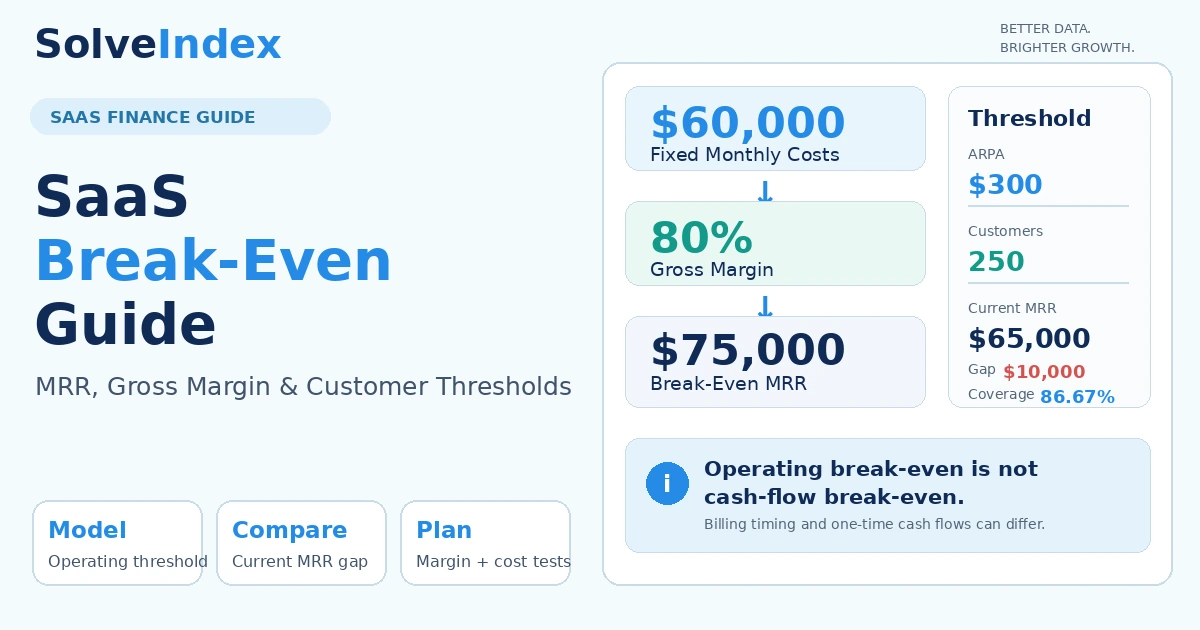
Using the default inputs, monthly fixed operating costs are $60,000 and gross margin is 80%. Dividing $60,000 by 0.80 gives $75,000 of break-even MRR. Dividing $75,000 by $300 monthly ARPA gives approximately 250 accounts.
Current MRR is $65,000, so modeled current monthly gross profit is $52,000. The MRR gap to the threshold is $10,000 and current MRR covers about 86.67% of break-even MRR. The example is deliberately reproducible so each input can be changed independently for scenario testing.
| Input or output | Example value | How it is used |
|---|---|---|
| Fixed monthly operating costs | $60,000 | Cost base to cover |
| Gross margin | 80% | Revenue share available after direct service costs |
| Monthly ARPA | $300 | Converts revenue threshold to accounts |
| Break-even MRR | $75,000 | $60,000 / 0.80 |
| Approx. break-even customers | 250 | $75,000 / $300 |
| Current MRR | $65,000 | Compared with threshold |
| Current gross profit | $52,000 | $65,000 x 80% |
| MRR gap | $10,000 | $75,000 - $65,000 |
| MRR coverage | 86.67% | $65,000 / $75,000 |
Scenario: Change Gross Margin
Gross margin has a nonlinear effect on the threshold because it sits in the denominator. With $60,000 of fixed operating costs, an 80% margin implies $75,000 of break-even MRR. At 70%, the threshold rises to about $85,714. At 60%, it rises to $100,000.
This sensitivity is useful when infrastructure costs, support intensity or service mix changes. It also shows why a growing SaaS company can increase revenue and still struggle to improve operating economics if gross margin deteriorates at the same time.
Scenario: Change Fixed Operating Costs
Holding gross margin constant, break-even MRR moves proportionally with fixed operating costs. At an 80% gross margin, every additional $8,000 of monthly fixed cost requires $10,000 of additional break-even MRR in this model.
This makes the calculator useful for hiring plans and budget changes. Add the recurring monthly cost of a proposed team or tool to the fixed-cost assumption, then compare the new threshold with the expected recurring-revenue base. Keep one baseline scenario unchanged so the incremental impact remains visible.
Scenario: Change ARPA
ARPA does not change break-even MRR because revenue break-even is determined by fixed costs and gross margin. It changes only the approximate customer count required to produce that revenue level. A higher ARPA means fewer accounts are needed; a lower ARPA means more accounts are needed.
That distinction is important when evaluating pricing. Raising ARPA can reduce the modeled account threshold, but the pricing change may also affect retention, acquisition, support costs or gross margin. Test those effects separately instead of assuming ARPA can move without consequences elsewhere.
How Retention and Churn Affect Break-Even
Churn does not appear directly in the formula, but it affects how quickly and how reliably the company can reach or stay above the threshold. Lost recurring revenue increases the amount of new and expansion MRR needed to close the gap, while stronger retention protects the existing base.
Use break-even together with MRR movement, gross revenue retention and net revenue retention. The break-even number gives the threshold; retention metrics describe how stable the recurring-revenue base is while the company tries to reach or maintain it.
How to Treat Sales and Marketing Costs
Do not enter CAC itself into the fixed-cost field. CAC is a unit-economics ratio, while this calculator expects monthly operating expenses. If the break-even scope is intended to cover sales and marketing, include the relevant monthly payroll, advertising, software and other operating expenses according to the company’s finance policy.
Early-stage teams may also run two scenarios: one with a current growth-investment budget and another with a normalized or steady-state sales and marketing level. That can separate “break-even at today’s growth spend” from a lower-cost operating threshold.
One-Time Fees and Professional Services
Setup fees, implementation revenue, consulting and other nonrecurring amounts can improve reported revenue or cash flow without increasing MRR. If the purpose of the calculation is recurring SaaS break-even, keep those amounts outside current MRR and model them separately.
If professional services are a persistent part of the business model, consider a separate services contribution model or a blended company break-even analysis. The SaaS MRR threshold should not silently assume that nonrecurring revenue will repeat every month.
Annual Prepayments and Cash Collections
Annual prepayments can create a large cash receipt at the start of a contract even though normalized MRR spreads the contract value over the service period. That is why an MRR-based operating threshold and a cash runway model can tell different stories at the same time.
For treasury and runway decisions, use actual collection schedules, payroll dates, vendor payments, taxes and financing flows. For recurring-revenue operating analysis, normalize contracts to the monthly revenue base and keep the cash timing separate.
Cash Break-Even vs Operating Break-Even
Cash break-even asks whether cash inflows are sufficient to cover cash outflows over a period. This calculator asks whether modeled gross profit from normalized MRR covers the selected fixed operating-cost base. Those are related but not equivalent questions.
Annual billing, payment timing, working capital, capital expenditures, financing, taxes and deferred collections can all produce a cash result that differs from the MRR-based operating threshold. A company can cross one threshold before the other, so label the metric clearly when communicating it.
Operating Threshold vs Accounting Profitability
The calculator is not a substitute for an income statement. Accounting profitability can include nonrecurring revenue, depreciation, amortization, stock-based compensation, interest, taxes and other items that are outside the simplified recurring-revenue model.
Use the break-even threshold as an operating planning tool. For statutory reporting, audited statements, tax decisions or investor disclosures, reconcile the assumptions to the company’s accounting records and apply the relevant accounting framework.
There Is No Universal SaaS Break-Even Benchmark
Unlike a rate such as gross margin, SaaS break-even MRR is not meaningfully comparable as one universal number across companies. The threshold depends on each company’s cost base, gross margin, pricing, customer mix and accounting definitions. A $100,000 break-even MRR can be conservative for one business and unrealistic for another.
The most useful comparison is usually the company’s own current and prior scenarios: how the threshold changes as margin, fixed costs and ARPA change, and whether actual recurring revenue is closing the gap.
When the Break-Even Number Can Mislead
The model can mislead when inputs use different periods, when annual contract values are treated as one month of MRR, when COGS is counted twice, or when a blended gross margin hides a loss-making segment. It can also mislead when teams treat a single scenario as a forecast rather than a sensitivity model.
Another limitation is step costs. Hiring a new support team, opening a region or adding infrastructure capacity can raise expenses in jumps rather than smooth increments. Recalculate the threshold after material changes instead of assuming the old relationship remains valid indefinitely.
Build a Break-Even Scenario Table
Create a baseline using reconciled current inputs, then change one assumption at a time. A margin scenario shows service-delivery sensitivity; a fixed-cost scenario shows operating leverage; an ARPA scenario changes the approximate customer threshold; and a current-MRR scenario shows progress toward the modeled target.
For a more advanced model, combine multiple changes only after the single-variable scenarios are understood. This keeps cause and effect visible and reduces the risk of attributing a better result to the wrong assumption.
Common SaaS Break-Even Mistakes
Common errors include using total revenue instead of normalized MRR, entering an annual contract value into one month, mixing monthly costs with annual revenue, using a gross-margin percentage from a different product or period, double counting COGS, and treating blended ARPA as a precise customer requirement.
Teams also create confusion by calling the result cash-flow break-even or accounting break-even without qualification. The simplest prevention is to document the period, revenue definition, margin policy and operating-cost scope beside every saved scenario.
Practical SaaS Break-Even Workflow
First, choose a monthly reporting period and reconcile normalized MRR from the billing or subscription system. Second, use the finance-approved gross-margin definition for the same scope. Third, assemble the monthly operating expenses that the modeled gross profit is intended to cover, making sure direct service costs are not counted twice.
Next, calculate break-even MRR, convert it to accounts with a representative ARPA, and compare it with current MRR. Save the baseline. Then test margin, fixed-cost and ARPA scenarios independently, and reconcile material changes back to the source systems before using the result in planning.
Frequently Asked Questions
Sources and Methodology
SolveIndex uses a transparent operating model rather than presenting SaaS break-even as a universal accounting standard. The formula was cross-checked against current break-even, SaaS gross-margin and recurring-revenue definitions from the sources below. Company accounting policies can classify costs differently, so reconcile material planning decisions to finance source systems.
- Xero - Break-even point formula
- Stripe - SaaS gross margin explained
- Stripe - Monthly recurring revenue explained
- ChartMogul - Monthly Recurring Revenue
Reviewed September 25, 2026. The calculator does not connect to billing, accounting or bank systems; it calculates from the values entered by the user.
Use the SaaS Break-Even Calculator
Enter fixed monthly operating costs, gross margin, monthly ARPA and current MRR to reproduce the worked example or test your own scenario.
Open the SaaS Break-Even Calculator