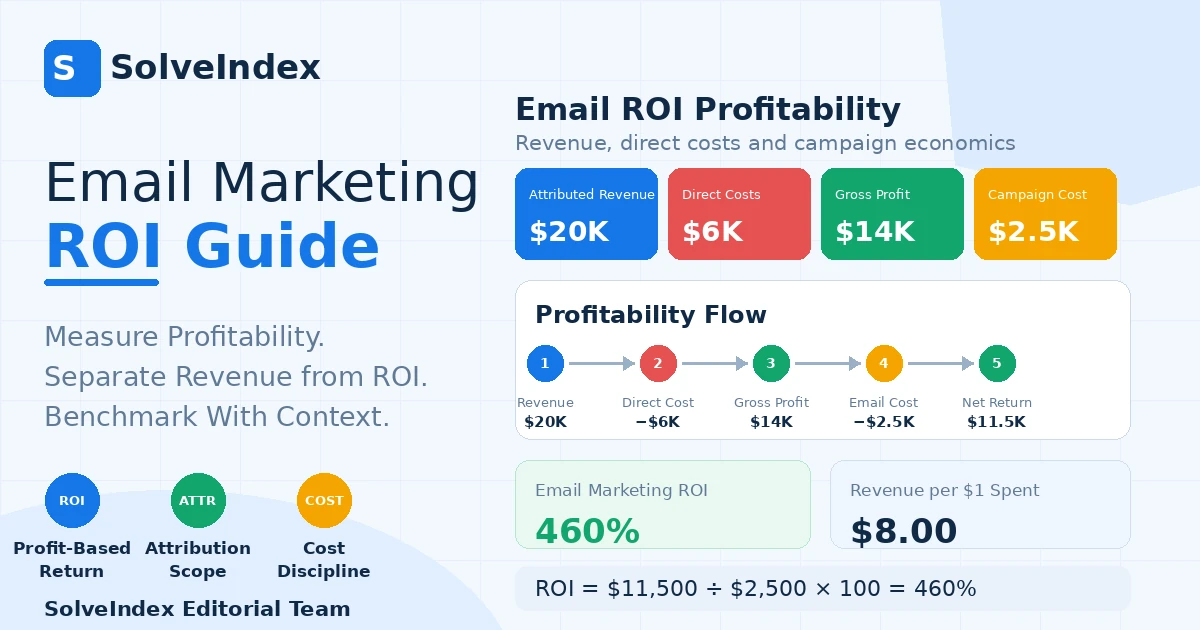
Email marketing ROI connects attributed revenue with margin and campaign cost. Use the formula with one consistent cost and attribution scope, then read the result beside engagement and conversion metrics instead of treating one benchmark as a universal target.
What Email Marketing ROI Measures
Email marketing ROI measures the financial return generated by email relative to the email marketing cost included in the analysis. The metric is most useful when revenue attribution, direct product or service costs and campaign costs all describe the same campaign, automation program or reporting period.
ROI is a profitability metric, not just an engagement metric. Opens, clicks and conversions help explain why performance changed, but ROI asks a different question: after the economic costs included in the model, how much return remained for every dollar invested in email?
Email Marketing ROI Formula
A transparent profit-based model starts with attributed email revenue, subtracts direct costs to get gross profit, then subtracts the email campaign cost to get net return. Divide that net return by email campaign cost and multiply by 100 to express ROI as a percentage.
Email ROI formulas
Gross Profit = Attributed Email Revenue - Direct CostsNet Return = Gross Profit - Email Campaign CostEmail Marketing ROI = Net Return / Email Campaign Cost x 100Revenue per $1 Spent = Attributed Revenue / Email Campaign CostMailchimp describes the same general structure: gross profit is revenue after direct product costs, and email ROI compares the remaining campaign profit with the cost of running email. The exact accounting scope still needs to be documented by the business.
Revenue, Gross Profit and Net Return Are Different
Attributed revenue is the top-line amount assigned to email. Gross profit removes direct product or service costs from that revenue. Net return goes one step further by subtracting the email campaign cost included in the analysis. These three numbers can tell very different stories.
For example, a campaign can generate high revenue but weak profit when fulfillment, cost of goods sold or service delivery is expensive. Reporting the intermediate values beside ROI prevents a strong top-line number from hiding poor economics.
Email ROI vs Revenue per $1 Spent
Revenue per dollar spent is calculated as attributed revenue divided by email campaign cost. It is useful as a simple efficiency multiple, but it ignores direct costs. The SolveIndex calculator reports it separately so users can compare top-line efficiency with profit-based ROI.
An $8 revenue-per-$1 multiple does not mean 800% ROI under the profit-based formula. If the campaign has material direct costs, net return is lower than revenue, so the ROI percentage will also be lower. Always label which metric a benchmark or case study is using.
Which Costs Should Be Included in Email Marketing ROI?
The correct cost scope depends on the decision. A campaign-level analysis may include platform allocation, copywriting, design, development, testing and external support tied directly to the send. A broader email-program analysis may also include staff time, automation software, data tools and agency retainers.
The important rule is consistency. If one campaign includes only platform fees and another includes labor, creative and software, the two ROI figures are not directly comparable unless the difference is clearly labeled.
Direct Product and Service Costs
Direct costs belong to the revenue side of the economic model. For ecommerce this can include cost of goods sold, payment-related delivery costs or fulfillment items included in your gross-profit policy. For services, it can include direct delivery labor or other incremental fulfillment cost.
These costs are separate from the cost of producing and sending email. Keeping them separate makes it possible to report gross margin, campaign cost and ROI without mixing product economics with marketing operations.
Email Campaign Costs and Hidden Expenses
Email campaign cost can extend beyond the ESP subscription. Depending on scope, it may include design, copywriting, coding, QA, list-management work, integrations, agency support and paid tools used specifically for the campaign. Under-counting these costs inflates ROI.
For recurring programs, document how shared platform or labor expenses are allocated. A reasonable allocation applied consistently is usually more useful than pretending shared resources have zero cost.
Campaign ROI vs Email Program ROI
A single-send ROI is useful for comparing campaigns, while program ROI can combine newsletters, promotional sends and automated flows over a longer period. Program-level analysis is often better for budgeting because it captures recurring platform and operating costs.
Do not compare a narrow campaign ROI with a fully loaded program ROI without labeling the difference. Use the same unit of analysis when tracking trends or deciding whether email investment should expand.
Email Revenue Attribution
Revenue attribution determines how much revenue is assigned to email. Platforms may use click-based windows, open-assisted rules, identity matching or cross-channel models. The same order can therefore be credited differently across systems.
Choose an attribution rule that fits the reporting question and keep it stable across comparisons. ROI can change materially even when actual customer behavior is unchanged if the attribution model or window changes.
Attribution Windows and Reporting Scope
A one-day click window and a seven-day click window will not normally produce the same attributed revenue. Longer windows can capture delayed purchases but can also increase overlap with other channels. The right window depends on the sales cycle and measurement policy.
When reporting ROI, record the attribution window beside the result. This turns the metric from an isolated number into a reproducible measurement that another analyst can audit later.
Attribution Is Not the Same as Incrementality
Attributed revenue is a reporting assignment, not automatic proof that email caused every credited purchase. Customers can receive an email and purchase for reasons that would have occurred without the send. Incrementality asks how much additional outcome email actually created.
When the decision is high stakes, use holdout groups, randomized tests or other causal methods where practical. Attribution remains useful for operational reporting, but it should not be described as a perfect causal estimate.
Worked Email Marketing ROI Example
Assume an email campaign receives $20,000 of attributed revenue and the direct product or service costs tied to that revenue are $6,000. Gross profit before email cost is therefore $14,000. If producing and sending the campaign costs $2,500, net return is $11,500.
Dividing $11,500 by $2,500 produces a 460% email marketing ROI. The same campaign also produces $8 of attributed revenue for every $1 of email campaign cost and $5.60 of gross profit per $1 of email cost. Those supporting figures explain the economics behind the percentage.
Break-Even Email ROI
Break-even occurs when net return is zero. In this model, gross profit equals email campaign cost. ROI is therefore 0%, meaning the campaign recovered the included marketing cost after direct costs but did not create additional net return within the chosen scope.
Break-even is not the same as a good target. A business may require a positive return to compensate for overhead, working-capital risk, customer-support cost or alternative uses of budget.
What Negative Email ROI Means
Negative ROI means the attributed gross profit did not cover the email campaign cost included in the model. The reason may be low conversion volume, low order value, weak margin, excessive campaign cost or an attribution rule that credits little revenue to email.
Do not react to one negative campaign without context. Lifecycle campaigns can have retention or learning value that is not fully captured in immediate revenue, while repeated negative results with consistent measurement deserve investigation.
Is Email Marketing Profitable or Worth It?
Searchers often ask whether email marketing is profitable or still worth the investment. The useful answer depends on the economics of the individual program. Email can be highly efficient because the marginal cost of sending is often low, but software, labor, creative and list quality still affect total return.
Use actual attributed revenue, direct costs and campaign costs from your own program before relying on an industry claim. Profitability should be evaluated with both ROI percentage and absolute net return, because a very high percentage on a tiny campaign may contribute less profit than a lower percentage at meaningful scale.
How to Measure Email Marketing Success
ROI is the financial endpoint, but it should be diagnosed with the metrics that feed it. Track deliverability, unique clicks, conversion rate, average conversion value, unsubscribe behavior, direct margin and campaign cost so you can explain why return changed.
A practical dashboard separates leading indicators from economic outcomes. Engagement metrics can identify friction early; ROI, net return and revenue provide the financial evidence needed for budget decisions.
What Is a Good Email Marketing ROI?
There is no universal ROI threshold that is automatically good for every business. A healthy target depends on gross margin, customer lifetime value, campaign purpose, list quality, program maturity and how fully costs are included.
Benchmark data is useful for context, not as a substitute for internal economics. Compare your current result with prior campaigns measured under the same attribution and cost policy, then use outside studies only to understand the wider range of reported outcomes.
The $36 per $1 Email ROI Benchmark
Litmus reports an average return of $36 for every $1 spent on email marketing and provides breakdowns by company and program characteristics. This statistic is widely cited, but it is a return-per-dollar benchmark rather than a universal profit guarantee.
Do not convert the $36 figure mechanically into the SolveIndex ROI percentage. Benchmark studies can use different definitions, populations and cost scopes. The safer use is directional: email can generate strong returns when list quality, measurement and execution are effective.
Mailchimp ROI Benchmarks Use a Different Methodology
Mailchimp currently reports platform-specific ROI benchmarks, including up to 30x annual ROI for certain ecommerce users in its ROI calculator. Mailchimp explains that its estimator also uses customer-survey and platform data, so the result is not directly equivalent to the SolveIndex profit-based campaign formula.
Vendor studies are useful evidence about possible outcomes, but each methodology should be labeled. Never mix a platform-specific revenue multiple, a survey-based estimate and a profit-based ROI percentage as if they were the same metric.
Email Marketing ROI by Industry
Industry affects ROI through purchase frequency, gross margin, sales cycle, average order value, repeat behavior and list composition. Ecommerce, nonprofit, B2B and service businesses can therefore produce very different return profiles even when engagement rates look similar.
When an industry benchmark is available, check whether the study matches your business model and cost policy. Internal cohort and campaign history usually provides a stronger operational baseline than a broad cross-industry average.
Email ROI vs Marketing ROI
Email marketing ROI isolates the email channel or program. Marketing ROI can combine paid search, social, SEO, content, events, email and other activities. The formulas may look similar, but the scope of investment and attributed return is different.
Use the dedicated Marketing ROI Calculator when the decision concerns the total marketing portfolio. Use Email Marketing ROI when revenue and costs can be isolated to email with enough consistency to support a channel-level conclusion.
Email ROI vs ROAS
ROAS usually compares attributed advertising revenue with ad spend. It is a revenue-efficiency metric. ROI is broader because it can account for direct product costs and the full email campaign cost, including software, labor or creative depending on scope.
An email program can have a strong revenue multiple but a weaker ROI after margin and operating cost are considered. Keep the two metrics separate in reports to avoid overstating profitability.
Email ROI vs CTR, CTOR and Conversion Rate
CTR measures unique clicks relative to delivered emails, CTOR compares clicks with opens, and email conversion rate measures the selected conversion outcome relative to its denominator. These are diagnostic funnel metrics rather than financial-return metrics.
Use them to explain ROI. If ROI falls, lower deliverability, lower CTR, weaker conversion rate, lower conversion value or higher costs may be responsible. Optimizing one engagement rate without checking downstream economics can improve the wrong part of the funnel.
How Deliverability Affects Email ROI
Email that does not reach the inbox cannot create the same commercial opportunity as delivered email. High bounce rates, poor sender reputation or spam placement can reduce the audience available to click and convert, which can depress attributed revenue while campaign cost remains similar.
Monitor deliverability alongside ROI and fix structural list-health issues before interpreting creative changes. The Email Bounce Rate and unsubscribe guides provide the dedicated definitions for those metrics.
How Segmentation Can Improve Email ROI
Segmentation can improve return by matching offers, timing and content to more relevant audience groups. Better relevance can raise conversion probability and reduce wasted sends, but the benefit should still be verified with measured revenue and costs.
A segment with high ROI but very low volume may not materially change total profit. Compare both percentage return and absolute net return before deciding where to scale.
How Automation Can Affect Email ROI
Automated welcome, cart-recovery, post-purchase and lifecycle flows can generate revenue repeatedly once configured, which may improve long-run economics. However, setup, platform and maintenance costs still belong in the program-level analysis when they are material.
Separate one-time implementation cost from recurring operating cost when useful. This helps teams distinguish a temporarily low launch-period ROI from the steady-state economics of an established automation.
A/B Testing, Personalization and ROI
A/B testing can improve subject lines, content, offers and calls to action, while personalization can increase relevance. These tactics are useful only when the winning change improves the business outcome that matters rather than a proxy metric in isolation.
For example, a subject line may raise opens without increasing purchases. Track the full path from engagement to conversion value and ROI before declaring an experiment economically successful.
How to Improve Email Marketing ROI Without Increasing Spend
Start with measurement quality, list hygiene and deliverability so the current budget has a fair chance to perform. Then improve segmentation, offer relevance, conversion paths, automation coverage and campaign production efficiency. Reducing avoidable labor or tool cost can improve ROI even when revenue is unchanged.
Prioritize changes with a clear economic hypothesis. A useful test states which input should move-conversion rate, order value, margin, attributed revenue or campaign cost-and how that movement should improve net return.
Common Email ROI Reporting Mistakes
- Using total company revenue instead of revenue attributed to the selected email scope.
- Ignoring direct product or service delivery costs when reporting profit-based ROI.
- Counting only ESP fees while excluding material labor, creative or agency costs.
- Changing attribution windows between campaigns without relabeling the result.
- Comparing campaign ROI with fully loaded program ROI.
- Treating revenue per $1 spent as if it were the same as ROI percentage.
- Using a benchmark from another methodology as a universal target.
- Optimizing open or click rate without checking conversion value and profit.
- Treating attributed revenue as guaranteed incremental revenue.
- Ignoring absolute net return and scale when comparing percentage ROI.
Practical Email ROI Measurement Workflow
- Define the campaign or email-program scope.
- Choose and document the attribution method and window.
- Collect attributed revenue for that scope.
- Subtract direct product or service costs to calculate gross profit.
- Total the email campaign costs included in the decision.
- Calculate net return, ROI and revenue per dollar spent.
- Review deliverability, CTR, conversion rate and average conversion value to diagnose the result.
- Compare with historical results measured under the same rules.
- Use external benchmarks only as labeled context.
- Recalculate after major tracking, cost or campaign-strategy changes.
Frequently Asked Questions
Sources and Methodology
SolveIndex cross-checked the core ROI formula and cost-scope guidance against Mailchimp's email marketing ROI guide and reviewed Mailchimp's current email ROI calculator methodology. Benchmark context was checked against Litmus email ROI research and the Litmus ROI calculator.
Reviewed September 13, 2026. External return multiples are benchmark context only and can use different definitions, populations and cost scopes. The SolveIndex calculator does not connect to an email platform or analytics account; every result comes from user-entered revenue and cost inputs.
Use the Email Marketing ROI Calculator
Enter attributed revenue, direct costs and email campaign cost to calculate gross profit, net return, ROI and revenue per dollar spent.
Open the Email Marketing ROI Calculator